

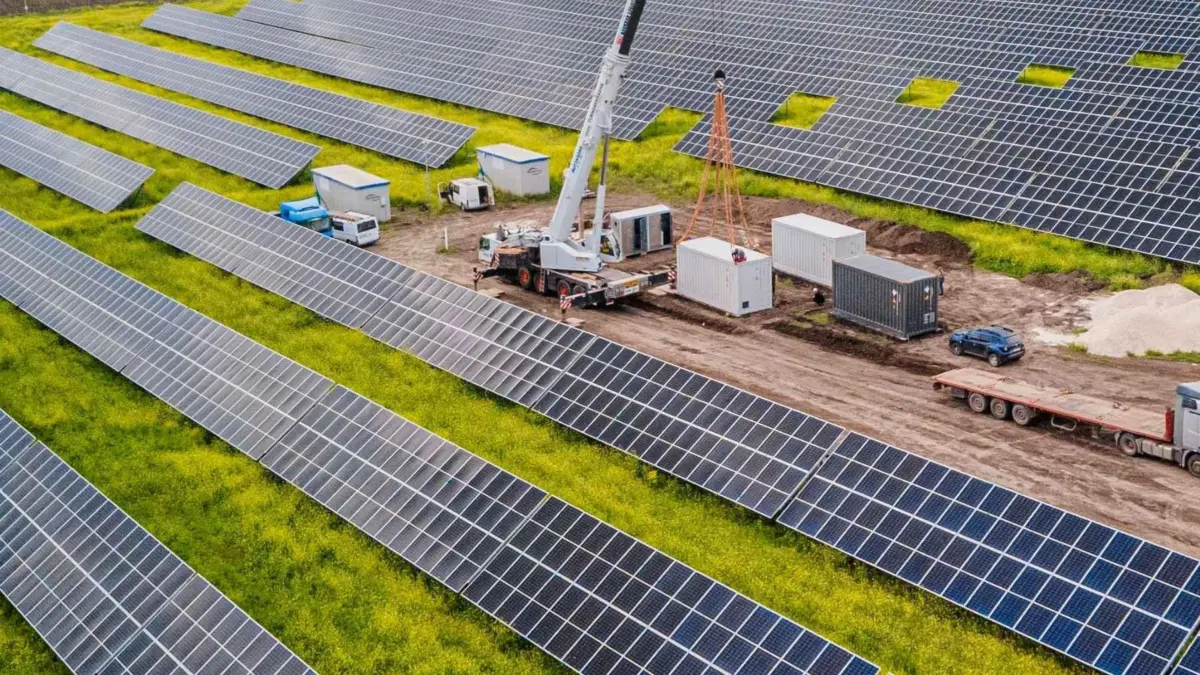
NEW DELHI, INDIA — Amid an escalating global climate crisis and an urgent imperative to restructure international power grids, the 2026 BRICS Summit in New Delhi served as a critical nexus for the future of clean energy. Held under the guiding theme "Building for Resilience, Innovation, Cooperation, and Sustainability," the 18th edition of the summit drew global leaders, financial architects, and environmental heads of state to the Bharat Mandapam convention center.
At the forefront of these discussions was Ashish Khanna, Director General of the International Solar Alliance (ISA), who took center stage alongside United Nations Secretary-General António Guterres. Together, they mapped out a transformative vision for a globally interconnected, secure, and resilient energy matrix. The core message of the summit was unmistakable: the convergence of photovoltaic solar technology, aggressive energy storage investments, and advanced artificial intelligence (AI) holds the key to liberating the Global South from energy poverty and steering humanity toward a sustainable, low-carbon future.
Main Facts
The 2026 BRICS Summit yielded several groundbreaking initiatives and high-level strategic alignments designed to accelerate the global energy transition:
- The Rise of AI in Energy Systems: ISA Director General Ashish Khanna emphasized that modern electrical grids have evolved from monitoring hundreds of physical assets to tracking millions. Artificial intelligence is no longer optional; it is a vital operational necessity for intelligent energy planning, load balancing, and resource allocation.
- Launch of the BRICS Digital Center of Excellence: A landmark initiative was introduced to leverage AI applications led by young, trained energy professionals from Latin America, Africa, and Asia over the next two years. This program aims to cultivate specialized human capital across the developing world.
- Financial Catalysis via the AIIB: Zou Jiayi, President of the Asian Infrastructure Investment Bank (AIIB), joined high-level talks with the ISA and the UN, committing to strengthened institutional ties, catalytic project financing, and accelerated solar deployment among member states.
- The "One Sun, One World, One Grid" Initiative: Echoing the sentiments of Indian Prime Minister Narendra Modi, the ISA reiterated that no single nation can achieve a secure and affordable energy future in isolation. The organization, which now unites 129 member countries, continues to champion a universal green energy ecosystem.
- The Affordability of Solar and Storage: Khanna underscored that solar energy paired with advanced battery storage is currently the most scalable, cost-effective energy solution available, positioning the BRICS bloc to define the next phase of the global transition.
Chronology of Events at the 2026 BRICS Summit
The energy dialogues in New Delhi unfolded through a carefully orchestrated series of high-level plenaries, bilateral meetings, and strategic unveilings:
Day 1: Opening Plenary and Strategic Frameworks
The summit commenced at the Bharat Mandapam with opening remarks addressing global resilience and multilateral cooperation. Prime Minister Narendra Modi set a collaborative tone, emphasizing that shared technological innovation and equitable resource distribution are prerequisites for modern security. Following the opening ceremonies, attention swiftly turned to climate finance and the realities of transitioning away from fossil fuels in developing economies.
Day 2: The ISA-UN Joint Briefing and AI Integration
Director General Ashish Khanna and UN Secretary-General António Guterres held a joint strategic briefing focusing on the geopolitical and technological hurdles of the energy transition. Khanna highlighted the unique vulnerabilities of Small Island Developing States (SIDS) and least developed countries (LDCs), arguing that capacity building and robust public policy frameworks must precede massive infrastructure deployments. During this session, the integration of artificial intelligence into grid management was formally introduced as a game-changer for cost reduction and operational efficiency.
Day 3: Financial Commitments and Institutional Partnerships
The final major energy panel featured a high-stakes dialogue between the ISA leadership, UN delegates, and AIIB President Zou Jiayi. Discussions centered on bridging the infrastructure financing gap. Jiayi outlined the AIIB’s strategy to provide catalytic capital to solar initiatives across the Global South. The summit concluded with the official presentation of the BRICS Digital Center of Excellence, cementing a cooperative roadmap for youth-led technological innovation in the energy sector.
Supporting Data and Technological Integration
The transition toward a renewables-dominated global economy faces severe logistical challenges, particularly regarding grid stability and intermittency. During the summit, the ISA presented data highlighting how artificial intelligence and advanced storage solutions are actively reshaping energy markets.
The Scale Challenge: From Hundreds to Millions of Assets
Historically, electrical grid operators managed a relatively small, centralized set of fossil-fuel and hydroelectric generation points. Today, decentralized renewable energy assets—ranging from utility-scale solar farms to millions of residential rooftop photovoltaic systems—feed power back into national grids.
According to Khanna, manual grid management is mathematically obsolete. AI algorithms can now predict weather patterns, forecast solar generation fluctuations in real-time, and automatically adjust localized power distribution within milliseconds. This digital transformation minimizes energy loss, optimizes storage discharge cycles, and prevents grid overloads.
Financial Mobilization and the AIIB Partnership
Entering its 11th year of existence, the International Solar Alliance is systematically shedding its image as a purely diplomatic forum and evolving into a hard-hitting operational and financial catalyst. The partnership with the AIIB, spearheaded by President Zou Jiayi, addresses the most persistent bottleneck in clean energy adoption: the high cost of upfront capital for developing nations.
By structuring catalytic finance mechanisms—such as blended finance, risk-guarantee funds, and low-interest development loans—the AIIB and ISA aim to lower the cost of capital in emerging markets. This is particularly vital for nations in Africa, Latin America, and parts of Asia, where high borrowing costs have historically stalled solar investments despite abundant natural sunlight.
Official Responses and Perspectives
The high-level discourse in New Delhi brought together diverse institutional voices, all converging on the necessity of multilateralism and technological adoption.
Ashish Khanna (Director General, International Solar Alliance)
Reflecting on the overarching mission of the ISA, Khanna stressed that solar energy combined with modern storage is no longer an idealistic aspiration—it is a present-day economic imperative.
"Solar energy, coupled with advanced storage, is today one of the most accessible and scalable solutions available," Khanna stated during his address. He further emphasized that the BRICS coalition holds a historic window of opportunity to dictate the pace and fairness of the global energy transition. Regarding human resource development, he added: "Our focus in developing nations and small island states must target capacity building, public policy implementation, energy storage investment, and human capital development to truly mobilize the Global South."
António Guterres (Secretary-General, United Nations)
The UN Secretary-General aligned closely with the ISA’s vision, underscoring that the climate crisis cannot be decoupled from economic equity. Guterres warned that without aggressive investments in renewable energy access for marginalized regions, global emission reduction targets will remain mathematically out of reach. He praised the collaborative frameworks being established within the BRICS framework, noting that multilateral cooperation is the only antidote to fragmented geopolitical green policies.
Narendra Modi (Prime Minister, India)
Prime Minister Modi’s philosophy of "One Sun, One World, One Grid" served as the philosophical bedrock for the summit’s energy declarations. Modi’s vision posits that as the sun sets in one part of the world, it rises in another, creating a continuous loop of clean energy generation that can be transmitted across borders through high-voltage direct current (HVDC) subsea and terrestrial cables. Khanna reiterated Modi’s warning that isolationist energy policies are bound to fail in an interconnected world.
Implications for the Global South and the Future of Energy
The outcomes of the 2026 BRICS Summit carry profound implications for geopolitics, economic development, and environmental sustainability.
Empowering the Global South Through Knowledge Transfer
For decades, developing nations have argued that global climate frameworks disproportionately burden economies that contributed the least to historical carbon emissions. The establishment of the BRICS Digital Center of Excellence directly counters this dynamic. By training young engineers, data scientists, and policy experts from Africa, Latin America, and Asia in AI-driven energy management, the initiative fosters long-term technological self-reliance. Instead of merely importing foreign green technologies, these nations will be equipped to design, program, and maintain their own localized smart grids.
Redefining Geopolitics Through Solar Abundance
Traditional geopolitical power has long been tied to the control of fossil fuel reserves—oil pipelines, coal mines, and natural gas fields. The transition to solar energy fundamentally democratizes power generation. Any nation blessed with high solar irradiance can, in theory, achieve energy independence. However, the manufacturing of photovoltaic panels, battery chemistries, and the software required to run AI grids have threatened to create new dependencies.
By pooling resources, technological know-how, and financial backing through organizations like the ISA, the AIIB, and the expanded BRICS bloc (which now represents a significant portion of the world’s population and GDP), developing nations are creating a counterweight to Western-centric energy monopolies. The ambition to incorporate more countries into the ISA’s 129-member strong coalition signals an expanding global consensus.
The Road Ahead: From Vision to Execution
As the 2026 BRICS Summit concludes, the challenge shifts from diplomatic declarations to practical implementation. The integration of artificial intelligence into millions of decentralized assets, the rollout of the Digital Center of Excellence over the next two years, and the deployment of AIIB’s catalytic funds will be closely watched by international climate analysts.
If successful, the frameworks established in New Delhi will not only accelerate the demise of fossil-fuel dependency but also prove that technological innovation and international solidarity can successfully converge to secure a livable planet for future generations.



Leave a Reply