

By Jhoan Sebastián Salazar
Enriched and Expanded Editorial Report
Main Facts
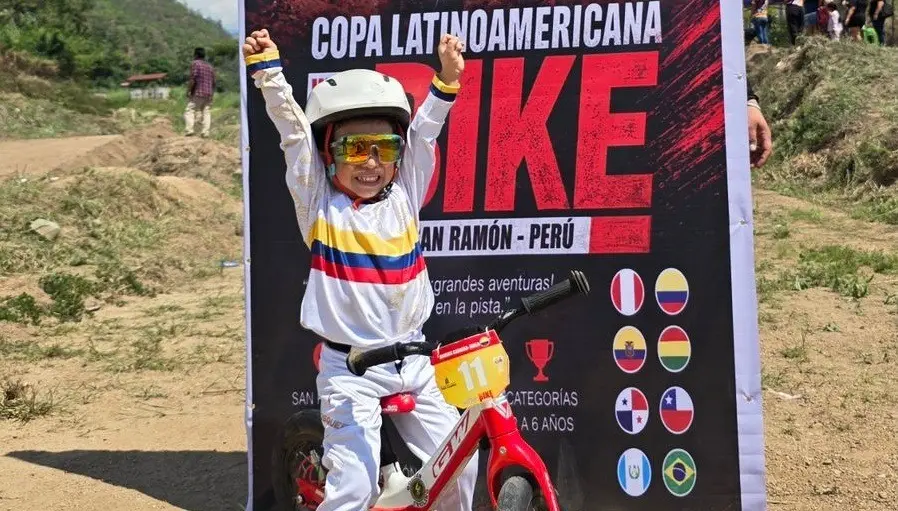
In the fast-paced, high-adrenaline world of international BMX racing, legends are usually forged over decades of rigorous training, broken bones, and relentless perseverance. Yet, in the heart of the Huila department in Colombia, a new phenomenon is rewriting the sport’s timeline. At just two years of age, Dominic Samuel Cabrera Mosquera—affectionately dubbed "El Rayo" (The Lightning Bolt) by peers and commentators alike—has emerged as a continental powerhouse, capturing regional, national, departmental, and international titles in the ultra-competitive Strider and toddler BMX categories.
Born in the municipality of Garzón and currently residing in the picturesque town of Rivera, Dominic has rapidly transitioned from rolling around on balance bikes to dominating the highest levels of early-childhood competitive cycling. His impressive palmarés already features championship titles earned on international soil in Peru, sweeping victories at the national level across Tolima and Cundinamarca, and regional triumphs in Rivera and Neiva.
Unlike most children his age, whose primary athletic endeavors involve playground equipment and learning to run, Dominic commands a BMX track with a consistency and tactical awareness that leaves seasoned coaches astonished. His ability to maintain a historical record of podium finishes in every single competition he enters has positioned him not merely as a local prodigy, but as the premier face of infant BMX in Colombia and the reigning champion of Latin America in his category.
Chronology of a Prodigy: From First Steps to International Glory
To understand the magnitude of Dominic Samuel’s achievements, one must examine the meteoric timeline of his brief yet impactful life. While the chronological span covers a mere 24 months, his developmental milestones in the sport read like a seasoned athlete’s career arc.
The Early Beginnings (Months 1–18)
Long before stepping onto a formal racing circuit, Dominic exhibited extraordinary motor skills and a natural affinity for balance. In households deeply rooted in active lifestyles, children often mimic their parents. For Dominic, balance bikes became an extension of his own body. Recognizing an unusual sense of coordination and fearlessness, his parents—Brayan Cabrera Quintero and family—provided an environment where safe exploration on two wheels was encouraged.
Regional and Local Ascendancy (Months 18–22)
As his confidence grew, so did the ambition to test his skills in structured environments. Dominic entered local races in his home department of Huila, quickly establishing dominance in municipal tracks across Neiva and Rivera. His innate sense of pacing, swift starts, and uncanny ability to navigate banking turns without hesitation made him an immediate fan favorite. Sweeping the regional circuits proved that his skills were not a fluke; he was head and shoulders above peers of his own age group.
National Consecration (Months 22–24)
With regional titles under his belt, the Cabrera family expanded their competitive horizon. Dominic traveled to neighboring departments, asserting his dominance on national stages in Tolima and Cundinamarca. Competing against the best young riders from across the Andean nation, "El Rayo" consistently climbed to the highest step of the podium, validating his status as a national powerhouse in infant cycling development.
The Continental Crown in Peru (Recent Months)
The crowning achievement of his nascent career occurred recently in Peru, where Dominic contested and won the Copa Latinoamericana of BMX in the Strider category. Facing the elite of South America’s youngest cycling talents, the toddler from Garzón put on a masterclass in balance-bike racing. Hoisting the continental trophy aloft, Dominic cemented his legacy as a pioneer of early-childhood sports in Colombia, proudly waving the tricolor flag on foreign podiums.
Supporting Data and Athletic Profile
While medals and trophies tell one story, the structural data behind Dominic Samuel Cabrera Mosquera’s rise highlights a unique paradigm in Colombian sports development:
- Age: 2 سنوات (2 years old).
- Hometown: Garzón, Huila, Colombia.
- Current Residence: Rivera, Huila, Colombia.
- Primary Discipline: BMX / Strider Category.
- International Palmarés: Copa Latinoamericana Champion (Peru).
- National Palmarés: Multiple gold medals and podium finishes in Tolima and Cundinamarca.
- Regional/Local Palmarés: Undefeated or top-podium status in municipal circuits across Neiva and Rivera.
- Nickname: "El Rayo" (The Lightning Bolt) Mosquera.
In statistical terms, Dominic’s 100% podium conversion rate across all sanctioned regional, national, and international events places him in an elite echelon. Very few athletes in any sporting discipline achieve such statistical consistency, let alone at an age when verbal communication is still developing. Sports scientists note that early exposure to motor-skill coordination under positive reinforcement frameworks significantly accelerates neurological development, spatial awareness, and core muscular strength—traits clearly visible in Dominic’s riding style.
Official Responses and Family Perspectives
In an exclusive interview with LA NACIÓN, Brayan Cabrera Quintero, the young champion’s father, opened up about the emotional and philosophical dimensions of raising a sporting prodigy. Rather than focusing purely on the competitive drive, the family emphasizes holistic human development.
"Our little one has demonstrated extraordinary athletic conditions that have positioned him not only as the primary promise of infant BMX in Colombia, but as the current Latin American Champion," stated Brayan Cabrera Quintero with palpable pride. "His sporting consistency has led him to be crowned champion at the departmental, regional, district, national, and now continental levels, maintaining a historical record of podiums in every event where he represents the country and the department of Huila."
Values Over Medals
The pressures of early fame can derail many young athletes, but the Cabrera family has established a firm boundary between athletic performance and personal character growth. For them, the BMX track is merely a classroom for life.
"At the age our son is, with barely two years old, our main dream does not begin on a track, but in his formation as a human being," the father explained. "For us as family, sport is the best tool to cultivate values and attitudes for life: responsibility, respect, self-care, empathy, and resilience against any challenge. We want him to understand competitiveness as an impulse for excellence and self-improvement in his future projects, but always maintaining humility and warmth in his personal life."
Looking toward the horizon, the family maintains a balanced, grounded outlook regarding Dominic’s athletic future, understanding that the child’s passion must remain self-directed.
"Of course, we would love for him to keep falling in love with BMX. If the day comes when he confirms this talent and love he already demonstrates, it would give us an enormous thrill to see him follow the footsteps of our great national references, representing our country in a World Championship or the Olympics," Cabrera Quintero added. "But beyond titles or medals, our greatest commitment today is to accompany him, guide his steps, and ensure he enjoys every pedal stroke. Wherever this beautiful path takes him, he will always have our unconditional support to grow happy, passionate, and with his heart firmly set on what he does."
Implications for Colombian Sports and Future Horizons
The emergence of Dominic Samuel Cabrera Mosquera carries profound implications for the sports infrastructure of Huila and the broader national ecosystem of Colombian cycling.
1. Revolutionizing Early Childhood Sports Training (Iniciación Deportiva)
Traditionally, structured athletic competition in Colombia begins during middle childhood (ages 6 to 10). However, the global rise of balance-bike (Strider) racing has democratized early motor skill training. Dominic’s success forces regional sports ministries and private academies in Huila to rethink how grassroots funding and infrastructure are allocated. Providing safe, specialized tracks for toddlers is no longer a luxury, but a necessity to capture talent at its inception.
2. Inspiring a New Generation in Huila
Historically, the Huila department has produced notable athletes, but cycling excellence is often associated with traditional powerhouses like Antioquia, Bogotá, or Boyacá. By placing Huila on the continental map through international victories in Peru, Dominic has sparked a wave of local inspiration. Parents in Garzón, Rivera, and Neiva are increasingly looking to cycling as a viable, positive pathway for early childhood development.
3. Long-Term Athletic Longevity and Protection
While the dream of seeing "El Rayo" don the colors of the Selección Colombia in future Olympic Games or UCI World Championships is a shared vision for the region, sports psychologists and pediatric experts emphasize the importance of safeguarding the child’s psychological well-being. The meticulous approach articulated by Brayan Cabrera—prioritizing joy, emotional resilience, and family support over relentless result-chasing—serves as a model for modern youth sports management.
Conclusion
Dominic Samuel Cabrera Mosquera is, without a doubt, a historical anomaly: a two-year-old champion carrying the hopes of an entire department on a balance bike. Yet, beneath the headlines of continental titles and gold medals lies a simple, beautiful reality: a little boy enjoying the wind in his face, supported by a loving family that values his smile far above any trophy. As "El Rayo" continues to pedal his way into the history books, the entire nation of Colombia watches in awe, knowing that this is merely the prologue to an extraordinary journey.

Leave a Reply