

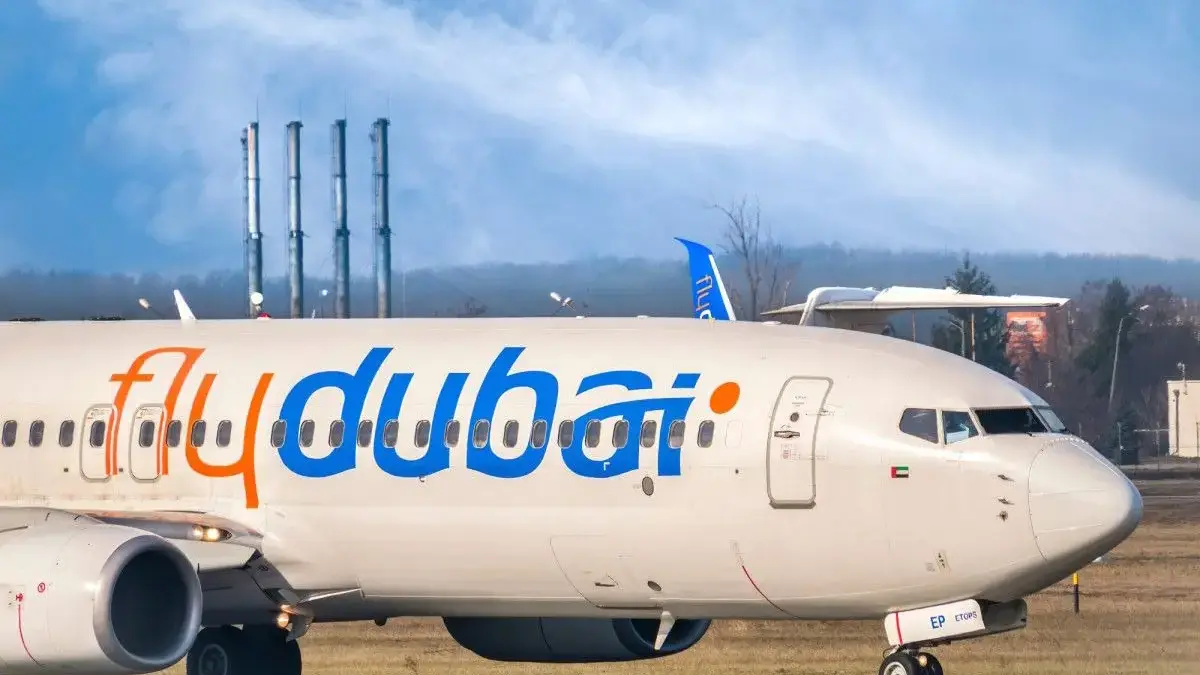
TABUK, Saudi Arabia — A routine commercial flight from the United Arab Emirates to Israel turned into a harrowing airborne nightmare on Wednesday morning when a violent confrontation erupted inside the cockpit. Flydubai Flight FZ1073, operating the heavily trafficked route between Dubai International Airport (DXB) and Tel Aviv’s Ben Gurion International Airport (TLV), was forced to make an emergency diversion to the Kingdom of Saudi Arabia.
The incident, which involved critical injuries to both members of the flight deck crew and subsequent intervention by brave passengers, has sent shockwaves through international aviation circles. While initial reports and viral social media footage point toward a knife attack or an attempted hijacking within the restricted cockpit confines, official authorities have thus far exercised caution, categorizing the episode as a severe onboard security breach while investigations remain strictly ongoing.
1. Main Facts: A Dramatic Mid-Air Crisis
Flydubai Flight FZ1073 was carrying dozens of passengers across the Middle East airspace when security protocols broke down in the most critical zone of the aircraft: the flight deck.
- The Flight: Operated by Flydubai, the Boeing aircraft was en route from Dubai (DXB) to Tel Aviv (TLV).
- The Incident: A violent altercation broke out in the cockpit, leaving both the pilot and the co-pilot injured. While Israeli media and passenger accounts strongly suggest a stabbing involving a knife, official Saudi and airline statements have maintained a more guarded posture, confirming only that a violent incident occurred and that both pilots sustained injuries.
- The Diversion: The aircraft abruptly changed course and made an emergency landing at Prince Sultan bin Abdelaziz International Airport in Tabuk, Saudi Arabia.
- Passenger Involvement: Leaked video footage and eyewitness testimonies reveal that a group of passengers rushed the cockpit area after the alarm was raised, physically subduing and neutralizing the alleged attacker—who was reportedly found wearing an oxygen mask on the cabin floor.
- Current Status: Both pilots were immediately rushed to a local Saudi medical facility upon landing. Passengers were safely disembarked, accommodated by local airport services, and promised an alternative aircraft by Flydubai to complete their journey.
2. Chronology of Events: From Routine Takeoff to Saudi Diversion
Flight-tracking data, air traffic control logs, and eyewitness accounts paint a chaotic picture of how a standard commercial transit dissolved into a high-stakes security emergency over the Middle East.
Morning Departure and the Escalation
Flight FZ1073 departed Dubai smoothly on Wednesday morning, tracking westward toward Israeli airspace. According to telemetry data provided by flight-tracking platform Flightradar24, the flight proceeded normally for the initial portion of the journey.
However, the situation deteriorated rapidly mid-flight. Sources from the Israeli Ministry of Transport indicated that an intense physical dispute erupted between individuals inside the cockpit, compromising the operational integrity of the flight deck.
Erratic Flight Path and Mayday Call
Flightradar24 logs reveal a profoundly erratic and anomalous flight trajectory in the moments leading up to the emergency declaration.
- The aircraft, initially flying on a steady west-bound heading toward Israel, executed a sudden, sharp turn northward.
- The plane experienced a noticeable loss of altitude as it neared the Jordanian border.
- Following this descent, the aircraft flew at a lower altitude along an irregular path, executed a complete U-turn toward the south, and locked in a trajectory heading deep into Saudi territory toward Tabuk.
At 08:44 local time (05:44 GMT), the air traffic control center at Prince Sultan bin Abdelaziz International Airport received an urgent distress call from the cockpit. Recognizing the extreme gravity of the situation, air traffic authorities immediately declared an official state of emergency, clearing the airspace and runway to safely receive the compromised aircraft.
The Landing and Ground Response
At 09:45 local time, Flight FZ1073 touched down safely on the tarmac in Tabuk without further incident. Emergency response teams, medical personnel, and airport security surrounded the aircraft instantly. Both the pilot and co-pilot—who were bleeding and severely incapacitated—were extracted from the aircraft and rushed under police escort to a regional medical facility. Meanwhile, uninjured passengers were guided safely into the terminal buildings to await logistical coordination.
3. Supporting Data and Eyewitness Accounts: Inside the Cabin
While official statements have trickled out slowly, the most visceral details of what occurred aboard Flight FZ1073 have emerged via leaked video footage broadcast by Israeli media outlets, alongside harrowing testimonies from passengers trapped on the plane.
The Viral Footage and Passenger Heroism
A video broadcast by Israel’s Channel 12 captured the immediate aftermath inside the cabin. The footage shows at least three passengers, visibly shaken and with blood-stained clothing, standing guard outside the cockpit door. Inside and directly adjacent to the flight deck, both pilots are visible—one of them stretched out on the floor receiving urgent medical attention, and another individual (the alleged assailant) pinned to the floor wearing an emergency oxygen mask.
Passengers featured in the recording asserted that they had to take matters into their own hands to prevent a catastrophic disaster. According to their statements, after realizing the flight crew was under lethal attack, they breached the cabin area, jumped on the suspect, wrestled him out of the cockpit, and neutralized him.
Eyewitness Testimony: "We Jumped on Him"
One of the passengers on board, identified as Yitzhak, provided a chilling first-hand account of the ordeal to reporters:
"We managed to neutralize a terrorist armed with a knife who had stabbed one of the pilots. We jumped on him, dragged him out of the cockpit, and subdued him. One of the pilots was in grave condition…"
Other passengers echoed these sentiments on social media, describing the event using terms typically reserved for acts of terrorism. However, international aviation analysts and security agencies have emphasized that until forensic investigations and formal interrogations are concluded, the precise motive—whether terror-related, political, or stemming from a sudden psychological breakdown—cannot be definitively established.
4. Official Responses and Diplomatic Maneuvers
The geopolitical sensitivities surrounding a commercial flight between the UAE and Israel making an unscheduled emergency landing in Saudi Arabia added an immediate layer of diplomatic complexity to the crisis.
Israeli Government and Transport Ministry
The Israeli Ministry of Transport confirmed to the Spanish news agency EFE that the flight’s abrupt diversion was directly tied to a violent crew altercation.
Shortly after news of the emergency landing broke, the office of Israeli Prime Minister Benjamin Netanyahu released a formal statement assuring the public that the situation was fully contained. The Prime Minister’s office stressed that active diplomatic and logistical channels were being utilized to coordinate with regional authorities, ensuring the rapid and secure repatriation of all Israeli citizens stranded in Tabuk.
Flydubai’s Official Stance
Low-cost carrier Flydubai adopted a measured corporate communications strategy in the wake of the crisis. The airline released a brief statement acknowledging that Flight FZ1073 had experienced an unspecified "incident" onboard, forcing the captain to divert.
Flydubai officials avoided using terms like "stabbing" or "hijacking," instead focusing on the safety of the landing and the wellbeing of the travelers:
"The aircraft landed safely in Saudi Arabia, and all passengers are safe. We are cooperating fully with local authorities to investigate the circumstances of this event. A replacement aircraft has been dispatched to Tabuk to bring our passengers home."
Saudi Authorities
The Kingdom of Saudi Arabia’s aviation and security apparatus handled the emergency protocol with textbook precision. Prince Sultan bin Abdelaziz International Airport ground services efficiently managed the distressed aircraft, while local law enforcement took the primary suspect into custody. Saudi officials confirmed the hospitalization of both the captain and first officer, noting that a comprehensive, multi-agency investigation is currently underway to reconstruct the timeline and exact nature of the onboard assault.
5. Implications for Aviation Security and Regional Relations
The incident aboard Flydubai Flight FZ1073 opens a Pandora’s box of critical questions regarding modern commercial aviation safety, crew vetting processes, and geopolitical dynamics in the Middle East.
Cockpit Security Re-evaluated
In the post-9/11 era, commercial aviation security has been overwhelmingly focused on hardening cockpit doors against external threats—specifically, unauthorized individuals attempting to breach the flight deck from the passenger cabin. Reinforced, locked doors designed to keep malicious actors out have inadvertently created an isolated environment where, in the rare event of an internal threat or psychological crisis involving the crew, intervention becomes exponentially more difficult.
The fact that passengers had to physically intervene to stop an assault inside the cockpit highlights a terrifying vulnerability: what happens when the danger originates from behind the closed and locked door? Aviation safety experts worldwide are expected to scrutinize this incident to determine whether current cockpit security paradigms require urgent structural or procedural reform.
Crew Mental Health and Vetting
The incident will inevitably cast a harsh spotlight on airline crew mental health support systems, psychological screening, and in-flight monitoring. The immense pressures placed on commercial pilots—compounded by regional political tensions, grueling schedules, and high-stress operational environments—require robust institutional safeguards. Airlines across the globe may face renewed pressure from regulatory bodies like the International Civil Aviation Organization (ICAO) to enhance psychological evaluations and establish fail-safes for cockpit crew interactions.
Geopolitical Cooperation
From a diplomatic perspective, the successful handling of the emergency by Saudi air traffic controllers and medical personnel, coupled with the swift coordination between Israeli and regional entities to repatriate passengers, demonstrates a pragmatic framework for crisis management. Despite complex political landscapes, the universal imperative of passenger safety overrode regional friction during those tense hours over Tabuk.
As the investigation moves forward, aviation authorities, security analysts, and the traveling public will be watching closely for answers. For the passengers and crew of Flight FZ1073, however, the harrowing events of Wednesday morning will remain an indelible reminder of how quickly the skies can turn perilous—and how ordinary people can become extraordinary heroes at 35,000 feet.



Leave a Reply