

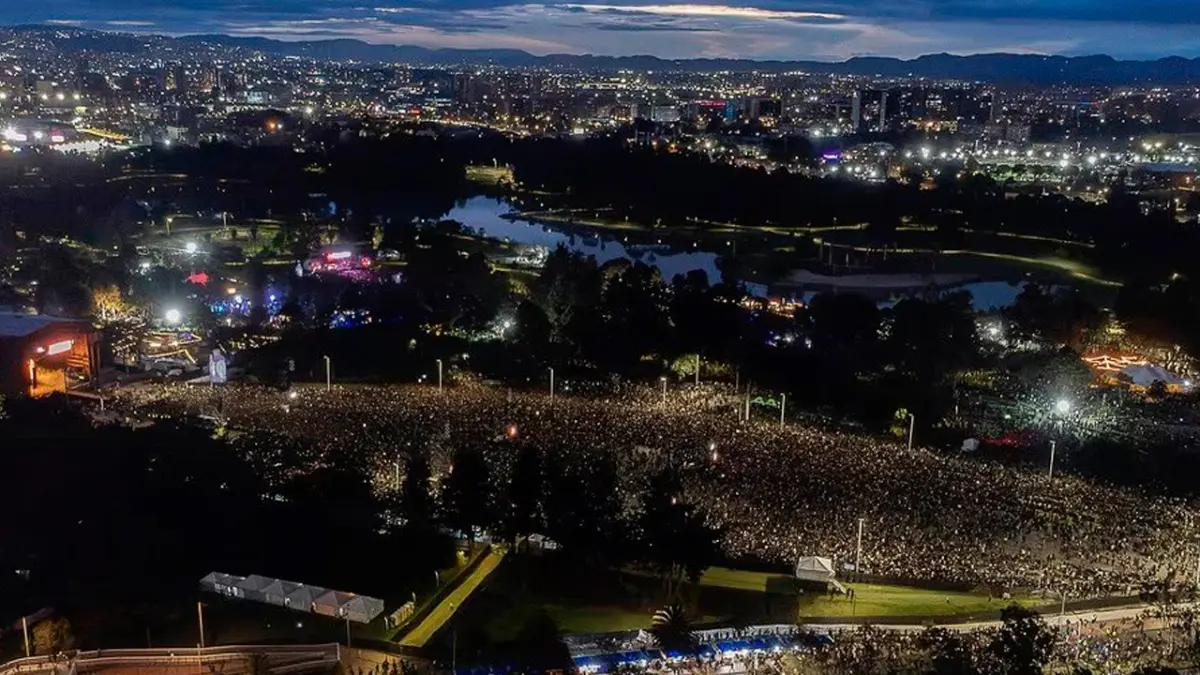
BOGOTÁ, COLOMBIA — In a monumental display of cultural devotion and musical passion, the 30th-anniversary edition of Rock al Parque has rewritten the history books. Before its final curtain call even began, Latin America’s largest free outdoor rock festival achieved an unprecedented milestone, drawing astronomical crowds to the iconic Parque Metropolitano Simón Bolívar.
With more than 465,500 cumulative attendees recorded across just its first two days—Saturday, October 10, and Sunday, October 11—the festival has officially surpassed the total attendance figures of its most legendary editions. As Bogotá basks in three days of relentless riffs, pounding percussion, and unbridled communal energy, Rock al Parque 2026 has cemented its status not only as a pillar of Colombian identity, but as one of the most powerful live music institutions on the global stage.
1. Main Facts: A Landmark Weekend of Sonic Supremacy
The numbers speak for themselves, painting a vivid picture of a festival operating at the absolute peak of its powers. According to official reports released by the District Secretariat of Culture, Recreation, and Sports, the appetite for live rock, metal, ska, and alternative music has never been stronger.
- The Cumulative Milestone: Across Saturday and Sunday alone, the festival registered 465,500 total attendances at the Parque Simón Bolívar.
- Day One Triumph: The inaugural Saturday kicked things off with a staggering 191,000-plus music fans storming the park gates, instantly setting a brand-new, all-time record for the highest attendance ever recorded on a Day 1 in the festival’s three-decade history.
- Day Two Surge: Sunday saw an even larger influx of humanity, with 274,500 people circulating through the grounds. The massive crowd was treated to spellbinding performances by international and regional heavyweights, including Mon Laferte, Esteman, Tokyo Ska Paradise Orchestra, Gondwana, Bándalos Chinos, and Claudio Narea.
- The Final Stretch: These numbers were locked in before the gates even opened for the third and final day on Monday, October 12 (Labor Day holiday), meaning the final cumulative tally for 2026 will push the historic benchmark even higher.
The atmosphere inside the park has been described by veterans and first-timers alike as electric. Spanning generations—from aging metalheads who witnessed the festival’s inception in 1996 to Gen Z punks experiencing the ritual for the first time—the crowd has demonstrated the unifying power of rock music in all its diverse subgenres.
2. Chronology of the Weekend: From Record-Breaking Kickoff to Sunday’s Massive Wave
To understand how Rock al Parque 2026 reached this stratospheric level of success, one must look at how the weekend unfolded hour by hour, stage by stage.
Saturday, October 10: The Day One Phenomenon
From the early morning hours, anticipation hung thick in the air across Bogotá. Public transit lines swelled with black-clad fans bearing patches, band tees, and banners representing decades of musical loyalty. By the time the first chords rang out across the multiple stages of Parque Simón Bolívar, it was clear that attendance was tracking well above historical averages.
When the District Secretariat of Culture, Recreation, and Sports dropped the official Day 1 figure of over 191,000 attendees, social media erupted. Never before had an opening day drawn such a massive horde. The diverse lineup balanced heavy local favorites with cutting-edge international acts, ensuring that every square foot of the festival grounds pulsed with life. Fans moved fluidly between the stages, united by a shared appetite for heavy guitars and experimental sounds.
Sunday, October 11: Breaking the Barriers of Expectation
If Saturday proved that the appetite for the festival was robust, Sunday demonstrated that it was insatiable. Buoyed by a stellar, star-studded lineup, Sunday saw a staggering 274,500 people converge on the park.
The day’s scheduling was a masterclass in cross-genre curation. The emotive, powerhouse vocals of Mon Laferte captivated tens of thousands, while the infectious pop-rock grooves of Esteman kept the field dancing. International flair was brought in abundance by the legendary Tokyo Ska Paradise Orchestra—whose high-octane brass lines turned the dust of the park into a giant dancing pit—alongside reggae staples Gondwana, the indie-pop charm of Bándalos Chinos, and rock royalty Claudio Narea.
As the sun set over the Bogotá skyline, illuminating a sea of raised fists and waving flags, it became mathematically certain: Rock al Parque 2026 was on track to shatter every attendance record in its 30-year history.
3. Supporting Data: How 2026 Stacks Up Against Festival History
To truly contextualize the magnitude of the 2026 figures, one must examine the archives of Rock al Parque. Since its founding in 1996 by Julio Correal and Radiónica’s precursor initiatives under the artistic direction of Mario Duarte, the festival has grown from a local countercultural gathering into a massive municipal institution. Yet, even its most celebrated years pale in comparison to this 30th-anniversary milestone.
Historical Attendance Comparison (1996–2026)
| Rank | Edition | Reported Attendance | Context / Notes |
|---|---|---|---|
| 1 | 2026 | More than 465,500 | Partial figure recorded across the first 2 days (Oct 10-11). |
| 2 | 2004 | More than 400,000 | Celebrated the festival’s landmark 10th anniversary across 3 days. |
| 2 | 2014 | Around 400,000 | Marked the 20th anniversary milestone. |
| 4 | 2023 | More than 390,000 | The post-pandemic resurgence spearheaded by Idartes. |
| 5 | 2015 | More than 350,000 | A solid mid-decade showing of alternative and heavy acts. |
(Note: While cultural analysts and festival organizers emphasize that crowd-counting methodologies have evolved over the 30-year history of Rock al Parque—shifting from manual gate estimations to advanced spatial and transit analytics—the sheer physical density of the crowds in 2026 leaves no doubt about its unprecedented scale.)
Even when compared against the benchmark 10th-anniversary edition in 2004 (which took three full days to clear 400,000 attendees) and the 20th-anniversary edition in 2014, the 2026 festival achieved those numbers with an entire day to spare.
4. Official Responses and Institutional Impact
The staggering success of Rock al Parque 2026 has prompted widespread commentary from cultural leaders, city officials, and the organizers at Idartes (Instituto de Artes de Bogotá).
The Cultural Value of Free Access
In official statements, municipal authorities highlighted that the core philosophy of Rock al Parque—providing high-quality, diverse, and completely free cultural access to the citizenry—remains its most radical and successful attribute. In an era where international music festivals have become increasingly exclusionary due to exorbitant ticket prices, Bogotá continues to champion the radical notion that culture is a public right, not a luxury commodity.
"Reaching over 465,000 people in just two days is a testament to the resilience, loyalty, and cultural hunger of our public," noted a spokesperson for the District Secretariat of Culture. "Rock al Parque belongs to Bogotá. It belongs to the youth, to the veterans, to the families who pass down their love for music from generation to generation. These numbers prove that rock and alternative music are not fading; they are evolving, expanding, and binding our community closer together."
Safety and Logistics
Managing a crowd of nearly half a million people over a single weekend requires military-grade logistical planning. City agencies, including mobility authorities, the Red Cross, civil defense, and private security forces, coordinated around the clock. Special transit frameworks—such as extended hours and feeder routes for the TransMilenio mass transit system—were deployed to ensure that hundreds of thousands of fans could travel to and from the Parque Simón Bolívar safely.
5. Implications for the Future of Rock al Parque
As the dust settles on the final notes of the festival, cultural critics and music industry insiders are evaluating what this record-breaking edition means for the future of live entertainment in Latin America.
- Global Destination Status: Rock al Parque has long been recognized as Latin America’s premier free rock festival, but the 2026 edition elevates its international profile. With travelers increasingly flying in from across South America, Central America, and North America specifically for the event, the festival is now a major driver of cultural tourism for the Colombian capital.
- Genre Fluidity and Generational Continuity: The massive turnout for disparate acts—ranging from extreme metal and brutal punk to breezy indie rock and traditional ska—proves that the contemporary festival-goer is genre-agnostic. This opens the door for future editions to embrace an even broader spectrum of heavy and alternative sounds without alienating the festival’s purist base.
- Economic and Social Resilience: In a post-pandemic economic landscape where major live music markets have faced severe headwinds, the explosive public response in Bogotá demonstrates an unyielding societal need for communal, physical spaces of expression and catharsis.
Conclusion: The Grand Finale and the Legacy Continues
With the historic milestone of 465,500 attendees safely secured after the weekend, the 30th-anniversary celebration prepared for its grand finale on Monday, October 12 (Labor Day).
The final day’s lineup promised to push the total attendance well past the half-million mark, featuring a ferocious slate of closing acts across the park’s four stages. Heavy metal titans Rata Blanca and industrial pioneers Ministry shared the spotlight with alternative icons Editors, Chilean rockers Los Bunkers, the experimental grooves of Ghetto Kumbé, alongside local favorites like Los Elefantes and La Severa Matacera.
As the final amps powered down on Monday night, signaling the close of three days of absolute sonic glory, one thing was definitively clear: Rock al Parque is not just surviving its third decade; it is thriving at a scale that its founders could only have dreamed of back in 1996. Bogotá has spoken, the guitars have roared, and rock and roll lives on stronger than ever in the heart of the Andes.
Stay tuned for ongoing coverage, photo galleries, and exclusive interviews via the official #RadiónicaEnRockAlParque broadcasts and digital channels.

Leave a Reply