

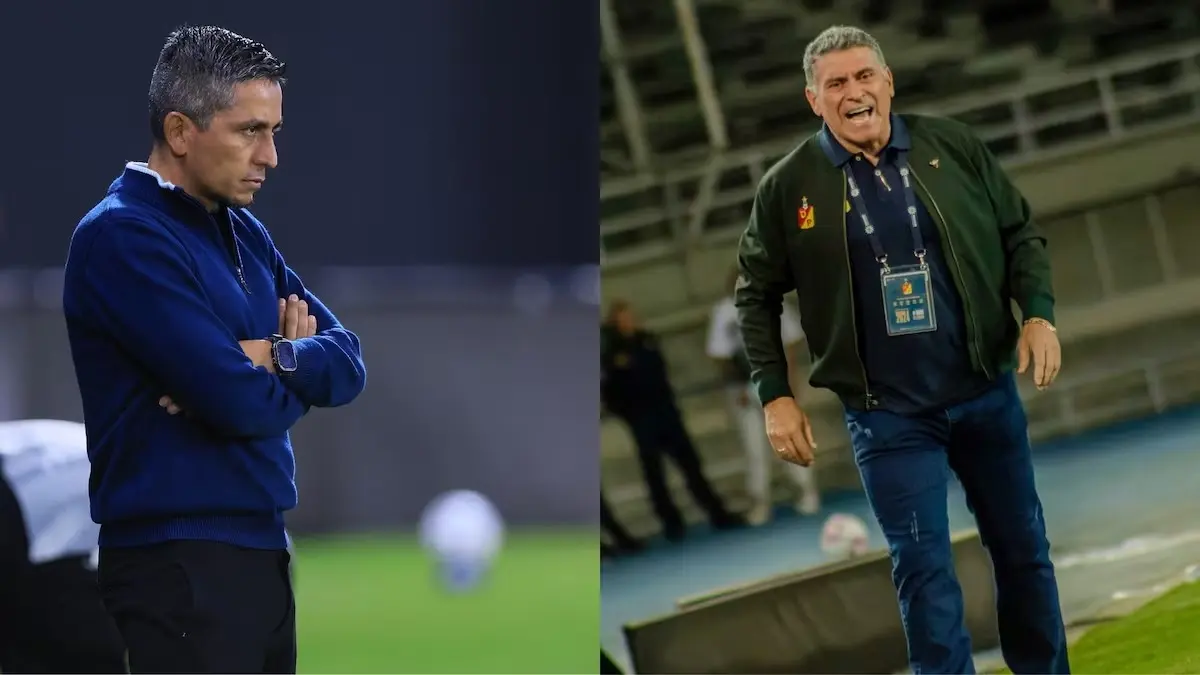
IBAGUÉ, COLOMBIA — In a decisive move that signals a fierce ambition to stabilize their campaign and chase domestic glory, the board of directors at Deportes Tolima has officially announced a major overhaul of the club’s technical staff. Sebastián Oliveros has been relieved of his duties as head coach of the professional squad, bringing an abrupt end to his tenure. However, the club wasted no time in unveiling a marquee replacement, confirming the much-anticipated return of seasoned tactician Luis Fernando Suárez.
The announcement, released through the club’s official communication channels on Tuesday, brings both closure to a turbulent period under Oliveros and a wave of renewed optimism with the appointment of Suárez, a revered figure in Colombian and international football. As the Pijao side navigates a crucial juncture in the Liga BetPlay, the leadership in Ibagué has opted for experience, pedigree, and a proven track record to steer the ship toward calmer, more triumphant waters.
1. Main Facts and the Coaching Transition
The winds of change are blowing strongly through the Estadio Manuel Murillo Toro. Deportes Tolima confirmed that Sebastián Oliveros will no longer lead the professional team, alongside his entire coaching staff. In the same official bulletin, the club moved swiftly to introduce Luis Fernando Suárez Guzmán as the new head coach, tasked with maximizing a talented roster that has struggled to find a consistent identity.
The transition marks a stark philosophical shift from a developing manager trying to solidify his standing in top-flight professional football to a seasoned World Cup-tested veteran who has walked the halls of elite footballing pressure across the globe.
In its official statement, the club expressed gratitude for Oliveros’s efforts while simultaneously welcoming the incoming crew:
“Professor Sebastián Oliveros will no longer continue as the head coach of our squad. We wish him and his coaching staff the utmost success in the new professional challenges they undertake,” the club’s initial statement read.
Immediately following the parting words to the outgoing staff, the club turned its focus to the future, detailing the comprehensive assembly of Suárez’s trusted lieutenants:
“Likewise, we announce the arrival of Professor Luis Fernando Suárez Guzmán and his coaching staff, comprised of Iván Niño (physical trainer), Fabián Torres (assistant coach), and Professor Henry Rojas, who will serve as the assistant coach for the professional team.”
This restructured technical department arrives with an explicit mandate: eliminate tactical inconsistency, optimize player performance, and cement Deportes Tolima as a bona fide contender for the domestic league title, all while repairing fractured confidence following premature cup exits.
2. Chronology of Events: The Rise and Fall of Oliveros’s Tenure
To understand the urgency behind Tolima’s decision to pull the trigger on a coaching change, one must examine the timeline of Sebastián Oliveros’s tenure—a period characterized by a promising start that gradually unraveled under the weight of mounting expectations and tactical friction.
The Appointment and Early Promise
When Oliveros initially took the reins, the club’s administration hoped his intimate knowledge of the institution’s youth structures and modern tactical frameworks would inject fresh energy into the senior squad. Early on, there were flashes of brilliance. The team strung together a few impressive performances, showing an ability to compete physically and technically against the heavyweight contenders of the Liga BetPlay. During the opening stretches of his tenure, Oliveros managed to keep the team afloat in the upper echelons of the league table, securing enough points to keep them within the coveted grupo de los ocho (the top eight spots that qualify for the championship playoffs).
The Cracks Begin to Show: Cup Shocks and Continental Pain
Despite sitting inside the qualification zone for the final phases of the tournament, the underlying metrics and the subjective eye-test told a different story. Fans and analysts alike grew increasingly restless over the team’s lack of a distinct tactical identity. Tolima frequently alternated between stellar performances and abysmal, disjointed displays where the team lacked structural cohesion in possession and defensive resilience under pressure.
The fragility of Oliveros’s project was brutally exposed in knockout competitions. The first major blow came in the Copa Colombia, where Deportes Tolima suffered a shocking and humiliating elimination at the hands of Deportes Quindío—a side competing in the second-tier Torneo BetPlay (Categoría B). For a club accustomed to deep runs and asserting domestic dominance, falling to a lower-division rival was a bitter pill to swallow.
Compounding the domestic disaster was the continental heartbreak. Tolima’s campaign in the Copa Libertadores suffered a fatal blow following a painful elimination against Independiente del Valle. The continental exit laid bare the tactical limitations of the squad under Oliveros’s guidance, highlighting an inability to manage high-stakes, high-intensity international matches against disciplined tactical setups.
The Breaking Point and Dismissal
While Oliveros managed to keep the team mathematically afloat in the league standings, the mounting pressure from the supporters, combined with the loss of prestige in the Copa Colombia and Copa Libertadores, forced the board’s hand. The lack of conviction in the team’s style of play, coupled with an unsustainable 50% overall rendimiento (performance yield), meant that a change was no longer just an option—it was an absolute necessity. The board chose to act before the league season reached the point of no return, opening the door for a high-profile rescue mission.
3. Supporting Data and Statistical Breakdown
Numbers rarely lie, and the statistical footprint of Sebastián Oliveros’s reign at Deportes Tolima paints a vivid picture of a team caught in a cycle of mediocrity, unable to achieve the dominance demanded by the club’s ambitious hierarchy.
Oliveros’s Record at a Glance:
- Total Matches Directed: 14 official games across all competitions (Liga, Copa Colombia, and Copa Libertadores).
- Victories: 6
- Draws: 3
- Defeats: 5
- Overall Yield (Rendimiento): Exactly 50%.
While a 50% success rate might be acceptable for mid-table clubs seeking stability, it falls drastically short of the championship-or-bust standards set at Deportes Tolima.
Contextualizing the Metrics:
- The League Paradox: Statistically, Oliveros left Tolima positioned inside the top eight. However, this illusion of safety was largely propped up by early-season momentum and the inconsistent form of other chasing clubs, rather than sustained, dominant displays by the Vinotinto y Oro.
- Defensive Vulnerabilities: Under Oliveros, the defensive line often looked exposed during transitions, conceding crucial goals late in matches. This lack of game-management cost them vital points in both the league and continental stages.
- Offensive Stagnation: Despite possessing quality attacking pieces, the team’s expected goals (xG) metrics plummeted during the middle weeks of his tenure, heavily relying on individual brilliance rather than cohesive, systematic chance creation.
The Incoming Blueprint: Luis Fernando Suárez’s Recent History
In stark contrast to Oliveros’s brief and turbulent senior managerial chapter, Luis Fernando Suárez arrives with decades of institutional knowledge and battle-tested experience. Suárez’s most recent high-profile domestic stint came at the helm of Deportivo Pereira, a club he managed from June 2024 through April 2025.
During his time at Pereira, Suárez was praised for his ability to organize defensive blocks, maximize the output of veteran players, and install a pragmatic, highly competitive tactical culture. Even when facing financial and structural limitations at Pereira, Suárez managed to keep the team fiercely competitive, demonstrating the exact kind of stabilizing presence that Deportes Tolima desperately requires right now.
Furthermore, this appointment represents a nostalgic and historic homecoming: this will be Suárez’s second official cycle as the head coach of Deportes Tolima, having previously managed the Ibagué outfit back in 2002. Bringing back a manager who understands the unique cultural identity, altitude challenges, and passionate fanbase of the club is a calculated gamble by the board to fast-track the team’s adaptation phase.
4. Official Responses and Staff Composition
The leadership of Deportes Tolima has moved decisively to frame this transition not as a panic reaction, but as a strategic upgrade designed to elevate the club to the elite tier of South American football.
The New Technical Structure
Recognizing that modern football requires a multidisciplinary approach, Suárez has brought along a tightly knit, highly respected group of professionals to ensure every physical, tactical, and psychological angle is covered:
- Luis Fernando Suárez Guzmán (Head Coach): The mastermind of the operation. A veteran of multiple FIFA World Cups (notably managing Ecuador to the Round of 16 in 2006, Honduras in 2014, and leading Costa Rica to the 2022 tournament), Suárez brings an unparalleled level of authority, tactical acumen, and crisis-management expertise to the locker room.
- Iván Niño (Physical Trainer): Tasked with eradicating the late-game fatigue that plagued Tolima under the previous regime. Niño is known for implementing rigorous, scientifically backed conditioning programs designed to keep players at peak physical output through congested fixture lists.
- Fabián Torres (Assistant Coach): A trusted tactical lieutenant who acts as Suárez’s eyes and ears on the training pitch, breaking down opponent video analysis and translating tactical philosophies into daily drills.
- Henry Rojas (Assistant Coach): A fascinating and celebrated addition to the staff. Rojas, a former professional player deeply respected in Colombian football circles, transitions to the technical side with a wealth of on-field experience. Having experienced the pressures of top-flight Colombian football firsthand, Rojas is expected to serve as a vital bridge between the coaching staff and the playing squad, helping younger players mentally navigate the pressures of playing for a powerhouse like Tolima.
Reactions from the Club Hierarchy
While direct press conferences following the announcement are scheduled for later in the week, sources close to the club’s board of directors indicate that the decision to hire Suárez was unanimous. The executive committee felt that while Oliveros had potential, the club could not afford to waste a competitive roster on an unproven tactical project when the championship window is wide open.
"We need a leader who does not blink when the pressure reaches its peak," an internal club source noted anonymously. "Luis Fernando has coached on the biggest stages in world football. He knows how to win championships, he knows how to handle elite egos, and most importantly, he knows the DNA of Deportes Tolima from his time here in 2002."
5. Implications for the Season and the Future
The arrival of Luis Fernando Suárez at Deportes Tolima carries profound implications, not only for the remainder of the current Liga BetPlay campaign, but for the long-term trajectory of the institution.
Immediate Tactical Re-Alignment
Fans can expect an immediate shift in how Deportes Tolima approaches matches. Suárez is historically known for establishing a fiercely disciplined defensive structure, prioritizing tactical balance over reckless, open-field attacking. By tightening the screws at the back, Suárez aims to eliminate the sloppy, avoidable goals that cost Oliveros his job.
However, labeling Suárez purely as a "defensive coach" would be a disservice to his tactical flexibility. Throughout his storied career, his teams have mastered the art of vertical transitions, utilizing pacy wingers and intelligent central midfielders to strike opponents quickly on the counter-attack. Players who previously found themselves out of favor under Oliveros may find a clean slate and renewed opportunities to prove their worth under a manager who values merit and tactical compliance above all else.
The Pressure to Perform Immediately
There is no honeymoon period for Suárez. Walking into a club that currently occupies a playoff spot means the expectations are immediate. The board did not bring in a World Cup manager to rebuild for next year; they brought him in to challenge for silverware now.
The supporters, while respectful of Suárez’s legendary status in Colombian football, will demand an immediate improvement in the team’s playing style. The scars of the Copa Colombia elimination against Deportes Quindío and the continental exit against Independiente del Valle will take time to heal, and the fastest medicine for a hurting fanbase is a string of convincing, dominant victories in the league.
A Test of Legacy
For Suárez himself, this second stint at Deportes Tolima represents a deeply personal chapter. Having first managed the club over two decades ago in 2002, returning to Ibagué allows him to cement his legacy with a club that gave him important early reps in his legendary coaching journey. If he can guide this talented squad to a Liga BetPlay title, it will add yet another glittering chapter to an already illustrious career that has spanned Honduras, Ecuador, Costa Rica, and the biggest clubs in Colombia.
As the squad prepares for their upcoming fixtures under the watchful eye of Suárez, Niño, Torres, and Rojas, the atmosphere at the Estadio Manuel Murillo Toro has transformed overnight. Uncertainty has been replaced by expectation. The Vinotinto y Oro have made their statement to the rest of the league: they are done experimenting, and they are ready to conquer.

Leave a Reply