

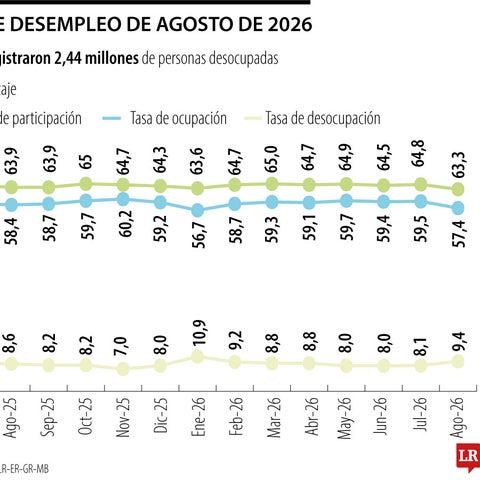
BOGOTÁ — In a concerning shift for the national economy, Colombia’s jobless rate broke through the critical 9% threshold for the first time in six months. According to the latest labor market report released by the National Administrative Department of Statistics (DANE), the unemployment rate climbed to 9.4% at the close of August, pushing the total number of unemployed individuals to 2.44 million.
The latest data reflects a significant deterioration in labor conditions compared to the same period in 2025, when unemployment stood at 8.6%. This 0.8 percentage point (pps.) increase translates to an additional 207,000 people joining the ranks of the unemployed over a 12-month span. Analysts attribute this sudden spike to a convergence of compounding crises: a major natural disaster, shifting macroeconomic policies, structural weaknesses in key industrial sectors, and long-standing regional security challenges.
1. Main Facts: The Anatomy of the August Labor Crunch
The August employment report serves as a stark reminder of the vulnerability inherent in Colombia’s economic recovery. With 2.44 million citizens out of work, the labor market has experienced its highest unemployment rate for the month of August since 2024, abruptly halting a six-month period of relative stability where the indicator remained below the 9% ceiling.
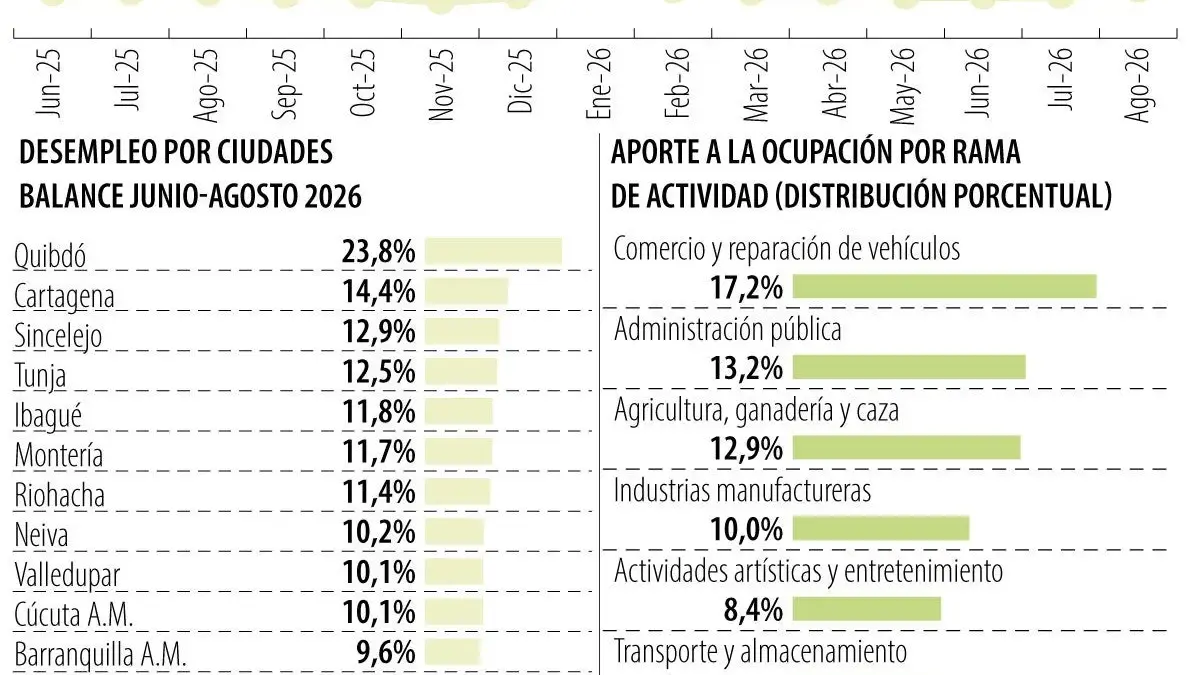
The deterioration was not isolated to a single region or economic sector; rather, it represents a widespread contraction in job creation. DANE’s metrics highlight that the manufacturing sector bore the heaviest burden, shedding 240,000 jobs over the past year. This was closely followed by the arts, entertainment, and recreation sector, which lost 102,000 positions, and the agricultural sector, which dropped 91,000 workers.
When examining employment categories, the losses were most heavily concentrated among the nation’s most vulnerable workforce segments:
- Day laborers and farmhands (jornaleros y peones): Down by 154,000 positions.
- Domestic workers: Down by 117,000 positions.
- Own-account workers (cuentapropistas): Down by 57,000 positions.
Geographically, the crisis manifested unevenly across major urban centers. Quibdó recorded the highest unemployment rate in the country at a staggering 23.8%, followed by Cartagena at 14.4% and Sincelejo at 12.9%. Conversely, the major metropolitan hubs fared better, with Bogotá, Medellín, and Bucaramanga registering the lowest jobless rates at 7.9%, 7.5%, and 7.3%, respectively.
2. Chronology of Events Leading to the August Spike
To understand how the Colombian labor market arrived at this juncture, experts point to a series of distinct chronological pressures that converged in August:
- Late 2025 – Early 2026: The macroeconomic landscape began shifting as the previous administration’s cycle of heavy public spending—traditionally ramped up ahead of election periods—gave way to a new government focused heavily on fiscal restraint and reduced state investment.
- Mid-2026: Domestic manufacturing and commerce began absorbing the shockwaves of an influx of lower-priced foreign goods, putting immense pressure on local profit margins and payrolls. Concurrently, ongoing migration shifts and rural security constraints began to severely constrain agricultural productivity.
- August 10, 2026: A major earthquake struck the country, severely impacting regional infrastructure, business operations, and local supply chains, particularly in economic hubs like Cali and surrounding areas.
- Late August 2026: DANE compiles its monthly household surveys, capturing the immediate, devastating intersection of structural economic slowdowns and the physical destruction wrought by the natural disaster.
3. Supporting Data and Statistical Breakdown
A deeper dive into the DANE datasets reveals critical vulnerabilities across various pillars of the economy. The total population of unemployed individuals reaching 2.44 million signifies that the engine of job formalization has stuttered.
The manufacturing sector’s loss of 240,000 jobs is viewed by economists as a flashing red light for industrial output. For years, manufacturing has served as a primary driver of urban employment. Its sudden contraction underscores how local producers are struggling to compete against cheaper international imports.
In the agricultural sector—traditionally a massive employer in rural Colombia—the loss of 91,000 jobs highlights systemic hurdles. Analysts note that the sector has been battered not only by shifting weather patterns and the August earthquake, but also by persistent regional security issues and rural labor shortages driven by internal migration trends.
Furthermore, the arts and entertainment sector’s contraction of 102,000 jobs points directly to government budget cuts. As state-sponsored cultural investments dwindled under tighter fiscal policies, creative industries and events saw immediate freezes in hiring and project development.
4. Official Responses and Expert Analysis
As the numbers sent ripples through the financial sector, economists, labor experts, and business leaders offered stark assessments of the situation and outlined what needs to be done to reverse the trend.
Iván Jiménez: The Impact of Fiscal Policy and Public Contracting
Iván Jiménez, director of the Labor Observatory at the Pontificia Universidad Javeriana, emphasized that the jump in unemployment cannot be viewed in a vacuum. He pointed to structural shifts in public sector recruitment and spending.
"Last year marked the end of a government term sitting right on the doorstep of elections—a period where historical precedent dictates higher investment in public employment," Jiménez explained. "However, we are now dealing with an administration that entered office with a strict focus on curbing state investments, driven by an imperative for fiscal pressure."
Jiménez also highlighted the timing of the August 10 earthquake, noting that the country is "only just beginning to witness the full economic fallout of that disaster." He added that reductions in state investment directly crippled the cultural and artistic sectors, heavily weighing down the month’s final tally.
María Claudia Lacouture: An Atypical Month and Industrial Weakness
María Claudia Lacouture, president of the American Chamber of Commerce of Colombia (AmCham Colombia), echoed these sentiments, describing August as a uniquely atypical month.
"The earthquake undoubtedly impacted employment in the affected disaster zones, although its precise national ripple effect is still being measured," Lacouture stated. She reinforced that the industrial sector was already displaying underlying weaknesses long before the tremor, which directly translated into the loss of hundreds of thousands of jobs.
Daniel García: Regional Devastation and Sectoral Pressures
Daniel García, senior economist at Davibank, tied the national headline figure directly to the regional devastation caused by the natural catastrophe.
"Given the elevated participation of these specific sectors in the regions most heavily impacted by the earthquake—particularly around Cali—this natural disaster was undoubtedly one of the primary drivers behind the surge in unemployment to its highest level for an August since 2024," García noted.
Beyond the earthquake, García pointed out that structural headwinds continue to plague primary industries. Agriculture is hampered by persistent security and migration challenges, while manufacturing and commerce are fighting a defensive battle against cheap foreign imports.
Bruce Mac Master: A Call for Public-Private Synergy
In response to the troubling DANE report, Bruce Mac Master, president of the National Business Association of Colombia (ANDI), called for immediate, coordinated action between the national government and the private sector. Mac Master stressed that sustainable job creation cannot occur without deliberate policies aimed at boosting overall economic growth, aggressively reducing high rates of labor informality, and unlocking better professional opportunities for the citizenry.
5. Broader Implications for the Colombian Economy
The breach of the 9% unemployment barrier carries profound implications for Colombia’s macroeconomic outlook for the remainder of the year and into 2027.
First and foremost, the concentration of job losses among vulnerable demographics—such as day laborers, domestic workers, and informal own-account workers—threatens to widen income inequality gaps. When lower-income segments lose their primary sources of income, domestic consumption contracts, creating a negative feedback loop that can further stifle retail, commerce, and service sectors.
Second, the data forces a difficult policy conversation regarding fiscal restraint versus countercyclical spending. While the current administration has prioritized fiscal discipline to control national debt metrics, the August employment data suggests that pulling back public investment too sharply, combined with an unexpected natural disaster, can severely destabilize the labor market.
Finally, the industrial and agricultural contraction underscores the urgent need for structural reforms. For Colombia to sustainably bring unemployment back down below the 9% mark, policymakers must address the root causes of industrial erosion—such as import competition and infrastructure vulnerabilities—while deploying targeted relief and reconstruction funds to the regions devastated by the August earthquake.
As the fourth quarter approaches, all eyes will remain on the central bank, national ministries, and private enterprise to see if collaborative emergency measures can restore momentum to Colombia’s recovering job market.




Leave a Reply