

By Global Cycling Desk
Published: October 3, 2026
Main Facts: The Final Pedal Stroke of a Colombian Legend
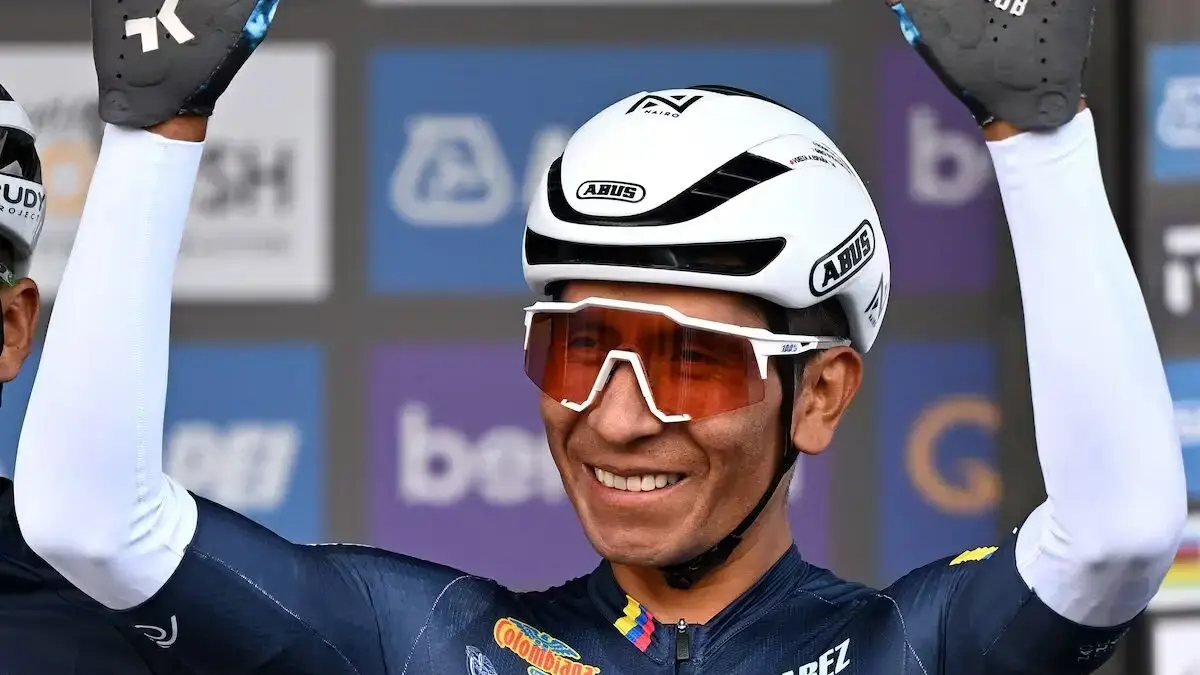
The international cycling community paused on October 3 to witness the end of an era. At the start line of the prestigious Giro dell’Emilia, Nairo Quintana—one of the most defining climbing talents of the 21st century—officially brought the curtain down on a glittering 17-year professional career.
Before the flag dropped for the race, a deeply emotional scene unfolded in the heart of the peloton. Peers, lifelong rivals, and longtime teammates formed a solemn yet celebratory guard of honor, raising their bicycles skyward to salute the Colombian climber. It was a rare, universal display of respect reserved only for the sport’s most transcendent figures.
The setting for this poignant farewell was far from accidental. It was precisely on the tortuous ramps of the Giro dell’Emilia, specifically on the iconic, punishing slopes of the San Luca climb, that a young, diminutive Quintana announced his arrival to European cycling back in 2012 by claiming a breakthrough victory. Fourteen years later, standing on the same Italian soil, the boy from Boyacá stepped off the professional stage, leaving behind a legacy as a trailblazer, a Grand Tour champion, and an idol to millions across Latin America and the globe.
Quintana’s retirement marks the definitive closing chapter of a generation of climbers who defined the golden age of modern Grand Tour racing. Over nearly two decades at the absolute summit of the sport, the Colombian not only amassed an astonishing palmarès but fundamentally shifted the geopolitical landscape of professional cycling, opening the floodgates for a new wave of South American talent in the WorldTour.
Chronology of a Career: From the Mountains of Boyacá to the Summits of Europe
To understand the magnitude of Nairo Quintana’s career, one must trace a path forged in the high-altitude landscapes of the Colombian Andes, where his journey began long before the television cameras and European contracts.
The Early Years and the European Breakthrough (2009–2012)
Born in Combita, Boyacá, Quintana grew up riding miles over mountainous terrain just to get to school. His raw physiological gifts for climbing were evident early on. After showing immense promise in the amateur ranks in Colombia, he turned professional in 2009 with the Café de Colombia-Colombia es Pasión team.
In 2012, he made the monumental leap to the UCI WorldTour with the Spanish powerhouse Movistar Team, managed by Eusebio Unzué—a partnership that would define the peak years of his career. It did not take long for the world to notice. His victory at the Giro dell’Emilia in 2012 served as a harbinger of things to come, proving that the young Colombian could suffer and conquer the steepest European bergs against seasoned veterans.
The Grand Tour Breakthrough and Historic Pink Glory (2013–2014)
Quintana’s Grand Tour debut came at the 2013 Tour de France. In what remains one of the most stunning neo-professional performances in modern cycling history, he finished second overall behind Chris Froome, secured three prestigious jersey classifications—the King of the Mountains and the Best Young Rider competitions—and etched his name into the sport’s collective consciousness with a breathtaking stage victory atop Annecy-Semnoz.
If 2013 introduced him to the world, 2014 immortalized him. Skipping the Tour de France to target the Giro Italia, Quintana weathered freezing temperatures, controversial neutralized descents over the Stelvio, and a grueling three-week test of attrition. He emerged victorious, pulling on the iconic Maglia Rosa in Trieste. With this triumph, he became the very first Colombian—and the first Latin American—ever to conquer the general classification of the Giro d’Italia, touching off nationwide celebrations in his homeland.
The Peak Rivalries and Tour de France Near-Misses (2015–2016)
The mid-2010s were defined by the titanic, high-altitude duels between Nairo Quintana and Team Sky’s Chris Froome. In the 2015 Tour de France, Quintana mounted a ferocious late-race charge in the Alps, launching a daring attack on Alpe d’Huez that left Froome clinging desperately to his yellow jersey. Quintana finished just 1:12 behind Froome in Paris, securing another hard-fought second-place finish. He repeated his podium dominance at the Tour the following year, taking third place in 2016.
Later that same season, Quintana channeled his Tour de France frustrations into the Vuelta a España. In a tactical masterclass across the Spanish mountains, he seized the red jersey and successfully defended it against a relentless Chris Froome, capturing his second career Grand Tour victory and cementing his status as one of the premier stage racers of his era.
Later Years, Resilience, and the Final Chapter (2017–2026)
As cycling evolved into a sport dominated by hyper-aerodynamic time-trialists and explosive, multi-surface puncheurs, Quintana’s pure, diesel-like climbing abilities faced new challenges. Despite shifting team dynamics and changing fortunes in the latter half of his career—including stints with Arkéa-Samsic and a triumphant return to Movistar—he never lost his competitive fire or his penchant for animating mountain stages.
His final seasons were characterized by resilience, leadership, and mentorship of younger riders, proving that his value to the sport extended far beyond results sheets. As he rolled out for the Giro dell’Emilia one last time, the cycle came full circle: beginning and ending on the hallowed slopes of San Luca.
Supporting Data: An Extraordinary Palmarès
Nairo Quintana leaves behind a statistical record that places him firmly among the elite tier of twentieth and twenty-first-century stage racers. His comprehensive palmarès reflects consistency, versatility across all three Grand Tours, and dominance in one-week WorldTour stage races.
Grand Tour Summary
- Giro d’Italia: 1x Overall Winner (2014) + General Classification podium finishes and stage wins.
- Vuelta a España: 1x Overall Winner (2016).
- Tour de France: 2x Runner-up (2013, 2015), 1x Third Place (2016), King of the Mountains classification winner (2013), Best Young Rider classification winner (2013), and 3 individual stage victories.
One-Week WorldTour Stage Races
Quintana was exceptionally lethal in mountainous week-long races, collecting a formidable collection of trophies:
- Tirreno-Adriatico: 2x Overall Champion (2015, 2017).
- Volta a Catalunya: Overall Champion (2016).
- Tour de Romandie: Overall Champion (2016).
- Vuelta al País Vasco (Itzulia Basque Country): Overall Champion (2013).
- Vuelta a Burgos: 2x Overall Champion.
Career Milestones
- Seasons in the Elite WorldTour: 17 years.
- Grand Tour Podium Finishes: 6 overall podiums across France, Italy, and Spain.
- Total Professional Victories: Over 50 professional wins, encompassing prestigious mountain stages, time trials, and overall classification titles.
Official Responses: Tributes from the Cycling World
The announcement and execution of Quintana’s retirement prompted an outpouring of emotion, respect, and gratitude from teammates, competitors, and governing bodies alike.
Eusebio Unzué, general manager of Movistar Team and the man who guided Quintana through his most successful years, reflected on the rider’s profound impact on the team and the sport:
"Nairo represents one of the most brilliant chapters in the history of our team and in the history of Latin American sport. Beyond his immense physical capabilities and his incredible victories in Italy and Spain, what we will remember most is his character, his humility, and the way he united an entire country behind a television screen. Seeing the peloton pay tribute to him today is a testament to the respect he earned every single day in the saddle."
Fellow competitors also took to social media and press microphones to voice their admiration. Competitors who once traded blows with him on the HC-rated climbs of the Alps and Pyrenees acknowledged the tactical depth and relentless tenacity he brought to the race.
In a heartfelt statement shared on digital platforms, the Colombian Cycling Federation noted:
"Nairo opened the doors of European cycling for generations of Colombian kids who dared to dream beyond our borders. He taught us how to suffer on the mountains and how to win with dignity. Today, Colombian cycling does not say goodbye to Nairo; we simply turn the page on an immortal legacy."
Implications: The Enduring Legacy of a Colombian Trailblazer
As Nairo Quintana hangs up his wheels for good, the implications of his retirement stretch far beyond the immediate shockwaves felt in the professional peloton. His career fundamentally altered the demographics, commercial landscape, and cultural perception of professional cycling.
Opening the Gates for Latin American Cycling
Before Quintana’s emergence as a consistent Grand Tour contender, Colombian cyclists were largely viewed as exotic anomalies—exceptional climbers capable of winning individual mountain stages, but rarely equipped to contend for three-week overall titles due to deficiencies in time-trialing and tactical consistency. Quintana shattered that stereotype.
By winning the Giro d’Italia and the Vuelta a España, and consistently challenging for the yellow jersey in France, he proved that a rider from the high-altitude towns of the Andes could master every single facet of modern stage racing. In his wake, a new generation of Colombian and Ecuadorian Grand Tour winners and contenders—such as Egan Bernal and Richard Carapaz—burst onto the WorldTour stage, standing directly on the shoulders of the path that Quintana carved out.
A Cultural Phenomenon
In Colombia, Quintana transcended the boundaries of sport. During the peak years of July, millions of Colombians woke up before dawn, transformed their daily routines, and gathered around televisions to watch "NairoMan" battle against the titans of European cycling. He became a symbol of national pride, resilience, and upward mobility. His success fostered a massive boom in cycling infrastructure, recreational riding, and youth development programs across South America.
The Evolution of the Climber Archetype
Tactically, Quintana helped redefine how teams approach high-mountain stages. His willingness to launch long-range, audacious attacks from dozens of kilometers out forced teams with superior time-trial squads to rethink conservative racing strategies. Even as the sport evolved into a data-driven, hyper-calculated discipline, Quintana retained a romantic, instinctual style of racing that resonated deeply with purists.
What Lies Ahead
While Quintana’s days of pinning a number to his jersey and suffering through the freezing rain of a mountain stage are officially over, his relationship with the sport is unlikely to sever completely. Whether through mentoring young talent in Colombia, advocating for sports development, or serving as an ambassador for the sport he helped shape, his influence will be felt for decades to come.
As the sun sets on his illustrious 17-year career, the image of the peloton lifting their bikes in unison at the Giro dell’Emilia will endure as the definitive image of a champion’s farewell—a fitting tribute to a quiet titan who scaled the highest peaks of world cycling and left the sport permanently transformed.

Leave a Reply