

Main Facts
Colombia stands today at a precarious political crossroads, defined by rapid ideological shifts, institutional erosion, and deep societal fatigue. In his latest book, La democracia fatigada ("Fatigued Democracy"), veteran statesman, former minister, constituent assembly member, and chief peace negotiator Humberto de la Calle diagnoses the structural decay of contemporary democratic systems. He argues that the rise of unconventional political figures is not an anomaly, but rather the predictable symptom of a political ecosystem exhausted by polarization, institutional distrust, and widening socio-economic divides.
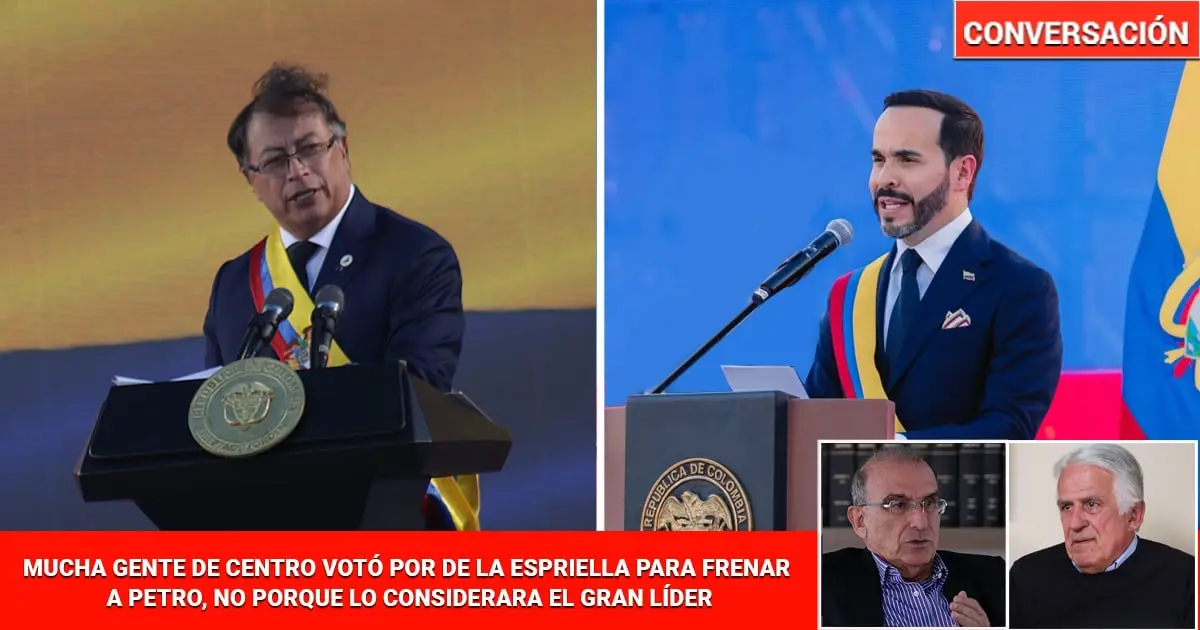
The core catalyst for De la Calle’s recent reflections is the dramatic pendulum swing in the nation’s highest office: the rapid transition from Gustavo Petro—Colombia’s first leftist president—to the election of right-wing populist figure Abelardo de la Espriella, colloquially referred to in political circles as "El Tigre." In a span of just four years, the Colombian electorate lurched from an unprecedented progressive experiment promising social transformation to a hardline conservative alternative anchored in promises of absolute order, authority, and uncompromising governance.
This transition highlights a profound crisis within the political center. Once heralded in pre-election polling as the dominant sentiment of a moderate majority, the political center was systematically crushed between two expanding ideological poles during the recent electoral cycle. Today, Gustavo Petro acts as the consolidated leader of a mobilized opposition, serving as the unifying glue for a leftist coalition that has rarely experienced such cohesion. Meanwhile, the ascendant right has captured power but is already showing internal fractures, characterized by early confrontations with traditional business federations (gremios) and the media within weeks of taking office.
This article explores the depth of Colombia’s institutional crisis through the lens of De la Calle’s analysis, examining the chronological trajectory of the nation’s political polarization, the underlying socio-economic data fueling voter frustration, the official and institutional responses to this shifting landscape, and the long-term systemic implications for Latin America’s oldest continuous democracy.
Chronology of a Political Earthquake: From the Peace Accords to "El Tigre"
To understand how Colombia arrived at the doorstep of its current political reality, it is necessary to trace the rapid unraveling and reconfiguration of the nation’s power structures over the past decade.
1. 2016–2018: The Peace Dividend and the Birth of Deep Polarization
The signing of the historic peace agreement between the Colombian government and the Revolutionary Armed Forces of Colombia (FARC)—a process heavily steered by Humberto de la Calle—was meant to inaugurate a post-conflict era focused on social reform, regional integration, and institutional strengthening. Instead, the plebiscite of 2016 exposed a deeply fractured country. The narrow defeat of the accord at the polls (subsequently modified and pushed through Congress) laid bare an electorate susceptible to narratives of fear, historical grievances, and anti-establishment sentiment. This laid the groundwork for the 2018 election of Iván Duque, backed by right-wing strongman Álvaro Uribe, which effectively paused the progressive implementation of the peace deal.
2. 2019–2022: Social Strains, Pandemics, and the Rise of Petro
Frustration with traditional governance boiled over during the national strikes (paros nacionales) of 2019 and 2021. Amplified by the socioeconomic shocks of the COVID-19 pandemic, millions of Colombians took to the streets to demand systemic changes in education, taxation, and labor rights. The traditional political parties, viewed as out of touch and corrupt, suffered a severe loss of legitimacy. Capitalizing on this widespread discontent, Gustavo Petro united disparate progressive movements, anti-establishment figures, and regional discontent to win the 2022 presidential runoff. For the first time in modern history, the left captured the Casa de Nariño, promising sweeping reforms in healthcare, pension systems, and environmental policy.
3. 2022–2026: The Progressive Administration and Institutional Friction
Petro’s tenure was marked by relentless friction. While his administration attempted structural overhauls to address historical inequalities, it faced fierce resistance from a hostile Congress, conservative judicial checks, skeptical financial markets, and powerful economic elites. Key legislative reforms stalled or were watered down, and internal cabinet turnover generated an image of administrative chaos. Polarization intensified daily, with the administration frequently using social media and public mobilizations to bypass traditional institutional checks and attack critical media outlets.
4. 2026: The Pendulum Swings Back and the Rise of "El Tigre"
Exhausted by years of ideological confrontation, economic uncertainty, and administrative turbulence, the Colombian electorate reacted predictably. The pendulum swung sharply back to the right with the election of Abelardo de la Espriella ("El Tigre"). Running on an uncompromised platform of law, order, and aggressive economic deregulation, the new president secured a narrow victory. However, he inherited a deeply divided nation. With modest public approval ratings at the outset of his mandate, the new administration immediately opened adversarial fronts with national business syndicates and journalistic institutions, signaling that the era of institutional conciliation remains a distant dream.
Supporting Data: The Anatomy of a Fatigued Democracy
Humberto de la Calle’s thesis regarding a "fatigued democracy" is supported by extensive empirical data concerning institutional trust, economic anxiety, and social polarization in Colombia and the broader Latin American region.
Institutional Confidence Deficit
According to recent Latinobarómetro and local polling data (such as Invamer and Cifras & Conceptos), trust in traditional democratic institutions has plummeted to historic lows in Colombia:
- Political Parties: Less than 12% of Colombians express trust in political parties, consistently ranking them among the least trusted institutions in the country.
- Congress: Legislative approval ratings hover below 20%, reflecting widespread public perception that lawmakers prioritize partisan interests over constituent welfare.
- The Judiciary: While historically viewed as a more resilient branch, public confidence in the justice system fluctuates heavily depending on high-profile political rulings, averaging around 30% to 35%.
Economic Pressures and Inequality
Despite periods of macroeconomic growth, structural inequality remains a persistent wound in Colombian society:

- The Gini Coefficient: Colombia consistently ranks as one of the most unequal nations in Latin America and the OECD, with wealth concentration heavily skewed toward urban centers and elite networks.
- Informality: Informal labor markets account for roughly 55% to 60% of the economically active population, leaving millions of citizens without social security, pensions, or stable legal protections. This precarity makes working-class voters highly receptive to populist messaging, whether from the radical left or the nationalist right.
The Erosion of the Center
Polling trends leading up to the 2026 election highlighted the collapse of the political center. In 2021 and early 2022, centrist and independent coalitions captured upwards of 40% of prospective voter preference in theoretical matchups. However, as the electoral machinery of the polarization extremes (Petro’s progressive coalition versus the consolidating right) ramped up, voters engaged in strategic or defensive voting. The center’s distinct programmatic voice was drowned out, resulting in a binary choice that forced moderates to hold their noses and vote for the lesser of two perceived evils.
Official Responses and Perspectives
The publication of La democracia fatigada and the subsequent public dialogue between Humberto de la Calle and fellow statesman Juan Manuel Ospina have triggered intense reactions across the Colombian political spectrum.
The Moderate and Institutionalist Perspective
De la Calle and Ospina argue that the root cause of Colombia’s political instability is the systemic failure of the ruling class to address structural inequalities before they manifest as populist uprisings. In their discussions, De la Calle emphasizes that liberal democracy cannot survive as a mere procedural ritual when millions of citizens feel excluded from economic progress and physical security. He warns that when democratic institutions fail to deliver tangible public goods—such as quality education, healthcare, and safety—citizens naturally gravitate toward messianic figures who promise simple solutions to complex systemic failures.
The Leftist Opposition Perspective
Defenders of the previous leftist administration view the rise of "El Tigre" as a reactionary pushback orchestrated by traditional economic elites and entrenched political cartels terrified of losing their historic privileges. Figures aligned with Petro’s movement argue that their time in office was sabotaged precisely because they attempted to dismantle an unjust socioeconomic model. From this viewpoint, the current right-wing administration is interpreted as an authoritarian regression aimed at rolling back environmental protections, labor rights, and social investments secured during the progressive era.
The Right-Wing and Populist Perspective
Supporters of the newly installed conservative government counter that the progressive experiment brought Colombia to the brink of institutional collapse, economic stagnation, and public insecurity. From the perspective of the new administration’s allies, the decisive victory of "El Tigre" represents a mandate from citizens demanding order, economic pragmatism, and a decisive end to ideological governance. They defend the new president’s early confrontations with the media and business federations as a necessary disruption of cozy establishment pacts that have historically paralyzed effective governance.
Implications for the Future of Colombian Democracy
The convergence of historical grievances, systemic institutional fatigue, and rapid ideological oscillations carries profound implications for the future of the Colombian state.

1. The Normalization of Hyper-Polarization
When a political system swings from a historic left-wing presidency to a hardline right-wing populist within a single electoral cycle, polarization ceases to be a temporary campaign tactic; it becomes the permanent operating environment of the state. Governing by consensus becomes nearly impossible when every administration views its predecessor’s policies as an existential threat to be dismantled rather than refined.
2. The Vulnerability of Checks and Balances
As observed in other Latin American nations experiencing democratic erosion (such as Peru, Ecuador, and Venezuela historically), the constant friction between the executive branch, the legislature, and the judiciary weakens the institutional architecture designed to protect minority rights and public transparency. If the newly installed right-wing government continues its early trajectory of hostile relations with independent bodies, civil society, and the press, Colombia risks entering a cycle of low-intensity institutional warfare.
3. The Crisis of Representation
The eclipse of the political center leaves large segments of the population politically homeless. Moderates, technocrats, and citizens who value institutional stability over ideological crusades find themselves politically marginalized. Without a coherent, programmatic center capable of articulating social grievances without resorting to populist demagoguery, the political arena remains vulnerable to continuous shocks and populist volatility.
4. A Warning for the Region
Colombia has long prided itself on having one of the oldest, most resilient constitutional democracies in Latin America, having avoided the military dictatorships that plagued its neighbors in the 20th century. However, as Humberto de la Calle cogently argues in La democracia fatigada, modern democracies do not usually fall to dramatic military coups; rather, they rot from within, exhausted by cynicism, inequality, and the failure of democratic institutions to respond to the basic needs of their people.
Ultimately, the rise of "El Tigre" and the turbulent legacy of the Petro administration serve as a stark reminder: unless Colombia’s political class undertakes deep, structural reforms to restore institutional trust and bridge the chasm of inequality, the democratic pendulum will continue to swing wildly, threatening to shatter the glass of a weary republic.


Leave a Reply