

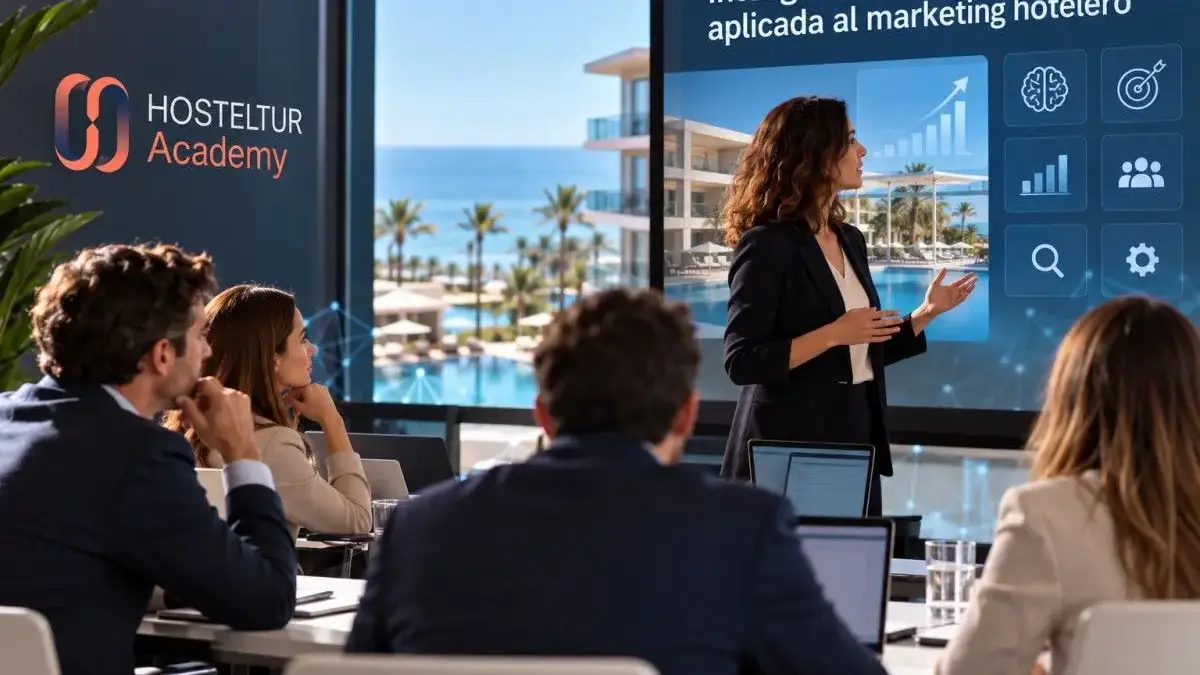
MADRID — In an era where digital transformation dictates the survival and prosperity of the global tourism sector, Hosteltur Academy officially launched the inaugural edition of its Executive Program in Artificial Intelligence Applied to Hotel Marketing, with a Focus on Revenue Management. Commencing today, October 15, this intensive educational initiative arrives at a critical juncture for the hospitality industry, as hoteliers worldwide grapple with the profound disruptions and unprecedented opportunities presented by artificial intelligence (AI).
Designed to bridge the gap between theoretical technology and pragmatic commercial strategy, the program spans 50 hours of rigorous learning, distributed across 21 live sessions. It brings together an elite cohort of executives from prominent hotel chains, boutique properties, and specialized tourism businesses, guided by a distinguished faculty of more than 20 active industry and technology professionals. Co-directed by Oliver Espinosa and Laura Laiz, Director of Hosteltur Academy, the program is engineered to redefine how lodging establishments attract guests, manage distribution networks, optimize dynamic pricing, and hyper-personalize the modern guest experience.
1. Main Facts: Redefining Commercial Strategy Through AI
The core premise of Hosteltur Academy’s new executive training is encapsulated in a powerful guiding philosophy shared by its creators:
"We do not teach artificial intelligence. We teach commercial intelligence supported by artificial intelligence."
This distinction is vital. Rather than focusing on the technical coding or backend architecture of AI models, the curriculum concentrates on strategic execution. It addresses the most pressing commercial challenges facing modern hoteliers through real-world case studies, live software demonstrations, and direct peer-to-peer insights from active industry leaders.
Key Pillars of the Curriculum:
- Customer Intelligence & CRM: Harnessing predictive analytics to understand consumer behavior, lifetime value, and micro-segmentation.
- Distribution and OTA Management: Navigating complex relationships with Online Travel Agencies while maximizing margins.
- Direct Channel Optimization: Leveraging AI-driven content, user experience design, and personalization to drive high-value direct bookings.
- Digital Advertising & Generative SEO: Adapting to the evolution of search engines, including generative AI search (SGE), and optimizing paid media spend through machine learning.
- Revenue Management: Integrating demand forecasting, dynamic pricing algorithms, and inventory control with broader marketing initiatives.
The program’s ultimate deliverable is highly practical: every participating executive will craft a customized roadmap for applying artificial intelligence to their organization’s commercial strategy, enabling them to identify immediate implementation opportunities and prioritize long-term tech investments.
2. Chronology: The Road to the Inaugural Edition
The launch of this pioneering executive program is the culmination of months of meticulous market research, curriculum design, and faculty recruitment by Hosteltur Academy.
- Q1–Q2 2024 (Market Identification): Recognizing that traditional hotel marketing and revenue management silos were becoming obsolete in the face of rapid generative AI advancements, Hosteltur Academy began conceptualizing a cross-disciplinary training framework. Industry surveys highlighted a growing anxiety among executives regarding technological obsolescence juxtaposed with a lack of actionable educational resources tailored specifically to hospitality.
- Q3 2024 (Faculty Assembly and Curricular Refinement): Co-directors Oliver Espinosa and Laura Laiz curated a multidisciplinary faculty. Moving away from purely academic instructors, they recruited over 20 frontline practitioners actively managing data, technology, marketing, and revenue strategies within major hotel groups and travel tech firms.
- Late Q3 2024 (Executive Recruitment): Admissions were opened selectively to ensure a high-caliber student body. The response was swift, attracting C-suite executives, directors, and senior managers from diverse lodging segments.
- October 15, 2024 (Official Launch): The program officially kicks off its first live session, marking the beginning of a transformative multi-week educational journey.
- Post-Program Phase (October 2024 and Beyond): Hosteltur Academy has announced plans to publicly share core themes, key learnings, and industry insights derived from the sessions through a series of dedicated articles, ensuring that the broader tourism community benefits from the knowledge generated during the course.
3. Supporting Data: The Profile of the Modern Hospitality Executive
The success of any executive education program relies heavily on the caliber of its participants. The inaugural cohort of the Executive Program in Artificial Intelligence Applied to Hotel Marketing boasts an exceptionally high-level professional profile, reflecting the complex, multifaceted nature of contemporary hospitality management.
Student Demographics and Responsibilities:
The student body encompasses senior decision-makers from a wide array of sectors within the tourism industry, including:
- Major international and domestic hotel groups
- Independent, unique, and boutique lodging establishments
- Specialized tourism and travel tech enterprises
Their day-to-day organizational responsibilities span critical commercial domains:
- Marketing and Corporate Communications:
- Sales and Business Development:
- Distribution and E-commerce Management:
- Revenue Management and Pricing Strategy:
- Business Intelligence (BI) and Data Analytics:
- Guest Experience and Customer Relationship Management (CRM):
This diversity of roles creates a dynamic, multi-dimensional learning environment. Rather than operating in isolated departmental silos, participants are encouraged to debate, collaborate, and synthesize solutions to shared industry challenges. By bringing together marketing directors and revenue managers in the same virtual classroom, Hosteltur Academy dismantles traditional organizational barriers, fostering a holistic approach to commercial leadership.
4. Official Responses and Leadership Insights
The leadership behind the program emphasizes that the integration of artificial intelligence is no longer an optional luxury for hotels seeking marginal gains, but a fundamental prerequisite for long-term viability in a hyper-competitive global marketplace.
Co-directors Oliver Espinosa and Laura Laiz designed the curriculum to address a glaring gap in executive education: the tendency for technology courses to focus on abstract engineering concepts rather than tangible business outcomes.
"The hospitality sector is sitting on unprecedented volumes of data, yet many organizations struggle to translate that data into profitable commercial decisions," notes the academic direction team. "By uniting more than 20 active industry experts with a cohort of top-tier executives, we are creating a unique sandbox where AI ceases to be a buzzword and becomes a concrete engine for profitability, direct channel growth, and enhanced guest satisfaction."
Industry observers have similarly praised the program’s multidisciplinary focus. As consumer expectations shift toward hyper-personalized travel experiences—and as digital distribution channels become increasingly automated through algorithmic bidding and generative search engines—hotel leaders must fundamentally rethink how they allocate marketing budgets and forecast demand.
5. Implications: Transforming Hospitality Competitiveness and Profitability
The launch of Hosteltur Academy’s AI and Revenue Management program carries profound implications for the broader travel and tourism ecosystem. As the first cohort embarks on its 50-hour journey, the ripple effects of this education are expected to manifest across several key dimensions:
Breaking Down Silos Between Marketing and Revenue Management
Historically, hotel marketing departments and revenue management teams have operated with distinct key performance indicators (KPIs)—often resulting in friction. Marketing focuses on top-of-funnel acquisition, brand awareness, and volume, while revenue management prioritizes yield, average daily rate (ADR), and total revenue per available room (TRevPAR). Artificial intelligence acts as the ultimate unifying force. By processing consumer intent data alongside predictive demand forecasting, AI allows marketers to target high-value guest segments at the exact moment dynamic pricing models dictate optimal inventory availability. The program trains executives to govern this convergence effectively.
Enhancing Direct Channel Competitiveness
With high commissions paid to Online Travel Agencies (OTAs) continuing to squeeze profit margins, independent hotels and large chains alike are desperate to reclaim ownership of the customer relationship. AI-powered personalization engines, conversational chatbots, and predictive CRM tools enable hotels to offer bespoke experiences and loyalty incentives that rival platforms cannot match. The strategic roadmap developed by participants will provide actionable blueprints for reducing OTA dependency and boosting direct web conversions.
Navigating the Shift to Generative Search
The digital discovery landscape is undergoing its most radical transformation since the advent of the mobile internet. Traditional search engine optimization (SEO) is rapidly giving way to generative engine optimization (GEO), where AI-driven platforms like ChatGPT, Google’s Search Generative Experience, and specialized travel assistants provide synthesized answers rather than a list of blue links. Hotel marketers must adapt their content strategies to remain visible to these AI agents. Hosteltur Academy’s curriculum prepares executives to navigate this algorithmic shift proactively.
Future Outlook and Industry Accessibility
Recognizing that the entire tourism sector must evolve to maintain global competitiveness, Hosteltur Academy has committed to democratizing parts of this educational experience. By publishing ongoing articles, case studies, and strategic reflections derived from the inaugural edition over the coming weeks, the institution ensures that the lessons learned within the executive classroom extend far beyond its enrolled participants.
For industry professionals seeking to future-proof their operations, understand upcoming cohort dates, or review the comprehensive syllabus, further information remains available directly through the Hosteltur Academy Official Portal.
As artificial intelligence continues to reshape the contours of global hospitality, initiatives like this executive program ensure that industry leaders are not merely reacting to technological disruption, but actively steering it toward sustainable growth and profitability.


Leave a Reply