

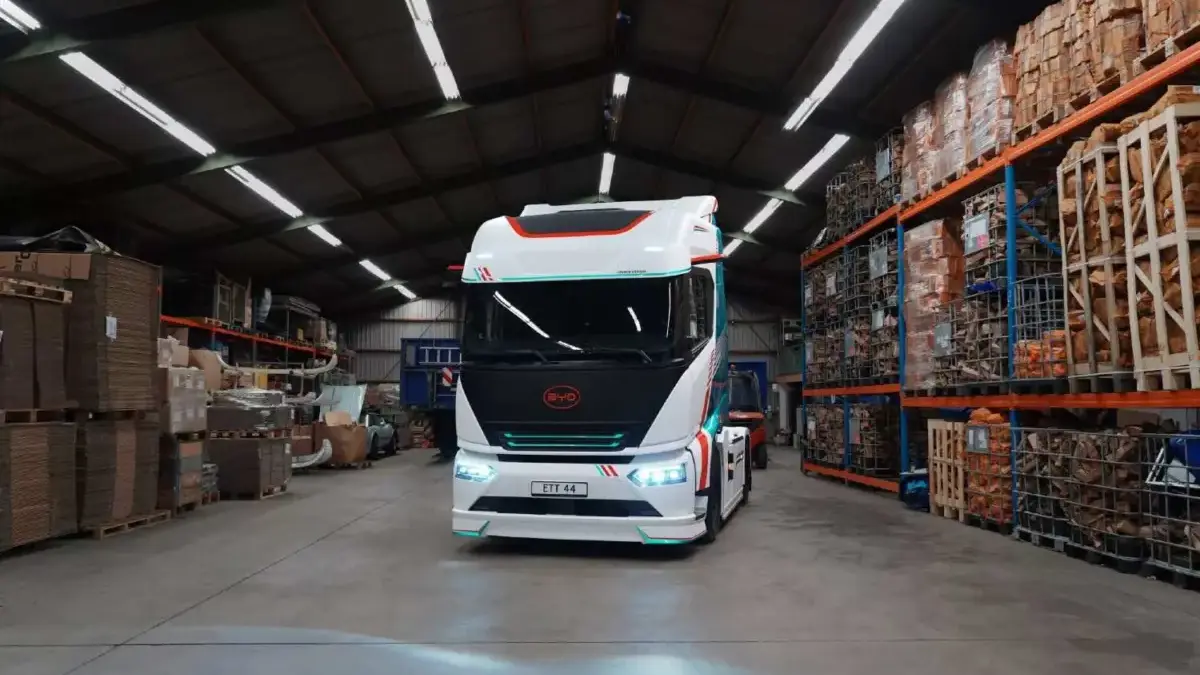
HANNOVER, Germany — The global automotive juggernaut BYD is no stranger to disruption. Having firmly established its dominance in the passenger electric vehicle (EV) market with staggering global sales figures, the Chinese giant has officially set its sights on a much heavier target: the European commercial transport sector.
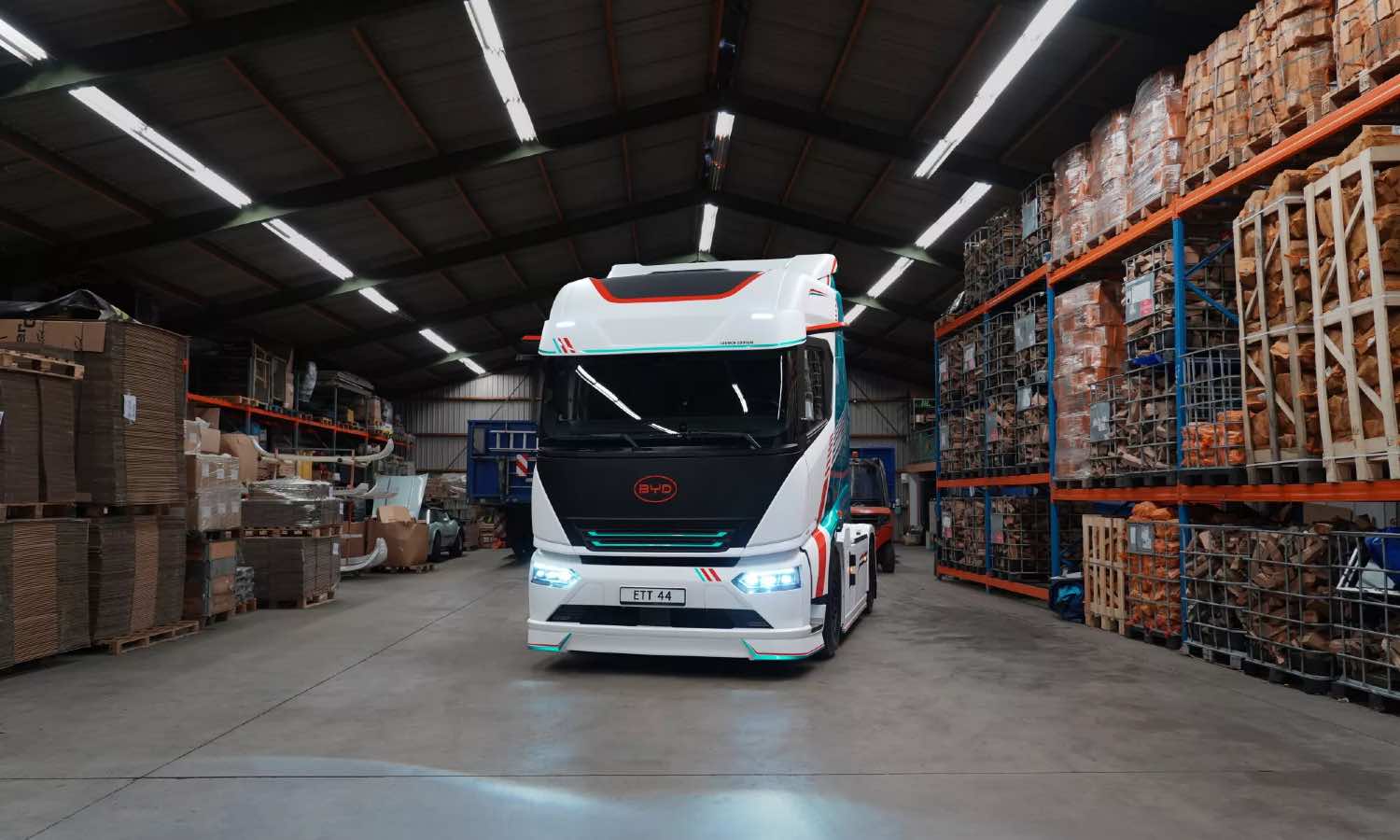
Making a definitive statement of intent at the prestigious IAA Transportation 2026 trade fair held in Hannover, Germany, BYD unveiled its crown jewel for the logistics industry—the ETT 44 electric heavy-duty tractor. This is not merely an experimental concept or an urban delivery van scaled up. The ETT 44 has been engineered from the ground up to go toe-to-toe with the most powerful diesel-powered long-haul trucks currently dominating European highways, introducing a suite of technologies that threaten to rewrite the rulebook for cross-border freight and heavy cargo logistics.
1. Main Facts: The Anatomy of a Heavyweight Electric Challenger
The ambition behind BYD’s European commercial offensive is clear from the vehicle’s technical blueprint. The ETT 44 is configured as a 4×2 heavy-duty tractor unit, engineered specifically to haul combined train weights of up to 44 metric tons—the gold standard and legal maximum for long-distance articulated semi-trailers across the European Union.
What truly separates the ETT 44 from legacy internal combustion engine (ICE) trucks and early-generation electric alternatives is its unprecedented powertrain and energy storage metrics:
- Massive Energy Storage: At the heart of the vehicle lies BYD’s proprietary Blade Battery technology utilizing Lithium Iron Phosphate (LFP) chemistry, packing an enormous 651 kWh of total energy capacity.
- Exceptional Range: Despite tipping the scales at over 10 metric tons unladen, the truck delivers an EPA-equivalent and WLTP-certified driving range of up to 600 kilometers (373 miles) on a single charge.
- Staggering Power Output: The electric driveline delivers a continuous nominal power rating of 743 horsepower, but is capable of unleashing a staggering 1,000 horsepower of peak performance under high-demand scenarios, such as tackling steep mountain passes or maintaining momentum on highway inclines.
- Megawatt-Level Charging Speeds: Leveraging the cutting-edge Megawatt Charging System (MCS) standard, the ETT 44 supports ultra-fast charging inputs of up to 1.5 megawatts (MW). This capability shatters previous charging bottlenecks, rocketing the battery state-of-charge from 20% to 80% in roughly 20 minutes, thereby replenishing up to 400 kilometers of driving range in the time it takes a driver to take a mandated rest break.
2. Chronology: The Road to Hannover 2026
BYD’s ascent into the European heavy commercial vehicle (HCV) market is the result of a calculated, multi-year strategic rollout rather than an overnight pivot.
- Pre-2023: Foundation in Public Transit: BYD initially built its footprint in European commercial sectors through electric buses and municipal fleet vehicles, establishing manufacturing and assembly footprints in countries like Hungary and France.
- 2023–2024: The Passenger Car Boom: While solidifying its commercial presence, BYD launched a blitzkrieg in the European passenger car market, introducing models like the Atto 3, Seal, and Dolphin. This built crucial brand equity, regulatory familiarity, and supply chain resilience across the continent.
- 2025: Specialized Industrial Expansion: BYD began testing localized heavy-duty utility trucks and port tractors (such as the T-series variants) in select European logistics hubs, quietly gathering real-world telemetry data regarding European road conditions, weather patterns, and grid constraints.
- September 2026 (IAA Transportation, Hannover): The watershed moment. BYD officially takes the wraps off the ETT 44 alongside its broader commercial ecosystem, marking its formal entry into the fiercely competitive European long-haul trucking sector.
3. Supporting Data: Redefining Fleet Economics and Infrastructure
The viability of heavy electric trucking has long been debated by fleet operators concerned about payload penalties, charging downtime, and total cost of ownership (TCO). BYD’s technical specifications directly address these pain points.
| Metric / Feature | BYD ETT 44 Specification | Industry Benchmark (Traditional Diesel / Early EVs) |
|---|---|---|
| Gross Combination Weight (GCW) | Up to 44 metric tons | 40–44 metric tons (Diesel standard) |
| Battery Capacity | 651 kWh (LFP Blade Battery) | 300–500 kWh (Older electric trucks) |
| Maximum Range (WLTP) | Up to 600 km | 300–450 km |
| Peak Power Output | ~1,000 HP | 400–500 HP (Average heavy diesel) |
| Maximum Charging Power | Up to 1.5 MW (MCS compatible) | 350 kW – 420 kW (Standard CCS) |
| 20%–80% Charge Time | ~20 minutes (via Megawatt charger) | 60–90 minutes |
| Battery Warranty | 10 years or 1.2 million kilometers | 5–8 years / 500,000–800,000 km |
To put the charging speed into perspective, a conventional high-power industrial charger operating at 420 kW requires approximately 60 minutes to bring an equivalent battery from 20% to 80%. By accelerating this process to 20 minutes via MCS, BYD drastically minimizes fleet downtime, aligning perfectly with European Union driver-rest regulations (which mandate a 45-minute break after 4.5 hours of driving).
Beyond raw performance, BYD is offering an unprecedented battery warranty of 10 years or 1.2 million kilometers. This extraordinary coverage directly mitigates residual value concerns—historically one of the primary hurdles for fleet managers hesitant to adopt unproven commercial EV technologies. Furthermore, the ETT 44 is engineered to conquer severe gradients of up to 25%, ensuring absolute operational reliability across challenging topography like the Alps or the Pyrenees, with a top speed electronically capped at the European legal limit of 90 km/h.
4. Official Responses and Industry Reception
The unveiling of the ETT 44 at the Hannover exhibition sent immediate shockwaves through an industry traditionally dominated legacy European manufacturers such as Mercedes-Benz (Daimler Truck), Volvo, Scania, and MAN.
Speaking at the launch event, senior representatives from BYD’s commercial vehicle division emphasized that the company’s arrival in Europe is built on holistic solutions rather than hardware alone.
"We are not merely selling trucks; we are delivering an entire paradigm shift in heavy logistics," said a senior BYD spokesperson during the global press conference. "European transport operators demand uncompromising reliability, payload capacity, and uptime. With the ETT 44, backed by our revolutionary Blade Battery technology and unprecedented megawatt charging compatibility, we are proving that zero-emission long-haul transport is no longer a distant aspiration—it is a commercially viable reality available today."
Industry analysts at the event noted that legacy European truck makers, many of whom are currently navigating their own transitions to battery-electric and hydrogen fuel-cell technologies, now face an aggressive, vertically integrated competitor capable of scaling production at a velocity rarely seen in Western industrial sectors.
5. Implications: A Holistic Ecosystem and the Future of Logistics
What makes BYD’s European push particularly formidable is its adoption of a comprehensive business model termed Total Cost of Mobility. Recognizing that an electric truck is only as good as the infrastructure supporting it, BYD is positioning itself as a one-stop-shop provider for logistics enterprises.
A Comprehensive Commercial Lineup
Alongside the flagship ETT 44, BYD showcased a versatile portfolio of commercial vehicles ranging from 3.5 to 44 metric tons. This includes:
- T020 and T028 models: Tailored specifically for regional distribution, urban logistics, and municipal utility applications.
- Terminal tractors: Designed for high-intensity port and logistics hub operations.
The Energy Ecosystem
BYD’s strategy extends far beyond vehicle sales. By leveraging its deep roots in battery manufacturing, the company offers a vertically integrated ecosystem that includes:
- Proprietary LFP battery architecture.
- Megawatt-scale charging infrastructure solutions.
- Commercial energy storage systems (ESS) for logistics depots.
- Tailored financial and leasing services designed to absorb initial capital expenditure fears.
Implications for the Spanish and European Markets
For logistics markets like Spain, where corporate decarbonization mandates and European Green Deal targets are tightening regulatory screws on heavy transport, the arrival of the ETT 44 could prove transformative. Spain’s vast network of long-haul corridors connecting industrial hubs to ports makes it an ideal testing ground for high-capacity electric trucks—provided that the deployment of megawatt charging corridors along major trans-European transport networks (TEN-T) accelerates as planned.
If charging infrastructure continues to scale in tandem with vehicles like the ETT 44, industry experts predict that fleet operators will increasingly abandon diesel out of pure economic necessity. By combining hyper-fast charging, monumental power, and class-leading component warranties, BYD has firmly signaled that its ambitions in Europe extend far beyond passenger cars—it intends to electrify the very backbone of continental trade.

Leave a Reply