

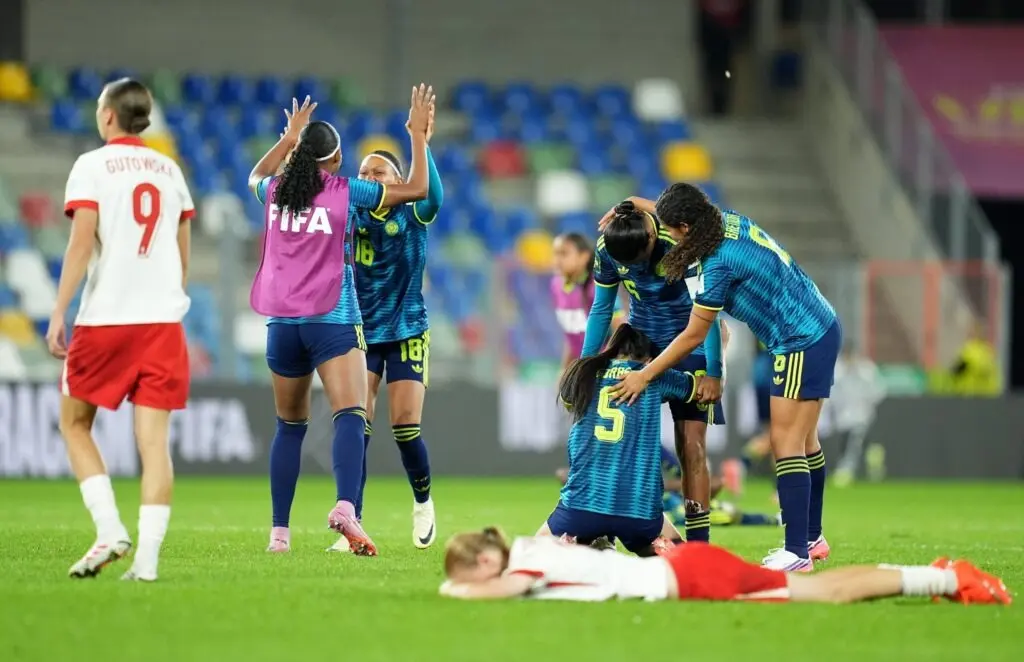
BOGOTÁ / WARSAW — In a dramatic display of defensive discipline, tactical fortitude, and unyielding psychological resilience, the Colombia women’s Under-20 national team etched another golden page into the history of the nation’s footballing evolution.
Securing a hard-fought, heart-stopping 1-0 victory over tournament hosts Poland, the Tricolor advanced to the quarterfinals of the FIFA U-20 Women’s World Cup. Played in front of a passionate, hostile crowd that packed the stadium to capacity in support of the European side, the match proved to be a grueling chess match where every square inch of turf was fiercely contested.
With this milestone achievement, head coach Carlos Paniagua’s squad has accomplished a feat of unprecedented consistency for Colombian youth football: reaching the elite top-eight bracket of the global tournament for the second consecutive edition. This victory is not merely a single-game triumph; it is a testament to the structural growth, systemic strengthening, and escalating competitiveness of women’s football across the Andean nation.
As the final whistle blew in Poland, sealing the fate of a resilient Polish side via a dramatic late own goal, celebrations erupted from the streets of Bogotá and Cali all the way to the team’s hotel in Europe. Yet, for the players and coaching staff, the jubilation was immediately tempered by the sobering reality of elite competition: the journey does not stop here. Standing between Colombia and a historic spot in the tournament semifinals is a formidable powerhouse, the national team of Nigeria, set to clash with the Tricolor on Sunday, September 20.
Main Facts
The fixture between Colombia and Poland will be remembered as one of the most tense, physically demanding, and strategically executed matches of the tournament’s knockout stages.
The primary headline of the encounter is, of course, the final scoreline: a 1-0 victory in favor of the South Americans, secured in the dying embers of regular time at the 89th minute. The decisive play materialized down the left flank through the relentless energy of substitute Mariana Silva, whose penetrating run and subsequent cross-shot forced Polish defender Martyna Bartczak into a panicked clearance that inadvertently redirected the ball past her own goalkeeper, sending the traveling Colombian contingent and millions watching back home into sheer ecstasy.
However, reducing the narrative of the match solely to a late defensive mistake would be a profound disservice to the tactical masterclass orchestrated by both teams.
- The Score: Poland 0 – 1 Colombia
- The Decisive Moment: Own goal by Martyna Bartczak (89′)
- Tournament Milestone: Second consecutive U-20 World Cup quarterfinal appearance for Colombia.
- Standout Performer: Luisa Agudelo (Goalkeeper), whose exceptional shot-stopping kept Colombia alive during relentless Polish onslaughts in both halves.
- Next Opponent: Nigeria, scheduled for Sunday, September 20, at 8:00 AM (Colombia time).
Throughout the match, the statistical run of play heavily favored the home side in terms of possession and territorial dominance, particularly in the opening phases of both halves. Poland launched wave after wave of attacks, utilizing their physical prowess and high-pressing schemes to pin the South Americans deep into their own defensive third. Yet, what the Tricolor lacked in possession percentage, they compensated for with tactical compactness, spatial awareness, and a masterclass in defensive resilience.
Chronology of the Match
First Half: Surviving the Early Storm
From the opening blast of the referee’s whistle, it was abundantly clear that Poland intended to leverage the deafening support of their home crowd to overwhelm the visitors. The European side burst out of the blocks with blistering intensity, pressing high up the pitch and forcing Colombia into hurried clearances and uncharacteristic turnovers in the midfield.
During the opening fifteen minutes, the game was played almost exclusively in Colombia’s defensive third. Poland’s wingers exploited the flanks, sending dangerous crosses into the box that tested the organizational integrity of the central defensive partnership. Time and again, the white shirts of Poland found openings, only to be systematically denied by a combination of last-ditch sliding tackles and the commanding presence of Colombian goalkeeper Luisa Agudelo.
Agudelo, displaying maturity well beyond her years, commanded her penalty area with absolute authority. She punched away dangerous corner kicks, smothered low crosses, and made two crucial reflex saves in the 7th and 12th minutes that silenced the roaring home crowd and settled the nervous energy of her teammates.
As the frantic opening storm subsided, Colombia began to find their tactical footing. The midfield anchor started to string consecutive passes together, easing the relentless pressure.
Then, at the 18-minute mark, the Tricolor manufactured their first clear-cut scoring opportunity of the match. A fluid transition from defense to attack caught the Polish defense shifting out of position. Valerin Loboa, finding a pocket of space just outside the penalty arc, received a crisp diagonal pass. With time to steady herself, Loboa unleashed a curling effort that beat the sprawling Polish goalkeeper, only to agonizingly skim past the outside of the left goalpost.
Though the shot missed its target, the psychological impact was immediate. It served as a stark warning to the hosts that Colombia could not be pinned back indefinitely without paying a heavy defensive price. The remainder of the first half settled into a tense, tactical arm-wrestle, with neither side willing to overcommit men forward, sending the teams into the locker rooms deadlocked at 0-0.
Second Half: The Tactical Chess Match and the Dramatic Climax
If the first half was characterized by early Polish pressure followed by a Colombian response, the second half began as an exact carbon copy of the opening stanza.
Poland emerged from the interval with renewed vigor, launching an aggressive assault on the Colombian goal. For the first twenty minutes of the half, the hosts penned Colombia deep into their own territory. The South American side, visibly fatigued and perhaps subconsciously managing their energy reserves with the looming possibility of extra time, appeared content to absorb the pressure, maintain their structural integrity, and frustrate the European attackers.
As the clock ticked past the hour mark, head coach Carlos Paniagua began utilizing his bench, introducing fresh legs to inject dynamism into the midfield and restore the team’s ability to transition into attack. Substitutions such as Mariana Silva brought a renewed sense of urgency. Slowly but surely, the Tricolor began to push higher up the pitch, carving out half-chances and winning crucial free-kicks in the attacking third to relieve the suffocating defensive pressure.
However, as regulation time wound down into its final ten minutes, the specter of extra time loomed large over the pitch. Both teams looked increasingly leg-weary, and the pace of the game began to slow as players battled not just their opponents, but the crushing weight of exhaustion. Most observers inside the stadium were mentally preparing for thirty additional minutes of nervy, extra-time football.
Football, however, is a game defined by micro-moments and relentless persistence.
At the 89th minute—with the fourth official preparing to display the stoppage-time board—Colombia launched one final, desperate foray down the left channel. Mariana Silva received the ball near the touchline, utilized a clever burst of acceleration to beat her marker, and drove menacingly toward the byline.
With limited passing options inside a crowded penalty area, Silva opted to drill a hard, low cross-shot across the face of the goal. The ball zipped through a forest of legs, creating immediate panic among the Polish central defenders. In a desperate attempt to clear the danger before it could reach onrushing Colombian attackers at the back post, Polish defender Martyna Bartczak threw herself at the ball.
Instead of clearing it to safety, Bartczak’s hurried clearance caught the inside of her boot and rocketed past her own helpless goalkeeper.
The stadium fell into stunned, disbelieving silence, save for the ecstatic roar of the Colombian bench and technical staff, who surged onto the touchline in pure euphoria. The scoreboard flashed 1-0. With barely any time left on the clock for Poland to mount a miraculous equalizer, the referee blew the final whistle moments later, confirming Colombia’s heroic qualification.
Supporting Data and Tactical Analysis
A comprehensive examination of the match statistics reveals the narrative of a team that won not through overwhelming dominance, but through supreme tactical efficiency, mental fortitude, and individual brilliance under fire.
- Possession: Poland 58% – 42% Colombia
- Total Shots: Poland 14 – 8 Colombia
- Shots on Target: Poland 5 – 2 Colombia
- Corner Kicks: Poland 7 – 3 Colombia
- Pass Accuracy: Poland 78% – 71% Colombia
- Goalkeeper Saves: Luisa Agudelo (Colombia) – 5 crucial saves
The data underscores the defensive masterclass delivered by Carlos Paniagua’s side. While Poland dominated possession and peppered the Colombian goal with 14 total attempts, the Tricolor’s low block, marshaled brilliantly by their central defensive pairing and anchored by Luisa Agudelo, limited the high-danger scoring chances.
Furthermore, Colombia’s conversion rate—while aided by an own goal—was built on the foundational philosophy of verticality and transition. Despite registering only two shots on target throughout the ninety minutes, the team capitalized on the one critical lapse in concentration by the Polish backline, proving that efficiency in the final third matters far more than empty possession in the modern game.
Official Responses and Post-Match Reactions
The historic qualification sparked an outpouring of emotional responses from the players, the coaching staff, and the broader leadership of Colombian football.
Speaking to international media in the post-match press conference, head coach Carlos Paniagua could not hide his immense pride in his players, attributing the victory to their unwavering discipline and collective spirit.
"This is a triumph of character, of a group of young women who have sacrificed immensely to represent their country with honor," Paniagua stated, his voice thick with emotion. "Poland is a tremendously physical, well-organized team, and playing against the hosts in front of their supporters is one of the hardest psychological challenges a young player can face. In the first half, we suffered. In the second half, we suffered even more. But this team knows how to suffer together, and they know how to fight until the very last second. This victory belongs to every single player, to our technical staff, and to the millions of Colombians who are supporting us from thousands of miles away."
Goalkeeper and hero of the night, Luisa Agudelo, reflected on her stellar performance and the collective defensive effort that kept the clean sheet intact against relentless pressure.
"We knew they were going to come at us hard, especially in the opening minutes of both halves," Agudelo remarked. "My job is to be there when the team needs me, to provide security from the back so that my teammates can play with confidence. But this wasn’t just about me; it was about every defender putting their body on the line, every midfielder running until their legs gave out. We came here with a dream: to make history again. And tonight, we took another massive step toward that dream."
Back in Colombia, the executive committee of the Colombian Football Federation (FCF) issued an official statement praising the squad’s historic achievement. The statement emphasized that this second consecutive quarterfinal appearance is not an isolated flash of brilliance, but rather the direct result of sustained, long-term investment in youth development leagues, national team training camps, and structural reforms within women’s football across the country.
Implications and the Road Ahead: Facing Nigeria
As the dust settles on the dramatic victory in Poland, the horizon shifts immediately toward the next monumental challenge. By securing their place in the quarterfinals, the Colombian U-20 women’s national team has firmly established itself among the elite tier of global youth football.
However, the margin for error narrows significantly from this point forward. Standing in the Tricolor’s path to the tournament semifinals is the powerhouse squad from Nigeria—a team renowned across international youth football for their blistering athletic pace, physical dominance, technical flair, and rich pedigree in African women’s football.
The quarterfinal showdown is officially scheduled for Sunday, September 20, at 8:00 AM (Colombia time).
To overcome a side as dangerous as Nigeria, the coaching staff will need to address several areas of concern highlighted during the match against Poland. Chief among these is the team’s struggles with sustained possession and the tendency to invite intense pressure during the opening phases of the halves. Against a Nigerian side capable of punishing defensive lapses with clinical efficiency, long periods of passive defending could prove fatal.
Nevertheless, the psychological boost of securing a victory in the dying seconds of a knockout match cannot be overstated. Momentum is a powerful currency in international tournaments, and Colombia enters the quarterfinal stage riding a wave of unbreakable confidence, defensive solidity, and national pride.
As the team transitions from the euphoria of the Polish victory to the intense tactical preparations for Nigeria, the entire nation of Colombia watches with bated breath. Win or lose on Sunday, this generation of players has already cemented its legacy, proving beyond a shadow of a doubt that the future of Colombian football is in exceptionally capable hands.


Leave a Reply