

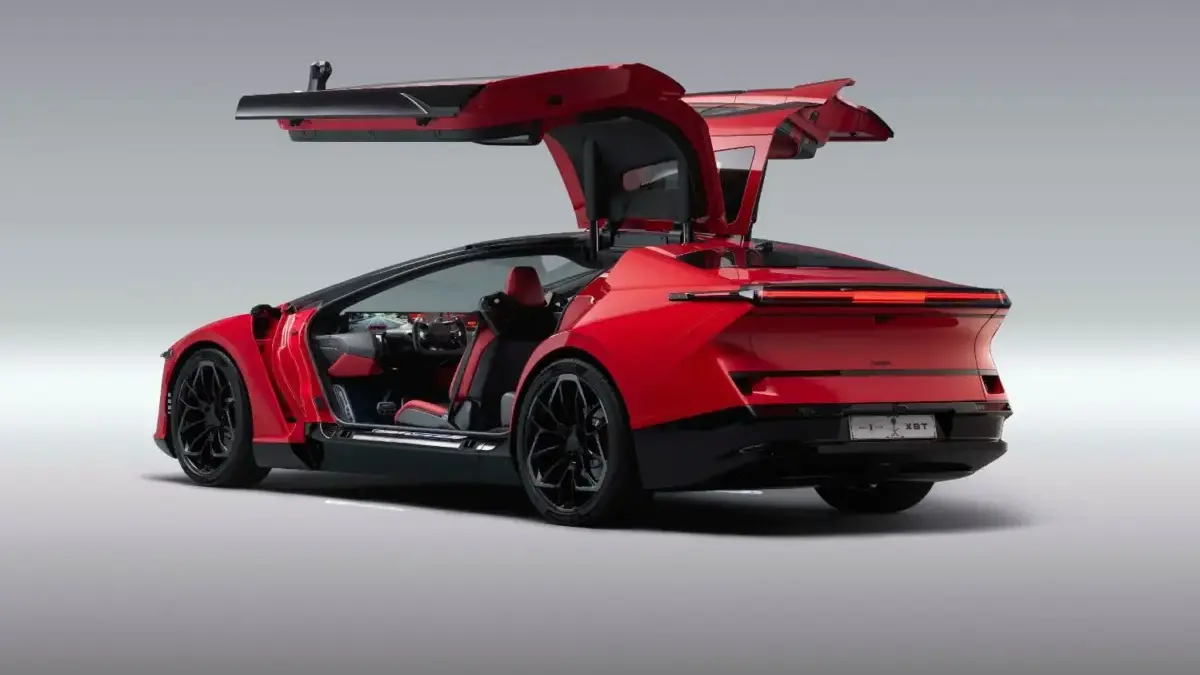
RIYADH — In a historic milestone that signals a seismic shift in the economic ambitions of the Middle East, Saudi Arabia has officially unveiled its first home-grown electric vehicle (EV) production model: the Ceer Exobot.
Unveiled during a high-profile premiere on September 21, at the company’s state-of-the-art manufacturing hub in King Abdullah Economic City (KAEC), the Exobot is more than just a new luxury car. It is the physical embodiment of the Kingdom’s strategy to future-proof its economy, break its historical dependence on fossil fuels, and establish itself as a heavyweight contender in the global next-generation automotive sector.
Main Facts: The Ceer Exobot at a Glance
The Ceer Exobot is not being introduced as a single niche prototype; rather, the brand has opted for a dual-body launch strategy, offering both a sweeping sedan and an imposing SUV. Both variants are built on an advanced, highly flexible electric architecture designed to offer uncompromising performance, luxury, and technology.
Dimensions and Exterior Architecture
The vehicle’s proportions are unmistakably grand.
- The Sedan: Measures an impressive 5.26 meters in length, 2.10 meters in width, and stands at a low-slung 1.43 meters.
- The SUV: Measures 5.02 meters long, retains the identical 2.10-meter width, and rises to a height of 1.69 meters.
- Wheelbase: Both body styles share a generous 3.2-meter wheelbase, ensuring cavernous legroom for all occupants.
One of the most striking design elements is the sweeping 2.4-meter panoramic windshield—which Ceer claims is the longest ever fitted to a production car. Featuring a radical 15-degree rake, it gives the vehicle a futuristic silhouette while utilizing a specialized reflective coating to combat harsh desert solar radiation.
Access to the cabin is granted via massive, nearly three-meter-long "Shahin Wing" doors. Reminiscent of falcon wings and bearing functional similarities to the gull-wing doors found on vehicles like the Tesla Model X, they pivot upward to ease ingress and egress for both front and rear passengers.
The exterior design also heavily integrates Saudi heritage:
- The Headlights: Incorporate 32 distinct luminous bars, paying homage to the year 1932, when the modern Kingdom of Saudi Arabia was unified.
- The Wheels: Forged aluminum wheels feature a distinctive triangular pattern directly inspired by the traditional historical architecture of Al-Ahsa.
Powertrain and Performance Options
Underneath the striking sheet metal lies a heavy-hitting, tri-motor all-wheel-drive electric propulsion system.
- First Edition: Delivers a staggering 850 horsepower and 1,000 Nm of torque. This enables the sedan to rocket from 0 to 100 km/h in just 2.6 seconds, while the heavier SUV accomplishes the sprint in 2.9 seconds.
- The Flagship Variant: For buyers seeking hypercar-rivaling dynamics, Ceer has confirmed an upgraded powertrain yielding 1,111 horsepower and 1,500 Nm of torque. The ultra-performance sedan shreds the 0–100 km/h run in a blistering 2.1 seconds (2.4 seconds for the SUV), topping out at an electronically limited 250 km/h.
Battery, Charging, and Range
Energy is stored in a sizable 112 kWh battery pack tied to an ultra-fast 800-volt electrical architecture. This setup supports rapid DC fast charging, capable of replenishing the battery from 10% to 80% in under 30 minutes.
Regarding driving range, official specifications claim 670 kilometers for the sedan and 560 kilometers for the SUV. However, analysts note these figures are calculated under the NEDC (New European Driving Cycle), which tends to be more optimistic than the stricter WLTP standards used in Europe. Real-world conditions are expected to yield slightly lower, though still highly competitive, operating ranges.
Chronology: From Vision to Reality
The journey to the Exobot’s public unveiling has moved at a breakneck pace, underscoring the urgency and capital backing behind the project.
- November 2022 — The Birth of Ceer: Crown Prince Mohammed bin Salman officially announces the launch of Ceer as Saudi Arabia’s first electric vehicle brand. The company is structured as a joint venture between the Public Investment Fund (PIF)—the Kingdom’s sovereign wealth fund—and Foxconn (Hon Hai Precision Industry), the Taiwanese multinational electronics manufacturing giant.
- 2023–2025 — Industrial Setup and Global Partnerships: Ceer begins constructing its industrial footprint in King Abdullah Economic City. To bypass decades of trial-and-error in vehicle dynamics and software engineering, the brand aggressively courts heavyweights in the global automotive supply chain. Licensing agreements are struck with BMW for vehicle platforms and core tech, while component contracts are awarded to Hyundai Transys and Rimac for advanced electric motors and performance components. Crucially, the company taps Rob Melville, former Head of Design at McLaren, to spearhead the Exobot’s striking aesthetic direction.
- September 21, 2026 — The Official Reveal: Ceer hosts a grand unveiling event at its KAEC production facility, showcasing the production-ready Exobot sedan and SUV to international media, government officials, and industry insiders.
- Early 2027 (Projected) — Market Launch: Commercial production ramps up, with the first customer deliveries scheduled to commence in Saudi Arabia during the first half of 2027, quickly followed by rollouts across the broader Gulf Cooperation Council (GCC) region.
- By 2030 (Projected) — Portfolio Expansion: Ceer intends to roll out a total of seven distinct models ranging from executive sedans to compact city vehicles, cementing a comprehensive domestic automotive catalog.
Supporting Data & Economic Metrics
The Exobot is much more than a halo product for wealthy motorists; it is a foundational pillar of Saudi Vision 2030, the national blueprint aimed at weaning the nation off its historic reliance on crude oil revenues.
- GDP Contribution: According to internal economic projections validated by the PIF, Ceer is expected to directly contribute approximately $8.0 billion (USD) to Saudi Arabia’s Gross Domestic Product (GDP) by the year 2034.
- Job Creation: The automotive project is designed to create thousands of high-skilled engineering, manufacturing, and management roles, fostering a knowledge-based industrial workforce.
- Foreign Direct Investment (FDI): By partnering with global technology leaders like Foxconn and utilizing tier-one European and Asian supply chains, the project acts as a powerful magnet for external capital and technological know-how.
- Ambitious Roadmap: The company’s long-term plan targets a complete portfolio of seven vehicles by the end of the decade, covering multiple market segments to capture both domestic and regional market share.
Official Responses and Industry Reactions
The rollout of the Ceer Exobot has drawn intense commentary from global industry analysts and political figures alike, highlighting the changing landscape of automotive manufacturing.
Speaking at the unveiling event in King Abdullah Economic City, key representatives from the Public Investment Fund emphasized that the Kingdom is no longer content with merely consuming global technology—it intends to author it.
"The Ceer Exobot represents a monumental leap forward for our industrial capabilities," noted a senior executive close to the project. "We have combined the absolute best of global engineering—drawing on expertise from Europe, Asia, and beyond—with the visionary spirit of Saudi innovation. This car proves that Saudi Arabia can design, engineer, and manufacture world-class electric vehicles on home soil."
Industry observers have praised the strategic inclusion of seasoned automotive talent, such as former McLaren designer Rob Melville, noting that it successfully avoids the awkward styling pitfalls typical of startup automotive brands. However, financial analysts also point out the inherent challenges ahead: breaking into a fiercely competitive global EV market requires not just brilliant styling and raw horsepower, but ironclad supply chain resilience, robust software support, and scalable manufacturing efficiency.
Implications: What the Exobot Means for the Global EV Market
The introduction of the Ceer Exobot carries profound implications for both regional geopolitics and the international automotive industry:
- A New Automotive Hub in the Middle East: For decades, the Middle East has been a premier consumer market for high-end, imported luxury vehicles. With the creation of Ceer and the localized production of the Exobot, Saudi Arabia is actively transforming itself from a consumer base into an active manufacturing exporter.
- Diversification Realized: As global energy markets gradually transition toward renewables and decarbonization, the financial pressures on petro-states are intensifying. Projects like Ceer validate the Vision 2030 framework, proving that sovereign wealth can be successfully channeled into building future-proof, high-tech industrial sectors.
- Challenging Established Giants: While initial sales will focus tightly on Saudi Arabia and the GCC nations, Ceer has engineered the Exobot to comply with global regulatory standards. Although no formal timeline has been established for a European or North American export push, the technical capability is clearly present. Should Ceer eventually look westward, established legacy automakers and EV pioneers like Tesla, Lucid, and Chinese export giants will find themselves competing against a deeply capitalized new rival backed by virtually limitless state resources.
As the industry counts down toward the official assembly line rollouts in early 2027, the Ceer Exobot stands as a bold statement of intent—a high-horsepower declaration that the future of mobility in the Kingdom has officially arrived.


Leave a Reply