

By Jhoan Sebastián Salazar
Enriched and Expanded Edition
Main Facts
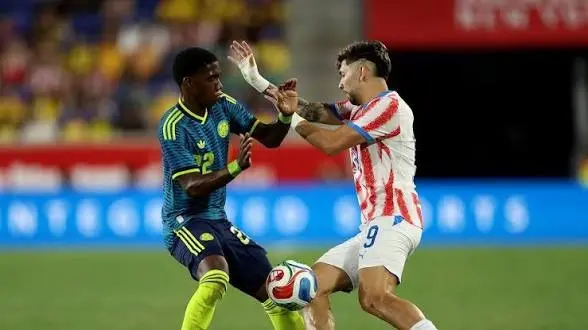
In an international friendly lacking offensive flair and tactical clarity, the Colombia National Football Team suffered a 1-0 defeat at the hands of Paraguay in New Jersey, United States. The match marked the Tricolor’s first loss of the new cycle, serving as a sobering reality check for head coach Néstor Lorenzo. The lone goal of the contest was scored by forward Adrián Benítez early in the second half, capitalizing on defensive vulnerabilities that plagued the South American powerhouse throughout the evening.
The fixture offered Lorenzo a wide canvas for tactical experimentation and roster evaluation. The Argentine tactician notably shifted away from his customary formations, deploying an unusual 5-4-1 defensive block designed to test structural adaptability. Furthermore, the match served as an international baptism for several fresh faces: Aldair Quintana, Edier Ocampo, and Kevin Andrade earned their senior team debuts in the starting XI, while Camilo Durán made his first appearance off the bench in the waning moments of the game.
Despite these tactical shifts, Colombia struggled to impose its rhythm. The squad was largely outplayed by a well-organized and resolute Paraguayan side under the astute guidance of fellow Argentine manager Gustavo Alfaro. Alfaro’s men showcased a clear tactical identity, outworking and outsmarting the Colombians in nearly every phase of the pitch.
With this encounter in the books, the Tricolor will turn its immediate attention to its final assignment of the current international window. Colombia is set to face Peru on Tuesday, October 6, in Miami, Florida—a fixture that represents the ultimate litmus test for Lorenzo’s experimental roster before domestic competitions resume and the November FIFA window approaches.
Chronology of the Match
First Half: A Tactical Chess Match with Few Sparks
The opening forty-five minutes at the New Jersey venue unfolded as a cautious, sparring affair. Both teams prioritized defensive solidity over attacking enterprise, resulting in a sterile midfield battle with very few clear-cut scoring opportunities.
Néstor Lorenzo’s radical 5-4-1 setup initially locked down the central corridors, neutralizing Paraguay’s vertical transitions. However, the structural change severely blunted Colombia’s own offensive output. The Tricolor labored to link midfield with attack, leaving isolated forwards to forage for scraps against a disciplined Paraguayan backline.
Paraguay gradually grew into the game, engineering the most dangerous sequence of the first half in the 26th minute. A pinpoint, looping cross from right-back Juan Cáceres caught the Colombian defense flat-footed. Inside the danger zone, electric forward Julio Enciso found himself completely unmarked with the goal at his mercy. To the relief of the Colombian bench, Enciso’s panicked, first-time volley soared agonizingly over the crossbar, letting the Tricolor off the hook.
As the half wound down, Colombia finally managed to inject a modicum of life into its attacking third. Deep into stoppage time (45+2′), a rare fluid sequence unlocked the Paraguayan defense. Luis Javier Suárez found himself in a promising position inside the box and audaciously attempted a backheel finish. While the execution caught the defense off guard, the Paraguayan goalkeeper was alert to the danger, comfortably smothering the effort to preserve the scoreless deadlock heading into the break.
Second Half: The Breakthrough and the Decisive Blow
Seeking to inject dynamism into a stagnant attack, Néstor Lorenzo reached for his bench at the start of the second half. Kevin Viveros and Jaminton Campaz were introduced in place of Luis Suárez and Álvaro Angulo, shifting the tactical balance toward a more recognizable 4-2-3-1 structure.
The tactical adjustment gave Colombia slightly more possession and territorial dominance, but the team’s trademark cutting edge remained absent. The Tricolor dominated the ball without asking serious questions of the Paraguayan goalkeeper.
The deadlock was finally shattered in the 55th minute, born out of unforced defensive errors. A routine, long clearance from the Paraguayan half should have been easily handled by the Colombian central defense. Instead, a sluggish clearance attempt resulted in a loose ball. Hugo Cuenca reacted quickest, aggressively anticipating the static Colombian defenders to nod the ball forward into the path of Hugo Adrián Benítez.
Benítez unleashed a powerful, first-time strike toward goal. Goalkeeper Aldair Quintana misjudged the trajectory, getting his feet tangled and parrying the fierce shot directly back into the danger area. Before the defense could recover, Benítez pounced on the rebound, ruthlessly sweeping it home to establish a 1-0 lead for the Albirroja.
The Late Push and Desperation
Trailing by a goal, Colombia was forced to chase the game. Lorenzo emptied his bench in search of an equalizer, introducing Samuel Velásquez, Matías Orozco, Jhon Solís, Daniel Muñoz, and debutant Camilo Durán as the match entered its final quarter.
The substitutions added temporary vigor, but the Tricolor’s attacks remained disjointed and frantic rather than methodical and clinical. Paraguay dropped into a compact, low defensive block, successfully absorbing wave after wave of Colombian pressure without panic.
Colombia’s best late opportunity fell to right-back Daniel Muñoz during a rare overlapping run into the box. Unmarked and presented with a shooting lane, Muñoz rushed his mechanics, dragging his volley hopelessly wide of the target. As the final whistle blew, Paraguay celebrated a hard-earned and tactically disciplined victory, while Colombia was left to ponder its offensive inefficiencies.
Supporting Data and Tactical Breakdown
- Possession and Control: Despite holding a marginal advantage in overall possession (52% to 48%), Colombia failed to translate that dominance into high-value scoring chances.
- Shooting Efficiency: The Tricolor registered only two shots on target throughout the entire 90 minutes, highlighting a severe lack of penetration in the final third.
- Defensive Fragility: The concession of Benítez’s goal underscored ongoing vulnerabilities in dealing with aerial duels and second balls inside the penalty area—an issue that has recurred in high-pressure moments across recent fixtures.
- Youth Integration: Lorenzo utilized the fixture to evaluate depth, handing senior debuts to Aldair Quintana, Edier Ocampo, Kevin Andrade, and Camilo Durán. While this signals a long-term vision for squad renewal, the lack of cohesion on the pitch demonstrated the steep learning curve associated with integrating inexperienced players into high-level international football.
Official Responses and Post-Match Reactions
Speaking to the press in the aftermath of the defeat, head coach Néstor Lorenzo adopted a pragmatic tone, emphasizing that the primary objective of the international window was experimentation rather than immediate results.
"We knew this match would present distinct challenges," Lorenzo remarked during his post-match press conference. "We decided to test variations in our structural approach, shifting to a five-man defensive line to observe how different personnel adapt to alternative tactical demands. While the result is certainly disappointing—because we always want to win—these matches exist precisely to expose our flaws, test new talents, and gather critical data before the competitive calendar resumes."
Captain and veteran leadership figures within the squad echoed the manager’s sentiments, acknowledging the need for collective introspection. Players pointed to the lack of precision in the final third and the necessity of maintaining concentration for the full duration of matches as key takeaways from the New Jersey test.
Meanwhile, Paraguayan media and technical staff celebrated the victory as validation of Gustavo Alfaro’s methodical project. The Argentine manager has steadily instilled defensive resilience and tactical discipline within the Guaraní setup, and the clean sheet against a formidable opponent like Colombia stands as a testament to his structural blueprint.
Implications for the Future
This 1-0 defeat carries significant psychological and tactical implications for the Colombia National Team as it navigates the post-World Cup 2026 landscape.
- The Limits of Experimentation: While squad rotation and the integration of emerging talent are vital for long-term sustainability, Lorenzo’s radical shift to a 5-4-1 formation demonstrated that structural overhauls can severely disrupt team chemistry. Finding the delicate balance between giving minutes to debutants and maintaining a competitive core will be crucial moving forward.
- The Urgency of the Peru Test: Having drawn against Mexico and now fallen to Paraguay, the Tricolor enters Tuesday’s fixture against Peru in Miami under mounting pressure. Fans and analysts will expect a commanding performance and a positive result to restore confidence before the demanding November FIFA window.
- Player Readiness for Domestic and International Cues: Following the conclusion of the Miami friendly, players will disperse back to their respective club environments. The physical and mental toll of international travel, combined with the pressure to secure regular starting berths at their clubs, will heavily dictate who earns a call-up for the final stretch of the year.
As the sun sets on New Jersey, the Colombian delegation packs its bags for Florida, carrying valuable lessons, tactical concerns, and the burning desire to rebound strongly against their upcoming Andean rivals.



Leave a Reply