

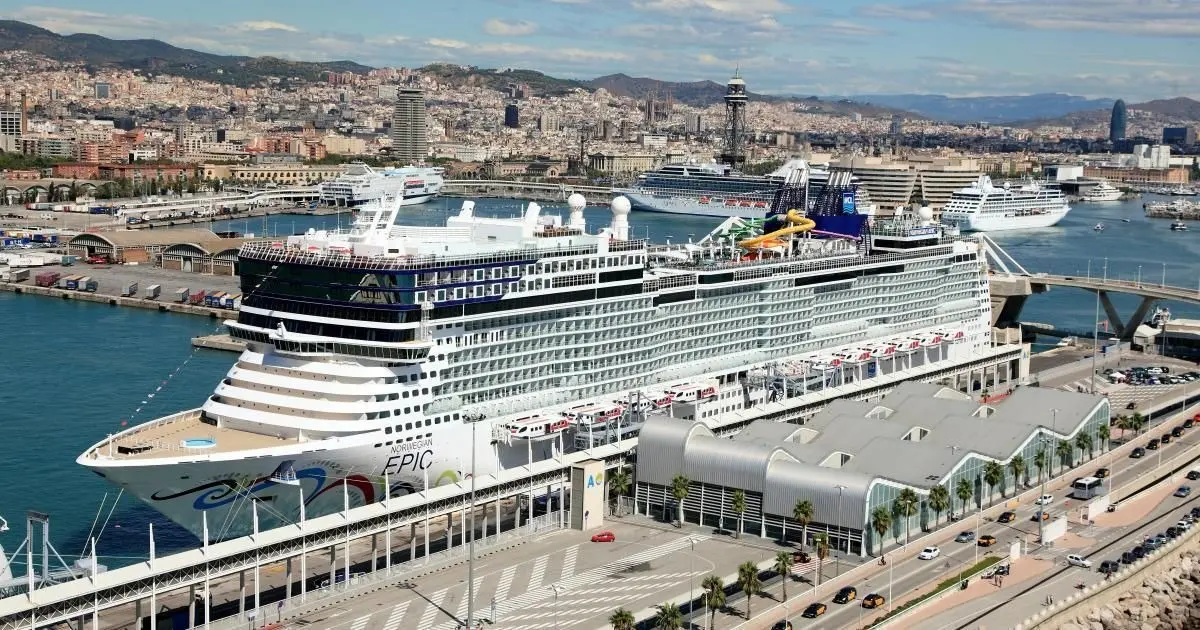
MADRID — Spain’s cruise sector has officially rewritten the record books. Closing out the summer season of 2026, the nation’s port authorities have reported an unprecedented surge in maritime tourism, shattering historical thresholds. Between the peak months of June, August, and September, Spanish ports of general interest handled a staggering volume of international travelers, solidifying the country’s status as the undisputed heavyweight champion of Mediterranean and Atlantic cruise itineraries.
According to official statistics released by Puertos del Estado, the June-to-August window welcomed more than four million cruise passengers for the first time in history. This milestone marks a significant 6.9% increase compared to the summer of 2025 and an even more robust 10.4% leap over the pre-pandemic recovery figures of 2024. Even more striking is the velocity at which cruise lines are increasing their operations: ship port calls surged by 14% year-on-year and a dramatic 22.5% over a two-year span.
While traditional powerhouses like Barcelona and the Balearic Islands continue to command the lion’s share of the market, the 2026 data reveals a democratization of maritime tourism. Secondary and regional ports—from the Bay of Cádiz and Málaga in the south to Bilbao, Santander, and Tarragona in the north and east—have successfully captured a larger slice of the pie, signaling a nationwide boom that extends far beyond the traditional tourist hubs.
Main Facts: The Numbers Behind the Historic Summer
The magnitude of the summer 2026 cruise season is best understood through hard metrics. Across the three peak summer months, Spanish ports registered a cumulative total of 4,017,489 cruise passengers. To contextualize this growth, the same period in 2025 recorded roughly 3.7 million passengers, while 2024 saw approximately 3.64 million. In absolute terms, this translates to nearly 259,000 more vacationers hitting Spanish docks than the previous year, and an extraordinary 377,000 additional visitors compared to two summers prior.
The expansion in ship traffic was even more pronounced. Between June and August 2026, ports recorded 1,187 total cruise ship calls, compared to 1,041 in 2025 and 969 in 2024. This represents an injection of 146 new vessel visits compared to last year and 218 more than in 2024.
However, volume tells only half the story. The geographical distribution of these passengers highlights a fascinating dichotomy between sheer passenger throughput and operational frequency. While Barcelona remains the undisputed king of passenger volume, the Balearic Islands have quietly stolen the crown for the highest number of individual ship arrivals, proving that different ports are carving out specialized niches in the evolving cruise economy.
Chronology of Growth: A Three-Year Trajectory (2024–2026)
To fully appreciate the meteoric rise of Spain’s cruise industry in 2026, it is vital to trace the trajectory back through the preceding two summers. The post-pandemic recovery phase laid a strong foundation, but the 2024–2026 period has shifted from recovery to aggressive expansion.
The 2024 Baseline
In the summer of 2024, Spain’s cruise sector was already operating at a high level, handling 3.64 million passengers across 969 port calls. At this stage, major destinations were heavily reliant on traditional routes, and while regional ports saw occasional visits, the vast majority of economic impact remained tightly clustered in Catalonia, the Balearic Islands, and parts of Andalusia.
The 2025 Consolidation
By the summer of 2025, the market demonstrated resilience and steady upward momentum. Passenger numbers climbed to 3.7 million, while vessel calls broke the thousand mark, reaching 1,041. Industry analysts at the time viewed this as a healthy, sustainable stabilization. Ports like Málaga, Cartagena, and Bilbao began aggressively courting cruise lines to diversify their tourism portfolios, planting the seeds for the structural shifts that would manifest fully in 2026.
The 2026 Breakthrough
The summer of 2026 shattered previous growth ceilings. Surpassing the symbolic four-million-passenger barrier, the season was characterized by larger vessels operating at higher capacities, coupled with an aggressive deployment strategy by major cruise operators. By diversifying their routes to include smaller regional ports, cruise lines avoided extreme congestion in primary hubs while meeting surging consumer demand for Mediterranean and Atlantic voyages.
Supporting Data: Regional Breakdown and Port Performance
A granular analysis of the Puertos del Estado data illustrates how different regions contributed to the historic summer performance.
The Giants: Barcelona and the Balearics
- Barcelona: Maintaining its crown as Europe’s leading cruise port, Barcelona handled an astounding 1.5 million passengers between June and August 2026. This builds significantly upon the 1.38 million recorded in 2025 and 1.33 million in 2024. In terms of ship calls, Barcelona logged 274 visits this summer, up from 250 in 2025 and 231 in 2024.
- The Balearic Islands: Securing the second spot by volume, the Balearics welcomed 1.09 million cruiser passengers this summer, edging past the 1.04 million figures of the previous two years. Crucially, the Balearics outperformed Barcelona in operational frequency, registering 312 ship calls in 2026 (up from 271 in 2025 and 263 in 2024).
Together, Barcelona and the Balearics accounted for 2.63 million passengers—roughly two-thirds of the entire national cruise traffic during the three-month window.
The Mid-Tier Contenders
Beyond the top two titans, several regional ports recorded substantial traffic:
- Bay of Cádiz: 217,220 passengers (101 port calls)
- Valencia: 211,769 passengers (83 port calls)
- A Coruña: 167,703 passengers
- Málaga: 143,626 passengers (71 port calls)
- Bilbao: 130,638 passengers (47 port calls)
- Vigo: 107,134 passengers (34 port calls)
The Growth Champions (Percentage Surges)
While the major hubs handle the bulk of the numbers, the most explosive growth rates occurred in smaller, ambitious ports leveraging strategic expansions:
- Santander: Stood out with a staggering percentage leap, jumping from 6 visits in the summer of 2024 to 8 in 2025, and hitting 14 in 2026—a monumental 133.3% increase over two years.
- Tarragona: Advanced from 15 visits in 2024 to 19 in 2025 and 27 in 2026, marking an 80% surge.
- Cartagena: Demonstrated steady, impressive gains, moving from 24 visits in 2024 to 33 in 2025, and 43 in 2026 (79.2% cumulative growth).
- Bilbao: Expanded its operations by 67.9% since 2024 (from 28 to 47 calls).
- Málaga: Added 26 new visits over the two-year period, growing by 57.8% to reach 71 calls.
Official Responses and Stakeholder Perspectives
The unprecedented 2026 data has sparked reactions across government bodies, port authorities, and tourism boards.
Representatives from Puertos del Estado emphasized that the performance validates Spain’s modern port infrastructure investments. "Our logistics capacity, combined with the continuous modernization of passenger terminals, allows us to absorb these historic volumes safely and efficiently," a spokesperson noted. The federal agency highlighted that the dispersal of traffic to smaller ports is a direct result of collaborative efforts between regional authorities and cruise operators to optimize routing.
However, local municipal leaders and tourism boards have struck a more nuanced chord. In major hubs like Barcelona and Palma de Mallorca, the economic windfall—which pumps millions of euros into local retail, hospitality, and transportation sectors—is continuously weighed against ongoing conversations regarding urban carrying capacity and sustainable tourism management.
Port directors in secondary destinations, conversely, have welcomed the influx with open arms. Authorities in Cartagena and Santander have praised the positive economic impact on shoulder-season local commerce, pointing out that cruise tourists provide a vital economic cushion that helps decouple regional economies from purely seasonal land-based tourism.
Implications: Balancing Economic Bonanza and Sustainable Tourism
The milestone of crossing four million cruise passengers in a single summer carries profound implications for Spain’s tourism strategy moving forward.
Economic Benefits
On the macroeconomic front, the cruise sector remains an undeniable powerhouse. Millions of transient visitors contribute significantly to local GDP, supporting thousands of direct and indirect jobs in stevedoring, tour guiding, coach transport, port services, and downtown retail. For secondary ports like Cádiz, Vigo, and Tarragona, the influx of international travelers introduces their cultural and culinary assets to a global demographic, encouraging repeat land-based tourism in the future.
Infrastructure and Environmental Challenges
Yet, the extraordinary growth rate—highlighted by a 22.5% increase in ship calls over two years—intensifies existing environmental and logistical debates. Urban centers, particularly historic port cities, face mounting pressure to accelerate green initiatives. These include enforcing shore-power connectivity (cold ironing) so docked ships can shut off their diesel engines, optimizing passenger flow to prevent overcrowding in historical quarters, and working alongside cruise lines to implement strict waste management and emissions standards.
The Future Outlook
As Spain closes the books on a record-breaking summer in 2026, the clear takeaway is that the appetite for maritime travel shows no signs of abating. The challenge for the coming years will not be generating demand, but rather managing success. By continuing to foster the growth of regional ports while implementing stringent sustainability measures in overcrowded hubs, Spain aims to ensure that its golden age of cruising remains both economically lucrative and socially harmonious for decades to come.



Leave a Reply