

By Global Hospitality Newsroom
The rapid integration of artificial intelligence into the global hospitality industry has triggered a profound shift in how hotel chains approach recruitment, talent development, and organizational strategy. While technology continues to automate day-to-day operations at an unprecedented pace, the market is grappling with a critical paradox: mastering software tools is no longer the primary differentiator for commercial talent. Instead, the ultimate competitive advantage lies in deep, cross-functional business acumen.
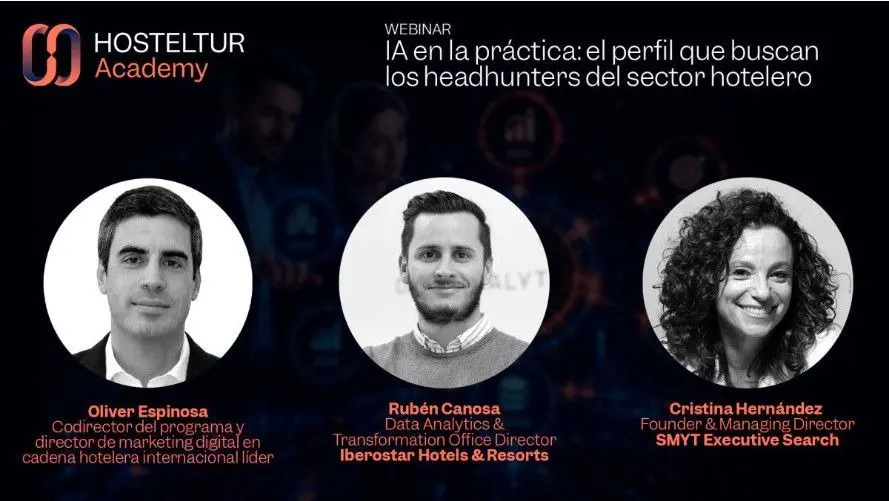
This tension took center stage during a high-profile industry panel organized by Hosteltur Academy. Titled "AI in Practice: The Profile Sought by Hotel Sector Headhunters," the session brought together leading voices from the front lines of digital transformation and executive search. The conversation was moderated by Oliver Espinosa, co-director of the Executive Program in AI Applied to Hotel Marketing at Hosteltur Academy.
The panel featured Rubén Canosa, head of Analytics, Data, and Artificial Intelligence at Iberostar Group, and Cristina Hernández Santonja, founder of Smyt and a specialist in executive search for the hospitality sector. Together, they dissected the evolving demands placed on commercial teams—spanning marketing, revenue management, and distribution—and explored whether the ideal AI-fluent hotel professional currently exists in the open market.
1. Main Facts: The AI Adoption Gap and the Talent Crunch
The hospitality industry is undergoing an undeniable technological overhaul, yet adoption rates reveal a stark operational disconnect. According to recent European research data from h2c cited during the panel, 86% of hotel chains are already utilizing artificial intelligence in various capacities across their operations.
However, this widespread adoption masks a deeper vulnerability: 80% of these same organizations acknowledge that they do not possess a formal strategy to govern, manage, or scale their AI initiatives. Furthermore, 60% of hospitality companies point to a severe lack of specialized knowledge as their primary barrier to future progress.
This data underscores a critical industry reality: the gap between acquiring technology and understanding how to strategically deploy it is widening. As algorithms take over execution, the human value shifts from operational output to strategic direction.
During the debate, the panel established several foundational truths regarding the current state of AI in hospitality:
- Augmentation vs. Replacement: AI is currently functioning as an "augmentative" tool, expanding individual capabilities in data analysis and task execution rather than replacing human judgment.
- The Danger of Plausible Errors: Advanced large language models and predictive algorithms can generate convincing yet strategically flawed recommendations, making domain expertise more critical than ever.
- Silo Collapse: Traditional boundaries separating marketing, revenue management, and data analytics are dissolving under the pressure of AI integration.
2. Chronology of the Debate: From Adoption to Strategic Intent
To understand how the industry reached this critical juncture, it is helpful to trace the evolution of technology adoption within hotel organizations over recent years.
Phase 1: The Race for Tool Adoption (2021–2023)
Initially, the hospitality sector viewed AI through the lens of efficiency and automation. Hoteliers rushed to implement chatbots for customer service, dynamic pricing engines for revenue management, and automated segmentation tools for digital marketing campaigns. The primary objective was cost reduction and speed. During this phase, success was measured simply by whether a hotel chain had integrated AI software into its tech stack.
Phase 2: The Strategy Vacuum (2023–2024)
As systems matured, hoteliers realized that deploying software without a guiding framework led to fragmented results. Campaigns were optimized for metrics that did not always align with overall business profitability. As the h2c data indicates, four out of five hotel chains found themselves with powerful tools but no overarching roadmap to govern their use.
Phase 3: The Human Pivot and Talent Realignment (Late 2024–Present)
The current phase—highlighted by the Hosteltur Academy panel—marks a fundamental shift in perspective. The industry is no longer asking which tools to buy, but who knows how to manage them. Headhunters and corporate strategists are discovering that technical proficiency in operating an AI platform is secondary to possessing deep, cross-departmental business knowledge. The core challenge has shifted from technological capability to human competence.
3. Supporting Data and Industry Insights
The transition from tactical execution to strategic oversight is backed by compelling insights shared by the panel experts.
The Illusion of Simplicity
Rubén Canosa of Iberostar introduced the concept of augmentative AI—technology designed to expand a professional’s capabilities within their existing domain of expertise. AI can process massive datasets, accelerate campaign rollouts, identify consumer behavioral patterns, and execute repetitive tasks at lightning speed.
However, Canosa warned against the dangerous temptation of using AI in domains where the professional lacks foundational knowledge. When an algorithm produces a compelling, well-formatted response in an unfamiliar area, human users are often lulled into accepting it blindly.
"The AI is not making a marketing professional need to know less. It is forcing them to understand more of what happens outside of marketing," Canosa emphasized during the discussion.
The Iberostar Case Study: Redefining Efficiency
To illustrate practical, value-driven AI integration, Canosa shared an example from Iberostar’s operational playbook. The company implemented AI to optimize room assignments—not merely to automate an administrative chore, but to fundamentally alter the guest experience. By drastically reducing the time reception staff spent on manual logistics, front-desk personnel were empowered to dedicate significantly more face-to-face time to guest relations.
This case demonstrates the correct sequence of technological implementation:
- Identify a core business need or friction point.
- Determine where value is truly created for the customer and the brand.
- Apply AI specifically to support that objective.
4. Official Responses and Expert Perspectives
The panel brought together contrasting yet complementary viewpoints from corporate strategy, executive search, and academic training.
Rubén Canosa: The Corporate Technologist’s View
Representing one of the world’s leading resort hotel chains, Canosa stressed that technology must always serve a clear business purpose. He argued strongly against the notion of trying to create "universal generalists." Instead, companies should use AI to amplify the strengths of specialists while fostering cross-functional empathy.
- For Marketing Professionals: Marketers can no longer operate in a silo focused solely on creative output, click-through rates, and brand awareness. They must understand core revenue metrics—such as demand fluctuations, occupancy rates, Average Daily Rate (ADR), availability, and distribution costs. A marketing campaign might successfully drive conversions, but if it captures low-value demand during a peak period when revenue management prefers to protect high rates, the algorithmic success translates into a commercial failure.
- For Revenue Professionals: Conversely, revenue managers must look beyond pricing algorithms. They need to understand digital acquisition, customer behavior, CRM data, and digital conversion funnels to feed richer, forward-looking demand signals into their pricing models.
Cristina Hernández Santonja: The Headhunter’s Perspective
Speaking from her extensive experience in executive search through Smyt, Cristina Hernández highlighted a growing disconnect in the recruitment market.
"Companies are increasingly asking for professionals with AI skills without always having precisely defined what they need those professionals to do with them," Hernández noted.
She cautioned against the misconception that because AI simplifies execution, the human experience and accumulated knowledge behind those tasks become obsolete. In reality, the exact opposite occurs:
- Analysis vs. Interpretation: The value shifts from generating an analysis to interpreting its strategic weight.
- Configuration vs. Optimization: The value moves from setting up a campaign to determining what the campaign should be optimizing toward.
- Data Production vs. Curation: Professionals must transition from producing data to discerning which information actually matters to the bottom line.
"Experience does not disappear with automation. It changes the place where it adds value," Hernández stated.
5. Implications for Hospitality Professionals and Corporate Strategy
The insights from the Hosteltur Academy panel carry far-reaching implications for hotel executives, department heads, and individual career development across the global hospitality landscape.
Rethinking the Recruitment Playbook
For human resources departments and executive search firms, the criteria for hiring commercial talent must be radically updated. Before drafting a job description for an "AI Marketing Manager" or an "AI Revenue Director," organizations must answer four foundational questions:
- What specific commercial decisions do we want to improve?
- What underlying business knowledge do those decisions require?
- What core competencies do our existing marketing, revenue, distribution, and data teams currently possess?
- What gaps must be bridged through internal development versus external hiring?
Iberostar’s approach serves as a model for the broader industry. Rather than relying solely on external recruitment, the company has invested in internal talent development through structured training, comprehensive AI readiness plans, and an internal network of cultural "champions" who guide peers through the digital transition.
The Death of the Generic Prompt
As AI tools become increasingly commoditized, accessible, and user-friendly, the ability to write a basic prompt will cease to be a competitive advantage. The real differentiator will be the rigor of the questions being asked and the critical evaluation of the outputs received.
A successful hotel executive of the future must be able to:
- Determine what business objective the AI should target.
- Select the appropriate variables and data signals to feed into the system.
- Interpret algorithmic recommendations through the lens of pricing, margin, and brand equity.
- Exercise the critical judgment required to reject an automated recommendation when it conflicts with broader strategic goals.
As the panel concluded: The defining question for modern hoteliers is no longer "Do I know how to use artificial intelligence?" but rather "Do I have enough business acumen to decide what artificial intelligence should do for me?"
Conclusion: Bridging the Gap Through Education
Recognizing this exact skills gap was the primary catalyst behind the creation of Hosteltur Academy’s Executive Program in AI Applied to Hotel Marketing with a Focus on Revenue Management.
Rather than building a curriculum around software tools, the program was engineered around decision-making outcomes. It deliberately breaks down institutional silos: marketing is taught in conjunction with revenue management; distribution strategies are integrated with CRM data; and automation is evaluated not by how many hours it saves, but by its direct impact on commercial profitability.
Spanning 50 hours of intensive training and featuring insights from more than 23 active industry professionals, the program addresses the core reality highlighted by the experts in Madrid: The more capable artificial intelligence becomes at execution, the more vital it is to deeply understand the business we are asking it to optimize.
To watch the full panel discussion featuring Rubén Canosa and Cristina Hernández Santonja, visit the official Hosteltur recording: "IA en la práctica: el perfil que buscan los headhunters del sector hotelero".



Leave a Reply