
Main Facts: A Watershed Moment in Colombian History
The year 1994 stands as a profound paradox in the modern history of Colombia. While the nation was pulsating with vibrant cultural transformations, sweeping political shifts, and technological modernizations, it was simultaneously battered by tectonic shocks that left generational scars. It was a twelve-month span defined by euphoric highs and devastating lows—a turbulent intersection where beauty pageants, blockbuster television, and the birth of cellular telephony coexisted with sporting heartbreaks and national tragedies.
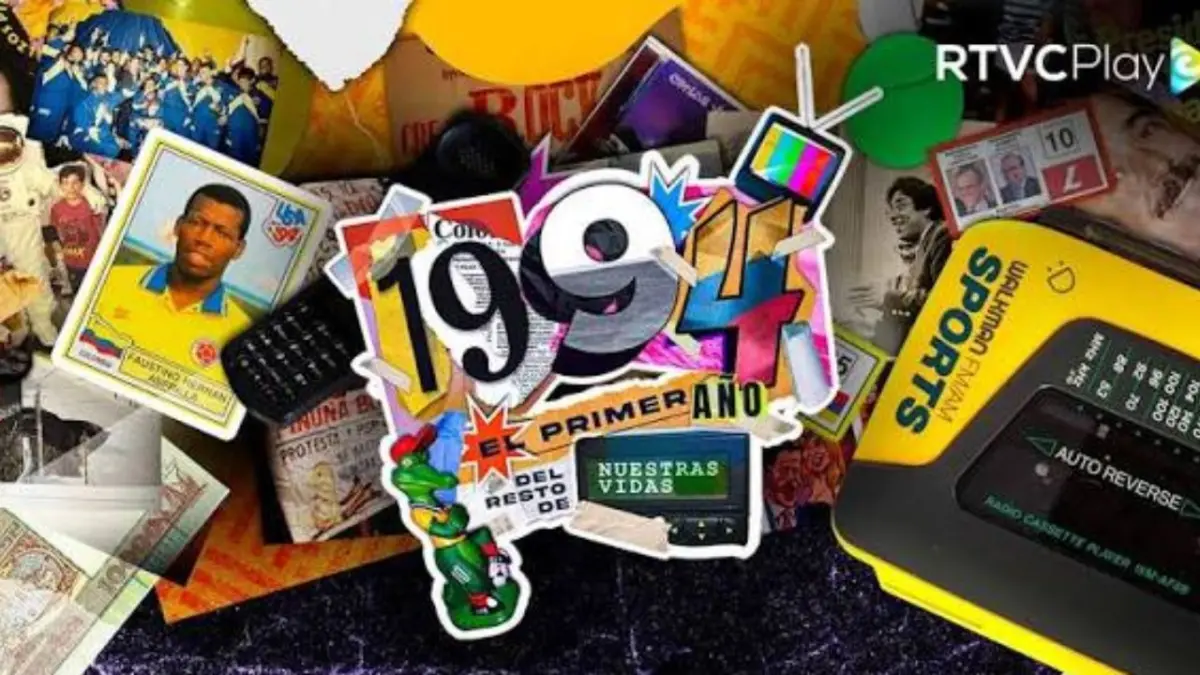
To capture this complex era, the feature-length documentary film 1994, the First Year of the Rest of Our Lives (1994, el primer año del resto de nuestras vidas) meticulously reconstructs the political, social, athletic, and musical fabric of the period. Directed by Julián Duque and Juan Pablo Astudillo, and brought to life from an original concept by Paco Cepeda and Juan Pablo Astudillo, the project is a collaborative tour de force. It represents a powerful co-production between RTVC Sistema de Medios Públicos (Colombia’s public broadcasting system), the Fundación Patrimonio Fílmico Colombiano (Colombian Film Heritage Foundation), and Diptongo Media Group.
Utilizing rare archival footage, deep-dive investigative journalism, and poignant testimonies from prominent cultural and political figures, the documentary serves as both a historical mirror and a time capsule. It explores how a single year encapsulated the resilience, trauma, cultural richness, and unwavering spirit of a nation undergoing an identity crisis on the global stage.
Chronology of a Tumultuous Year
To truly understand the weight of 1994, one must trace the chronological sequence of events that unfolded with cinematic intensity:
- May 1994: The initial commercial deployment of cellular telephony officially begins in Colombia, spearheaded by pioneers like Celumóvil, forever altering the landscape of national communication.
- May 21, 1994: Carolina Gómez takes the stage at the Miss Universe pageant in Manila, Philippines, securing the title of First Runner-Up (Virreina Universal) and extending Colombia’s unprecedented podium streak.
- June 1994: The first commercial mobile phone calls are successfully placed across the country, marking the dawn of the digital and telecommunications era in Colombia.
- June – July 1994: The Colombian Men’s National Football Team competes in the FIFA World Cup in the United States, facing a crushing early elimination in the group stage.
- July 2, 1994: National grief turns to profound horror with the tragic assassination of beloved defender Andrés Escobar in Medellín, just days after the team’s return from the World Cup.
- November 30, 1994: Canal A broadcasts the premiere of Café con aroma de mujer, a groundbreaking telenovela written by Fernando Gaitán and directed by Pepe Sánchez, which instantly becomes a cultural touchstone.
- May 1995 (Spanning from 1994 roots): The foundational efforts of the early nineties culminate in the birth of the Rock al Parque festival, establishing a massive public platform for alternative music in Bogotá.
Supporting Data: The Pillars of 1994
The cultural and social weight of 1994 can be measured through specific milestones across sports, beauty pageants, television, and technology.
1. The Miss Universe Hat-Trick and Global Pageant Dominance
In May 1994, Colombia’s fascination with international beauty pageants reached a fever pitch. Represented by Carolina Gómez, the nation came agonizingly close to capturing its second Miss Universe crown, finishing neck-and-neck with India’s Sushmita Sen, who ultimately took home the title.
This placement was far from a one-off occurrence; it solidified a golden era for Colombian beauty queens on the global stage. It extended an unprecedented consecutive podium streak:
- 1992: Paola Turbay secured the title of First Runner-Up.
- 1993: Paula Andrea Betancur similarly captured the First Runner-Up position.
- 1994: Carolina Gómez maintained the streak by finishing as the universal runner-up.
This formidable era proved that Colombian contestants were standard-bearers of poise, intelligence, and international appeal. The streak would later find echoes when Taliana Vargas achieved a second-place finish in 2008, culminating in Paulina Vega’s historic second Miss Universe victory for Colombia in 2014.
2. From the 5–0 Euphoria to World Cup Despair
In the realm of sports, the national consciousness was inextricably linked to the fortunes of the Selección Colombia. The team arrived at the 1994 FIFA World Cup in the United States blanketed in towering expectations. These hopes were not unfounded; they were built on the back of a breathtaking qualifying campaign, highlighted by a legendary, earth-shattering 5–0 thrashing of Argentina in Buenos Aires on September 5, 1993. That historic night convinced fans and international analysts alike that Colombia was destined to be a serious contender for the global trophy.
Yet, the reality of the tournament proved cruel. Plagued by immense pressure, internal tensions, and tactical missteps, Colombia suffered unexpected defeats against Romania and the United States. Although they bounced back to defeat Switzerland in their final group fixture, the damage was done, and they were shockingly eliminated in the first round.
The sporting disappointment, however, paled in comparison to the national tragedy that followed. On July 2, 1994, center-back Andrés Escobar—widely respected as a gentleman of the sport and a pillar of the national team—was gunned down outside a Medellín nightclub. His murder was widely attributed to the fallout from an own-goal he had scored against the United States, plunging the country into a collective mourning that exposed the dangerous intersection of sports, societal violence, and drug cartel influence.
3. Café con Aroma de Mujer: The Golden Age of Telenovelas
While the sports pages carried grief, the living rooms of millions of Colombian homes were captivated by a cultural phenomenon of unprecedented proportions. On November 30, 1994, the national television network premiered Café con aroma de mujer, written by master telenovela creator Fernando Gaitán and directed by Pepe Sánchez.
Starring Margarita Rosa de Francisco as Teresa Suárez ("Gaviota") and Guy Ecker as Sebastián Vallejo, the drama followed an intense, class-defying romance set against the lush, sweeping backdrop of the Coffee Cultural Landscape. The series did more than capture ratings; it captured the national soul, celebrating agrarian traditions while modernizing the narrative structure of Latin American melodrama. It achieved massive international export success, setting a gold standard for Colombian television production for decades to come.
4. The Genesis of Rock al Parque
During the early 1990s, Bogotá’s burgeoning rock and alternative music scenes were suffocated by a lack of institutional support and open-air performance spaces. Underground bands struggled to find venues that could accommodate their growing followings.
Recognizing this urgent cultural deficit, a visionary coalition emerged: Mario Duarte (frontman of the iconic rock band La Derecha), Julio Correal (promoter and music industry entrepreneur), and Bertha Quintero (a cultural manager tied to the district administration). Their tireless advocacy laid the groundwork for an initiative that would democratize live music in the capital. Although the first official edition of Rock al Parque took place between May 26 and 29, 1995—featuring 43 national bands alongside international acts—its conceptualization, political negotiations, and foundational struggles were forged entirely in the crucible of 1994.
5. Entering the Era of Cellular Telephony
Beyond culture and sports, 1994 marked the irreversible modernization of Colombia’s infrastructure. For the first time, mobile communication transitioned from science fiction to commercial reality. The launch of mobile operations by companies like Celumóvil introduced cellular technology to the public sphere.
In June 1994, the first commercial mobile calls were successfully placed in the country. Though initially treated as an exclusive luxury for executives and high-net-worth individuals, this technological leap laid the vital groundwork for the hyper-connected society that defines modern Colombia today.
Official Responses and Cultural Reflection
The resurgence of interest in 1994 is not merely nostalgic; it is an active cultural reckoning. Public institutions have recognized the necessity of processing this foundational period through modern artistic lenses.
When asked about the conceptual framework behind the documentary, the project’s co-creators emphasized that looking back at 1994 is essential for understanding contemporary Colombia. Through official releases, the public media network RTVC underscored that the era laid bare the deep contradictions of the nation: a society capable of producing world-class artistic masterpieces, sporting excellence, and global beauty icons, while simultaneously grappling with profound institutional crises, political instability, and internal conflict.
Cultural critics and historians have consistently pointed out that 1994 forced Colombians to confront their own duality. The official response from cultural preservation entities, such as the Fundación Patrimonio Fílmico Colombiano, highlights the critical importance of digitizing and protecting audiovisual archives so that younger generations can witness firsthand the textures, sounds, and visceral emotions of a bygone era.
Implications for Future Generations
The legacy of 1994 extends far beyond the calendar year it represents; it acts as a permanent blueprint for modern Colombian identity.
- A Shift in Collective Consciousness: The juxtaposition of the 5–0 victory against Argentina and the subsequent murder of Andrés Escobar permanently altered how Colombia viewed its relationship with sports, forcing a national conversation about fanaticism, violence, and social responsibility.
- Cultural Globalization: The international success of Café con aroma de mujer and the enduring legacy of Rock al Parque proved that Colombian creative industries could project a distinct, high-quality cultural identity onto the global stage, paving the way for today’s international success in music, film, and television.
- Technological Acceleration: The introduction of cellular telephony in 1994 initiated a digital migration that completely restructured commerce, personal relationships, and public safety infrastructure.
As Señal Colombia prepares to broadcast 1994, el primer año del resto de nuestras vidas this Sunday, October 11, at 8:00 p.m., viewers are invited to embark on a journey of collective introspection. The documentary does not merely chronicle historical events; it challenges contemporary audiences to examine how the triumphs and heartaches of thirty years ago continue to shape the political, social, and cultural realities of modern Colombia.