

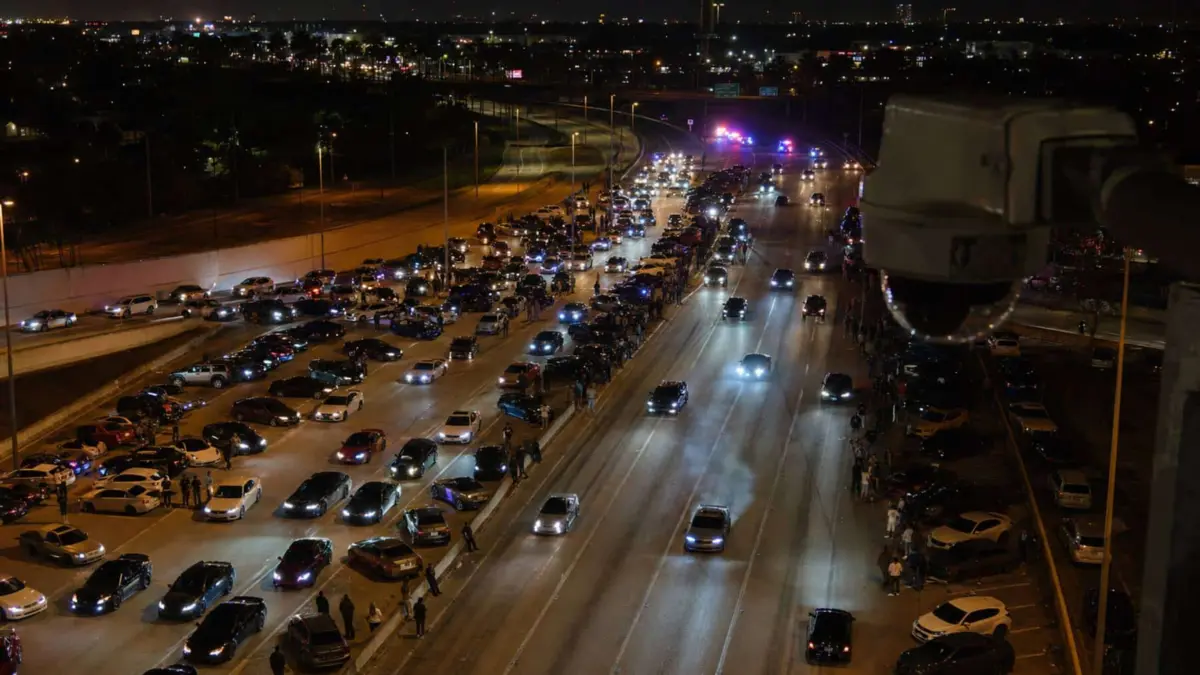
FLORIDA — The allure of illicit motorsport culture has once again collided with the unforgiving reality of the law. In the dead of night, a major Florida highway was abruptly transformed into an unauthorized racetrack, showcasing the escalating crisis of street takeovers that continue to plague metropolitan and rural arteries across the United States.
What began as a coordinated social media invitation quickly morphed into a chaotic scene of gridlock, dangerous stunts, high-speed evasion, and a multi-jurisdictional police response. While law enforcement successfully intervened and made initial arrests, the fallout from the night’s events extends far beyond the four individuals currently behind bars, as state troopers scour digital footprints to identify dozens of other participants.
Main Facts: The Anatomy of a Midnight Highway Takeover
The incident unfolded during the early morning hours on a Saturday, turning a critical commercial and commuter route into a private playground for automotive stunt drivers.
- The Location: Interstate 75, directly affecting all northbound lanes near the community of Thonotosassa in Hillsborough County, Florida.
- The Scale: More than 100 vehicles were involved in the complete shutdown of the multi-lane interstate, trapping hundreds of innocent motorists behind an impenetrable wall of cars.
- The Activities: Participants utilized the blocked lanes to perform "doughnuts," burnouts, and high-risk drift maneuvers mere feet away from crowds of spectators.
- The Response: The Florida Highway Patrol (FHP) deployed multiple units to break up the gathering, resulting in a dramatic high-speed chase, four immediate arrests, and the initiation of an expansive, technology-driven follow-up investigation.
The event underscores a troubling modern phenomenon: the use of encrypted messaging apps and public social media platforms to orchestrate flash-mob style traffic shutdowns, leaving local infrastructure vulnerable and emergency response times compromised.
Chronology of Events: From Gridlock to High-Speed Pursuit
To understand the scope of the operation, investigators have pieced together a timeline of the chaotic events that transpired over the course of less than an hour on that Saturday morning.
1:30 AM – The Complete Shutdown
Traffic along northbound Interstate 75 came to an abrupt, synchronized halt near Thonotosassa. Drivers trapped behind the blockade initially assumed an accident had occurred ahead. However, reality set in as vehicles ahead of them began positioning themselves diagonally across all available lanes, sealing off any possibility of escape or forward momentum.
Within minutes, the asphalt became a makeshift arena. Spectators poured out of their vehicles, setting up rings around the impromptu performance space. Cell phones emerged instantly, capturing video footage for live streams and immediate upload to various social media platforms. High-powered sports cars and modified sedans began spinning their tires, filling the night air with thick plumes of white smoke, the smell of burning rubber, and the roar of modified exhaust systems.
2:00 AM – The Arrival of the Florida Highway Patrol
The party atmosphere shattered abruptly as the vanguard of the Florida Highway Patrol arrived on the scene. Cruisers pushed through the congestion with emergency lights flashing and sirens wailing, cutting short the live streams and sending the crowd into a state of panic.
Dashcam footage released by the FHP details the immediate scramble. Dozens of spectators and drivers sprinted back to their vehicles, abandoning their vantage points to flee in every direction. While the vast majority of the hundred-plus vehicles managed to scatter before law enforcement could establish a perimeter, one vehicle’s driver made a fateful decision that escalated a misdemeanor traffic disruption into a felony pursuit.
2:15 AM – The 140 MPH Chase Begins
Amid the retreating chaos, a vibrant green BMW M3 bolted from the scene, its driver accelerating aggressively to merge back onto the interstate in an attempt to outrun state troopers.
The lead patrol vehicle immediately initiated a pursuit. What followed was a terrifying display of reckless driving. The fleeing BMW wove aggressively through conventional, unsuspecting traffic on the I-75 corridor, pushing speeds that ultimately peaked at 140 mph (approximately 225 km/h)—nearly twice the legal speed limit of 70 mph (113 km/h).
The high-stakes pursuit continued until the driver exited the interestatal at Bruce B. Downs Boulevard. Refusing to yield, the suspect ran a red light before plunging into a nearby residential area, attempting to lose the pursuing cruisers in the labyrinth of neighborhood streets.
2:30 AM – Termination and Arrest
The chase finally concluded in a commercial or residential parking complex, where converging patrol cars successfully boxed in the vehicle. The driver was ordered out at gunpoint and taken into custody without further incident. Inside the vehicle, officers found three passengers who were also detained on the spot.
Supporting Data: The Rising Toll of Street Racing and Takeovers
The incident on I-75 is not an isolated anomaly; rather, it represents a well-documented national surge in unauthorized street racing and stunt exhibitions. According to transportation safety data, law enforcement agencies across the country have reported exponential increases in highway takeovers over the past five years.
- Speed Disparities: The BMW involved in the pursuit traveled at 140 mph on a roadway engineered for a maximum safe speed of 70 mph, exponentially increasing the kinetic energy involved in any potential collision.
- Infrastructure Impact: The total blockage of a major interstate artery affects thousands of motorists, potentially delaying emergency medical transport, commercial freight logistics, and everyday citizens trying to return home from night shifts.
- Technological Evidence: Modern investigations rely heavily on digital forensics. Authorities in this case are parsing through hours of traffic camera feeds, dashcam recordings from multiple patrol cruisers, and user-generated content posted publicly on platforms like Instagram, TikTok, and Snapchat.
Official Responses and Legal Ramifications
The legal consequences for those caught in the sweep are severe, designed to send a clear message that highway takeovers will be met with the full force of the judicial system.
The Suspects and Charges
The driver of the green BMW M3 was identified as Yulian Lugo, 25. Following his cornering and arrest, Lugo was booked on multiple felony and misdemeanor charges, including fleeing and eluding law enforcement at high speeds, reckless driving, and participating in illegal street racing/takeovers.
Accompanying Lugo in the vehicle were three other young men: one aged 24 and two aged 18. All three passengers were transported in the back of patrol cruisers and booked into the Hillsborough County jail, facing charges related to obstructing traffic and aiding in the unlawful shutdown of a public highway.
The Ongoing Investigation
Despite four immediate arrests, the Florida Highway Patrol has emphasized that the case is far from closed. Investigators are actively cross-referencing the license plate numbers captured by traffic cameras, dashcams, and bystander videos with the vehicle registry databases of the state.
An FHP spokesperson noted that the agency possesses comprehensive digital evidence from the night in question. Investigators are methodically identifying registered owners of the other participating vehicles who managed to slip away before law enforcement could block their exits.
"As is standard in these large-scale illegal operations, accountability does not end at the physical scene," law enforcement officials stated. "Additional identifications, arrest warrants, and formal criminal charges are expected to be filed as forensic analysts review the totality of the video and photographic evidence gathered."
Broader Implications: Public Safety and the Future of Enforcement
The Thonotosassa takeover highlights a complex challenge for modern policing: balancing the safety of the general public with the inherent risks of high-speed pursuits and large-scale crowd control.
When more than 100 vehicles coordinate to immobilize an interstate highway, the playbook for law enforcement must evolve. Traditional traffic stops are rendered ineffective when outnumbered by hundreds of participants. Consequently, agencies like the Florida Highway Patrol are increasingly turning toward retroactive enforcement—utilizing air support, high-resolution traffic surveillance, automated license plate readers (ALPRs), and social media intelligence to identify, track, and arrest offenders days or weeks after an event has concluded.
For Yulian Lugo and his passengers, the legal battle is just beginning. They face rigorous prosecution in the Florida court system, where judges have grown increasingly unsympathetic to vehicular stunts that endanger human life and paralyze vital public infrastructure. Meanwhile, for the dozens of other drivers who fled into the Florida night, the knock on the door from state troopers may only be a matter of time.



Leave a Reply