

FLORIDA — "What on earth are we doing?"
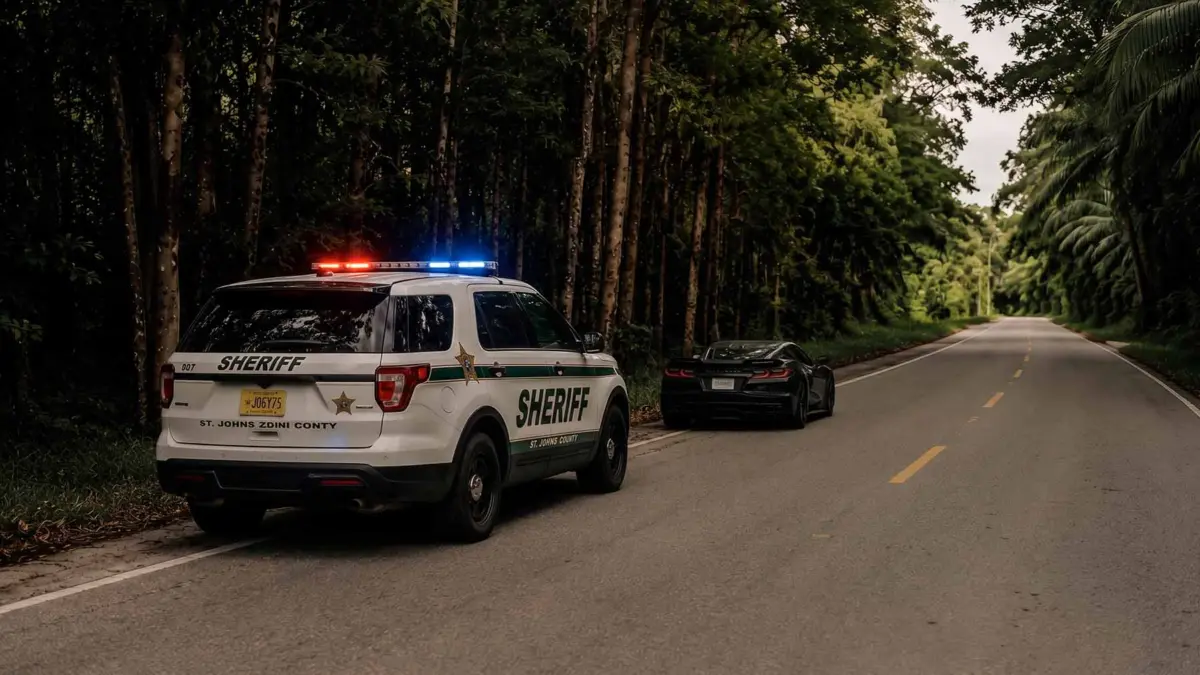
Those were the incredulous, exhausted opening words of a seasoned Florida law enforcement officer as he approached the driver’s side window of a high-performance Chevrolet Corvette that had just been safely brought to a halt on the shoulder of a Florida highway.
Moments earlier, the officer’s stationary radar unit had flashed an astronomical, terrifying figure: 209 km/h (130 mph). On that specific stretch of asphalt, the legal speed limit was a modest 72 km/h (45 mph).
What began as a routine traffic stop to address an egregious display of reckless acceleration ended with the driver stripped of their keys, read their rights, and fitted with steel handcuffs. The incident serves as a glaring, high-octane cautionary tale about the intersection of raw mechanical power, human limitation, and uncompromising state legislation designed to eradicate street racing and extreme speeding from public roads.
1. Main Facts: A High-Speed Interception on Public Asphalt
The core details of the enforcement action highlight a staggering disregard for public safety:
- The Vehicle: A high-powered Chevrolet Corvette, engineered for performance tracks but unleashed on standard public roads.
- The Speed: Clocked at 130 mph (209 km/h) in a designated 45 mph (72 km/h) zone.
- The Discrepancy: The driver was traveling 85 mph (137 km/h) over the posted limit, nearly tripling the maximum legal speed for the corridor.
- The Outcome: Immediate felony-level roadside detention, handcuffing, and transport to county holding cells, bypassing the traditional system of mere traffic infractions.
While the driver reportedly cooperated with authorities, remaining polite and conversational during the interaction, the sheer magnitude of the offense precluded any possibility of a warning. The velocity was simply too extreme, and the threat to surrounding motorists too severe, for discretion to play a role.
2. Chronology of the Stop: From Radar Spike to County Jail
To understand how quickly a routine patrol shift can transform into a high-stakes criminal apprehension, it is necessary to examine the sequence of events that transpired on the Florida highway:
- Phase 1: The Stationary Scan. The officer was conducting standard traffic monitoring from a concealed or stationary position, relying on calibrated radar technology to observe the flow of traffic.
- Phase 2: The Anomaly. The radar equipment locked onto an approaching Corvette. Instead of registering standard commuting speeds, the digital readout began climbing rapidly, defying normal traffic patterns.
- Phase 3: The Peak Velocity. The radar stabilized at 130 mph. The officer visually confirmed the sports car rocketing past surrounding traffic, which was moving at legal speeds. The closing speed and environmental dynamics immediately signaled an imminent catastrophe.
- Phase 4: The Interception and Realization. Activating emergency lights and sirens, the patrol vehicle caught up to the sports car as the driver pulled over. Upon approaching the window, the officer’s initial disbelief manifested in the rhetorical question that would later define the stop: "What on earth are we doing?"
- Phase 5: The Arrest. Recognizing that the conduct crossed the threshold from a civil traffic infraction into a criminal offense, the officer initiated standard arrest protocols. The driver was handcuffed on the spot—a stark reminder that extreme speed is no longer treated as a mere driving error—and subsequently transported to the local county detention facility for booking.
3. Supporting Data: The Physics of 130 MPH and Reaction Times
Beyond the legal ramifications, traffic safety experts and physicists emphasize that human biology is fundamentally incompatible with the forces generated at 130 mph on non-controlled access roads.
The Mathematics of Speed and Distance
When a vehicle travels at 130 mph (209 km/h), it covers approximately 58 meters (190 feet) every single second. To put this into perspective:
- In the time it takes for a driver to simply blink, process an unexpected hazard, and move their foot from the accelerator to the brake pedal (average human reaction time of 1.5 seconds), the vehicle travels well over 85 meters (nearly 280 feet) completely unchecked.
- Stopping distances multiply exponentially. Even with high-end carbon-ceramic brakes and optimal tire traction, a Corvette traveling at 130 mph requires an immense distance to scrub off speed, turning any sudden obstacle—such as a merging vehicle, a disabled car, road debris, or a pedestrian—into an unavoidable point of impact.
The Urban vs. Track Dynamic
Modern sports cars are marvels of automotive engineering, equipped with advanced stability control, telemetry systems, and aerodynamic downforce designed to keep them planted at high velocities. However, civil engineers design public highways and city corridors for standard human tolerances and mixed-use transit, not professional racing circuits.
Public roads feature intersections, driveways, variable lighting, and unpredictable human behavior. Marrying a 500-horsepower engine to a suburban or secondary roadway creates a localized hazard zone where technology cannot overcome the fundamental laws of physics.
4. Official Responses and Legal Framework: Florida’s "Super Speeder" Legislation
The decision by law enforcement to immediately arrest the Corvette driver was not left to the officer’s subjective discretion. It was mandated by strict state statutes designed to curb dangerous driving habits.
The Legislative Landscape
Under Florida law—specifically aligned with statutes targeting extreme velocity often referred to in legal and public safety circles as the "super speeders" framework—driving behavior of this magnitude is categorized as a serious criminal offense rather than a routine traffic violation.
According to state legal provisions, a driver can face criminal charges under two primary criteria:
- Velocity Threshold: Operating a vehicle at 50 mph (80 km/h) or more above the posted speed limit.
- Reckless Endangerment Threshold: Operating a vehicle at over 100 mph (161 km/h) in a manner that willfully and wantonly disregards the safety of persons or property.
The Corvette driver managed to breach both thresholds simultaneously: traveling 85 mph over the limit and hitting 130 mph in a 45 mph zone.
Penalties and Criminal Consequences
An arrest on the roadside is distinct from a formal conviction, but the legal pipeline for "super speeders" in Florida carries severe potential penalties:
- Criminal Record: Unlike a speeding ticket that results in points on a driver’s license and a fine, a conviction under these statutes results in a permanent criminal record.
- Incarceration: Offenders face up to 30 days in county jail for a first-time offense.
- Financial Penalties: Mandatory fines of $500 or more, alongside potential court costs, mandatory driver improvement courses, and drastic spikes in auto insurance premiums.
- Vehicle Impoundment: In many jurisdictions enforcing these statutes, vehicles utilized in extreme speed exhibitions or severe reckless driving incidents face immediate impoundment or forfeiture proceedings.
5. Broader Implications: A Cultural Shift Away from Automotive Recklessness
The Florida incident is part of a broader, nationwide reckoning regarding aggressive driving, street takeovers, and excessive speeding that surged during and after the pandemic years. Federal safety agencies, including the National Highway Traffic Safety Administration (NHTSA), have consistently warned that speed remains one of the top contributing factors to fatal traffic crashes across the United States.
The End of the "Speeding as a Victimless Crime" Myth
For decades, cultural depictions in movies, video games, and automotive media romanticized pushing cars to their absolute limits on open public roads. Speeding tickets were often viewed as an annoying "pay-to-play" tax for enthusiasts seeking an adrenaline rush.
However, aggressive legislative reforms across states like Florida, Virginia, and others have systematically dismantled that mindset. Law enforcement agencies are adopting a zero-tolerance posture. The message from the judiciary and public safety officials is unified: public highways are transit systems, not personal racetracks.
Conclusion: A Wake-Up Call for Drivers
The driver of the Corvette pulled over to the side of a Florida highway expecting, perhaps, a stern lecture or a costly ticket. Instead, they found themselves confronting the harsh reality of modern criminal traffic law—surrounded by flashing lights, facing handcuffs, and pondering the officer’s bewildered question: "What on earth are we doing?"
For the broader driving public, the incident stands as an urgent reminder. With high-performance engines meeting densely populated corridors and unforgiving penal codes, treating public roads as a venue for high-speed thrills is no longer a reckless game. It is a fast track to a jail cell, a criminal record, and an irreversible tragedy averted only by the grace of split-second timing.




Leave a Reply