

BOGOTÁ — In a high-stakes move carrying profound implications for the nation’s macroeconomic stability, Minister of Finance Miguel Gómez has officially petitioned the Constitutional Court to initiate a formal "fiscal impact incident" (incidente de impacto fiscal) regarding the landmark Sentence C-264 of 2026. The judicial ruling fundamentally restructured the timeline and parameters of Colombia’s heavily debated pension reform, pushing its ultimate implementation date to April 1, 2027.
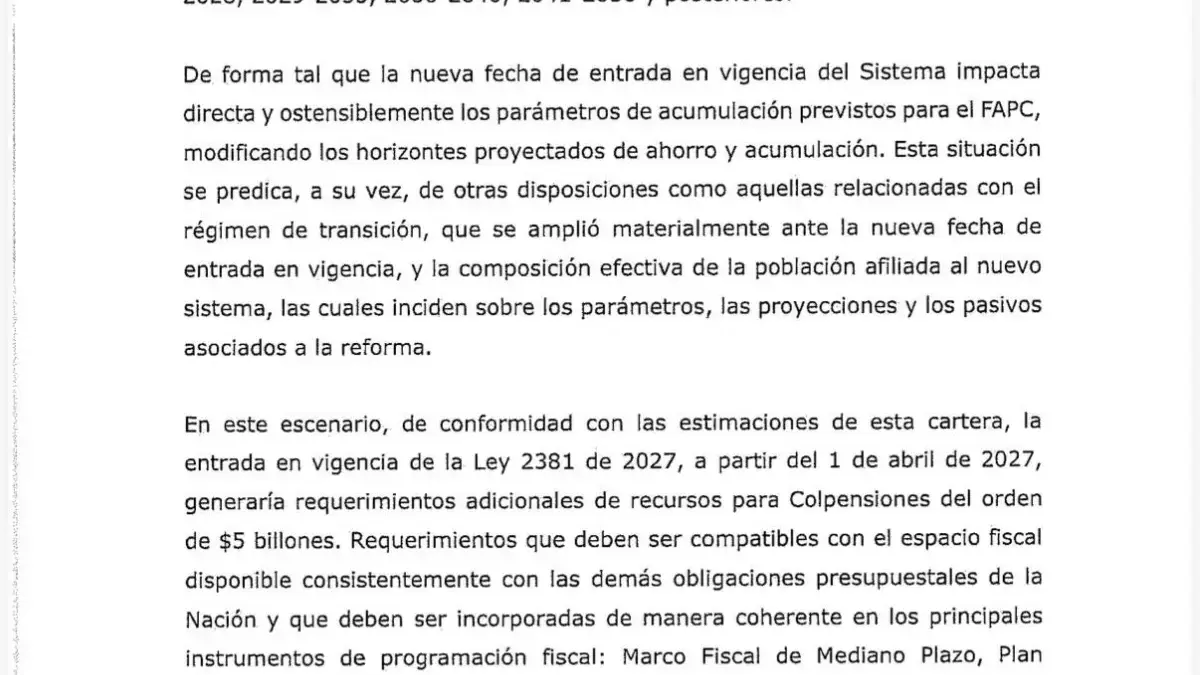
According to formal documentation submitted by the economic portfolio, the modifications mandated by the high court threaten to inject an immediate and unforeseen budgetary pressure of approximately $5 trillion COP into public finances. Minister Gómez argues that these structural shifts jeopardize the nation’s fiscal consolidation path at a time when public spending faces unprecedented rigidity.
The formal request sets the stage for a tense constitutional showdown between the judiciary’s mandate to protect rights and the executive branch’s obligation to safeguard macroeconomic sustainability. Below is a comprehensive breakdown of the unfolding crisis, examining its chronological evolution, underlying financial data, official statements, and broader systemic implications.
1. Main Facts
The core of the dispute centers on the intersection of judicial rulings, statutory law, and fiscal planning. Sentence C-264 of 2026 reviewed the constitutional validity and structural mechanics of the overarching pension overhaul (originally advanced via Law 2381 of 2024). While the Constitutional Court upheld the foundational spirit of the reform, it introduced modifications that altered the transitional calendar, pushing the full operational launch of the new multi-pillar pension system to April 1, 2027.
Minister Miguel Gómez, acting within the legal capacities granted to the head of the treasury, moved swiftly to invoke the fiscal impact procedure—a constitutional mechanism designed to alert the judiciary when a ruling threatens macroeconomic stability or imposes unsustainable expenditures on the public treasury.
Key factual pillars of the Ministry’s petition include:
- The Budgetary Gap: The Ministry of Finance estimates that the adjusted timeline and transitional rules will generate immediate additional resource requirements totaling $5 trillion COP.
- Pressure on Colpensiones: The state-run pension administrator will face accelerated liquidity demands that the government argues are incompatible with current medium-term fiscal frameworks.
- Savings Horizon Disruption: Altering the entry-into-force date directly disrupts the accumulation parameters of the Public Savings Fund for Pensions (FAPC, for its Spanish acronym), forcing a complete recalculation of long-term demographic and financial projections.
- Rigidity of Public Spending: The minister emphasized that Colombia’s current fiscal reality is defined by extreme expenditure rigidity, leaving very little margin to absorb unbudgeted multi-billion-peso liabilities.
2. Chronology of the Pension Reform and Judicial Review
To fully understand the gravity of the current fiscal impact incident, it is necessary to trace the turbulent timeline of Colombia’s pension reform from its legislative inception to the present judicial impasse.
- Late 2023 – Mid 2024 (Legislative Debate): The administration’s flagship pension reform project navigates a contentious path through the Congress of the Republic. Lawmakers debate the viability of a four-pillar system (solidarity, semi-contributory, contributory, and voluntary savings), culminating in the approval and sanction of Law 2381 of 2024.
- H2 2024 – 2025 (Constitutional Challenges): Various legal scholars, opposition politicians, and institutional actors file numerous lawsuits before the Constitutional Court, alleging procedural flaws during congressional debates and substantive violations of constitutional rights regarding acquired pension benefits.
- Early 2026 (The C-264 Ruling): The Constitutional Court issues Sentence C-264 of 2026. While avoiding a total collapse of the legislative framework, the Court rules on crucial adjustments, notably extending the transition periods and setting the definitive, unyielding date for the full operational implementation of the system as April 1, 2027.
- September 2026 (The Fiscal Intervention): Confronted with the updated financial models resulting from the Court’s calendar, Minister of Finance Miguel Gómez formally petitions the Constitutional Court to open an incidente de impacto fiscal, highlighting the $5 trillion COP deficit implication and demanding a coordinated approach to fiscal planning.
3. Supporting Data and Financial Projections
The technical arguments presented by the Ministry of Finance are rooted in rigorous actuarial and macroeconomic models. The $5 trillion COP figure is not an arbitrary estimate, but the calculated result of three converging structural alterations mandated by Sentence C-264:

Disruption of the FAPC Accumulation Parameters
The Public Savings Fund for Pensions was designed to absorb and manage the reserves generated by the new contributory pillar, ensuring long-term intergenerational equity. By shifting the implementation date to April 1, 2027, the structural inflow of funds is delayed, while existing liabilities continue to accrue under older, less sustainable parameters. Minister Gómez noted that this “impacts directa y ostensiblemente los parámetros de acumulación previstos para el FAPC, modificando los horizontes proyectados de ahorro y acumulación.”
Expansion of the Transition Regime
One of the most legally contentious aspects of the pension debate has always been the transition regime—the set of rules protecting individuals close to retirement age under the old system. The Constitutional Court’s modifications effectively broadened the scope and duration of this transition. According to the Ministry, this material expansion increases the population exempt from the new financial rules, forcing the state to shoulder a heavier burden of transitional subsidies for a prolonged period.
Affiliates Demographics and Passive Liabilities
The composition of the population entering the new system has shifted due to the revised calendar. The Ministry’s models indicate that these demographic shifts directly alter the actuarial calculations, increasing the hidden liabilities (pasivos asociados) that the nation must eventually finance. When combined with Colpensiones’ heightened immediate cash-flow needs, these factors strain the boundaries established by the Fiscal Rule.
4. Official Responses and Institutional Reactions
The announcement of the fiscal impact petition has triggered widespread reactions across political, economic, and judicial circles.
- The Ministry of Finance’s Stance: Minister Gómez has maintained a firm, technical tone, insisting that the executive branch is not attempting to bypass judicial authority, but rather fulfilling its legal duty to warn the state of impending insolvency risks. Gómez stressed that “el país se encuentra en un escenario de alta rigidez del gasto,” making it impossible to absorb unmapped fiscal shocks without cutting vital public investments or dangerously escalating national debt levels.
- Reactions from Congress: Lawmakers who championed the original text of Law 2381 have expressed frustration with the ongoing judicial modifications. Supporters of the reform argue that constant legal interventions threaten to destabilize a system designed to protect millions of vulnerable elderly citizens. Conversely, opposition legislators argue that the Ministry’s move validates their earlier warnings that the reform was financially unviable from its inception.
- Anticipated Judicial Response: Legal experts are closely monitoring how the Constitutional Court will handle the petition. While the incidente de impacto fiscal does not allow the Court to overturn its own substantive rulings, it forces a dialogue between the judiciary and the executive. Under Colombian law, if the Court acknowledges a severe fiscal impact, it can modulate the effects of its sentence, grant the government additional time for compliance, or urge Congress to pass corrective legislation.
5. Broader Macroeconomic and Social Implications
The standoff between the Ministry of Finance and the Constitutional Court carries profound consequences that extend far beyond government spreadsheets, touching upon the daily lives of millions of future retirees and the broader health of Colombia’s economy.
Credibility of the Fiscal Rule and International Markets
Global credit rating agencies and international investors closely monitor Colombia’s adherence to its Fiscal Rule—the legal framework that limits government deficit and debt growth. An unbudgeted expenditure of $5 trillion COP, if mishandled, could signal fiscal indiscipline to rating agencies, potentially leading to credit downgrades, higher borrowing costs for the sovereign state, and increased macroeconomic volatility.
Intergenerational Equity vs. Immediate Fiscal Reality
At the heart of the debate lies a profound philosophical conflict. Proponents of the pension reform argue that expanding coverage and protecting transitional populations are moral imperatives necessary to eradicate old-age poverty in a nation with high levels of informal labor. On the other side, fiscal conservatives and treasury officials argue that without macroeconomic stability, the pension promises of today will morph into hyperinflationary crises or sovereign defaults tomorrow, ultimately harming the very citizens the reform aims to protect.
The Path Forward: Coordination or Crisis?
As April 1, 2027, draws closer, the pressure on all branches of government will only intensify. The Constitutional Court must now evaluate Minister Gómez’s petition with judicial rigor, balancing constitutional rights with economic realities. Whether through the modulation of the sentence, targeted budgetary reallocation, or subsequent legislative adjustments, Colombia’s political leadership faces the urgent task of harmonizing social welfare goals with fiscal prudence to ensure the long-term viability of the nation’s retirement system.




Leave a Reply