

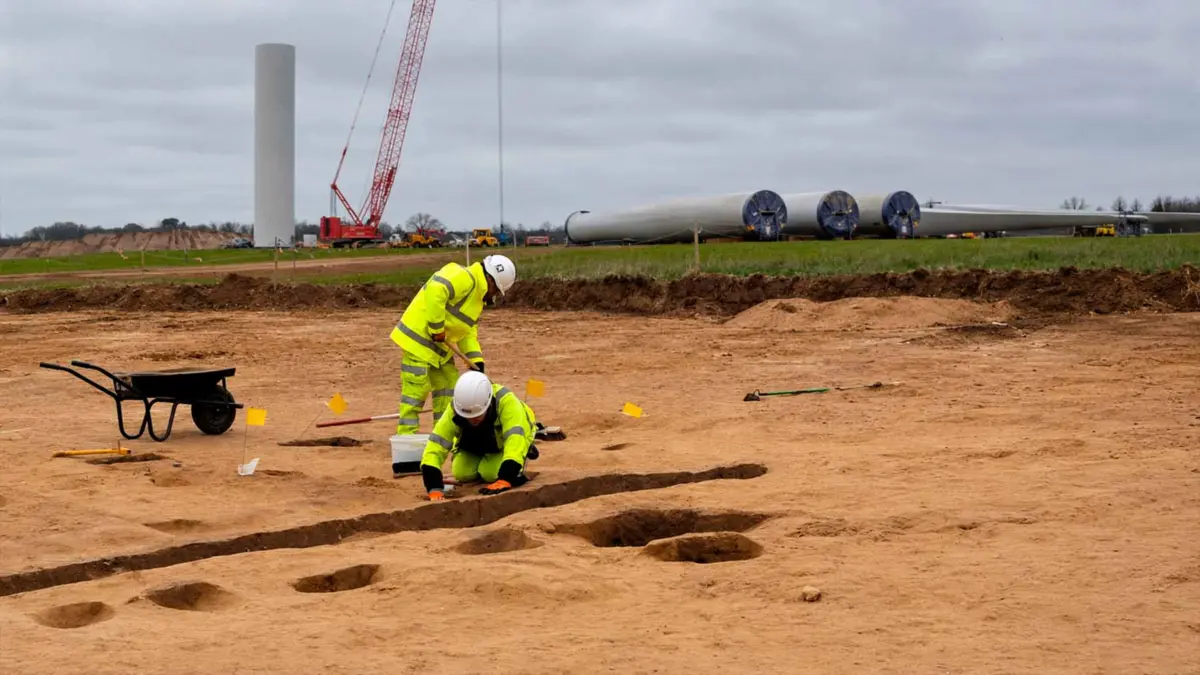
SUFFOLK, ENGLAND — Modern renewable energy infrastructure and ancient history are rarely bedfellows, yet in the rolling countryside of East Anglia, the two have converged in a remarkable archaeological discovery. What began as a routine, preliminary environmental and cultural heritage assessment for a proposed clean-energy project transformed into a window through time.
Beneath the soil designated for a modern electrical substation, field archaeologists stumbled upon more than just isolated artifacts. A single, pristine stone arrowhead—dating back more than four millennia—served as the literal and figurative key that unlocked an entire medieval community. The subsequent excavations revealed a thriving Anglo-Saxon settlement that endured for centuries before vanishing into the mists of history during the tumultuous 14th century.
The discovery highlights a profound, often overlooked reality of the modern era: beneath the asphalt, agricultural fields, and construction sites of the 21st century lie countless untold chapters of human history, preserved silently until the march of progress accidentally disturbs their rest.
Main Facts
The groundbreaking discovery took place in the county of Suffolk, England, during preparatory groundwork for a new wind farm infrastructure initiative. Conducted by specialists from the renowned organization Wessex Archaeology, the site evaluation was designed to identify and catalog any cultural assets before heavy construction could commence.
Initial expectations were modest. Standard archaeological evaluations in agricultural regions frequently yield scattered flint shards or isolated pottery fragments, but rarely anything of structural significance. However, the discovery of a remarkably well-preserved prehistoric arrowhead—clocking in at over 4,000 years old—completely shifted the trajectory of the project.
As researchers broadened their scope and removed successive strata of topsoil, a far more complex historical narrative emerged:
- Prehistoric Roots: Alongside the arrowhead, specialists recovered a prehistoric axe head, confirming that hunter-gatherer and early agrarian societies utilized the land millennia before the common era.
- The Anglo-Saxon Settlement: Beneath the prehistoric layers, archaeologists unearthed the substantial remains of a lost Anglo-Saxon village dating back to the Early Middle Ages.
- Architectural Evidence: The site featured a complex network of timber-framed residential dwellings, communal structures, and agricultural outbuildings indicative of a stable, long-term rural community.
- The Sudden Silence: The settlement remained continuously inhabited for centuries, supporting generations of families, tradespeople, and farmers, before being completely abandoned sometime during the 1300s.
Chronology of Discovery: From a Single Flint to a Lost Village
To understand how a modern green energy project successfully partnered with historical preservation, it is essential to trace the timeline of the Suffolk excavation.
Phase 1: Pre-Construction Assessments
Before laying the groundwork for the wind farm’s electrical sub-stations—critical nodes designed to channel renewable energy generated offshore and onshore into the national grid—developers complied with local planning regulations by commissioning a heritage survey. Wessex Archaeology deployed field technicians to conduct geophysical surveys and trial trenching.
Phase 2: The Prehistoric Breakthrough
During the manual examination of the upper soil layers at the substation footprint, a field archaeologist spotted an anomaly: a finely chipped stone arrowhead. In prehistoric times, flint and stone hunting implements were delicate and prone to shattering upon impact with bone or hard ground. Finding an intact specimen from the Neolithic or early Bronze Age was an immediate indicator of deliberate deposition or loss by ancient hunters. Shortly thereafter, the discovery of a polished stone axe head confirmed that the location had attracted human activity thousands of years before written records in Britain.
Phase 3: Delving into the Middle Ages
Encouraged by the prehistoric finds, the archaeological team expanded their excavation trenches deeper and wider. As they stripped away the centuries of accumulated sediment, the soil coloration shifted, revealing post-holes, ditch systems, and hearth pits. These soil discolorations mapped out the footprints of timber buildings—classic markers of an Anglo-Saxon agricultural community. The presence of domestic pottery, animal bones, and metalwork confirmed that this was not merely a seasonal camp, but a permanent, thriving village.
Supporting Data and Archaeological Significance
The significance of the Suffolk excavation extends far beyond the novelty of finding old items; it offers invaluable data regarding rural life in Anglo-Saxon and medieval England.
According to reports published by Wessex Archaeology, rural settlements from the Early and High Middle Ages are critical for understanding the socioeconomic fabric of pre-industrial Britain. While historical texts from the period frequently focus on royalty, monasteries, and major military conflicts, they rarely document the day-to-day existence of ordinary agrarian villagers.
Key data points emerging from the analysis include:
- Material Culture: Recovered pottery shards, loom weights, and iron tools indicate a self-sufficient economy where inhabitants engaged in textile production, animal husbandry, and localized trade.
- Spatial Organization: The layout of the excavated buildings suggests a planned or organically evolved community structure, with domestic spaces clearly segregated from livestock management areas.
- Environmental Data: Soil and botanical samples retrieved from ancient storage pits and hearths are currently undergoing laboratory analysis. These samples will shed light on the local diet, agricultural practices, and environmental conditions of Suffolk over a thousand years ago.
The Enigma of the 14th-Century Abandonment
One of the most compelling aspects of the Suffolk excavation is the question of its demise. The archaeological record demonstrates that the village was vibrant and resilient for centuries, adapting through shifting political landscapes, the Norman Conquest, and the fluctuating economic fortunes of medieval England. Yet, in the course of the 14th century, the lights went out permanently.
To date, researchers have found no evidence of a violent destruction event, such as a military raid or fire, which suggests the village suffered a slow or systemic decline. Archaeologists and historians are currently investigating several prominent hypotheses:
- The Shadow of the Black Death: The 14th century was rocked by catastrophic demographic crises, most notably the Black Death (1348–1350). The pandemic decimated up to 60% of the population in parts of Europe. Entire villages across rural England were rendered unviable due to sudden, catastrophic labor shortages, leading to the phenomenon known today as "lost medieval villages."
- Climatic Shifts: The transition from the Medieval Warm Period to the Little Ice Age brought colder temperatures, torrential rains, and failing crops across Northern Europe during the early 14th century, rendering marginal agricultural lands unsustainable.
- Economic and Feudal Shifts: Changing land-use patterns, such as the conversion of arable land into sheep pastures by local lords, frequently displaced peasant communities during this era, prompting voluntary or forced migrations to larger towns.
Further osteological and environmental studies are underway to determine whether the soil samples or nearby burial contexts bear the molecular signatures of disease or famine.
Implications: Coexistence of Progress and Preservation
As global demand for clean, renewable energy accelerates, the development of green infrastructure—such as wind farms, solar arrays, and transmission substations—requires vast swaths of land. Historically, conflicts have occasionally arisen between developers seeking rapid construction timelines and heritage organizations advocating for historical preservation.
The Suffolk project serves as a shining example of how modern industry and historical stewardship can successfully coexist.
Operational Synergy
Rather than halting the wind farm project indefinitely, the discovery initiated a well-coordinated rescue archaeology protocol. Under British planning law (often governed by frameworks like the National Planning Policy Framework), developers are typically responsible for funding archaeological mitigations when significant heritage assets are discovered.
By allowing Wessex Archaeology the necessary time and resources to thoroughly excavate, document, and remove the historical artifacts, the developers ensured that the heritage of the site was not lost to bulldozers. Once the scientific recovery phase concludes, construction on the wind farm’s electrical substation will resume as planned.
Bridging the Technological and the Timeless
The irony of the site is striking: a plot of land destined to generate electricity for the 21st century—powering homes, electric vehicles, and digital networks through the invisible force of wind energy—was previously home to a community whose existence relied entirely on muscle, timber, and the soil.
Experts note that modern archaeological techniques, including drone mapping, ground-penetrating radar, and isotopic analysis of teeth and bones, allow researchers to extract vastly more information from these rescue digs than was possible even a few decades ago. Consequently, the temporary disruption caused by the wind farm construction has inadvertently rescued an entire community from permanent oblivion.
Conclusion
The lost Anglo-Saxon village of Suffolk reminds humanity of the profound depth beneath our feet. What started as a routine environmental clearance check for a clean-energy installation turned into a historical triumph, bridging a 4,000-year gap between a prehistoric flint arrowhead and the high-tech green energy systems of tomorrow.
As the artifacts are cataloged, the soil samples analyzed, and the construction machinery prepares to return to the site, this forgotten medieval community has finally reclaimed its place in history. Through careful scientific inquiry and corporate responsibility, the past has not been sacrificed for the future; rather, the future has given the past a voice once more.




Leave a Reply