

Main Facts
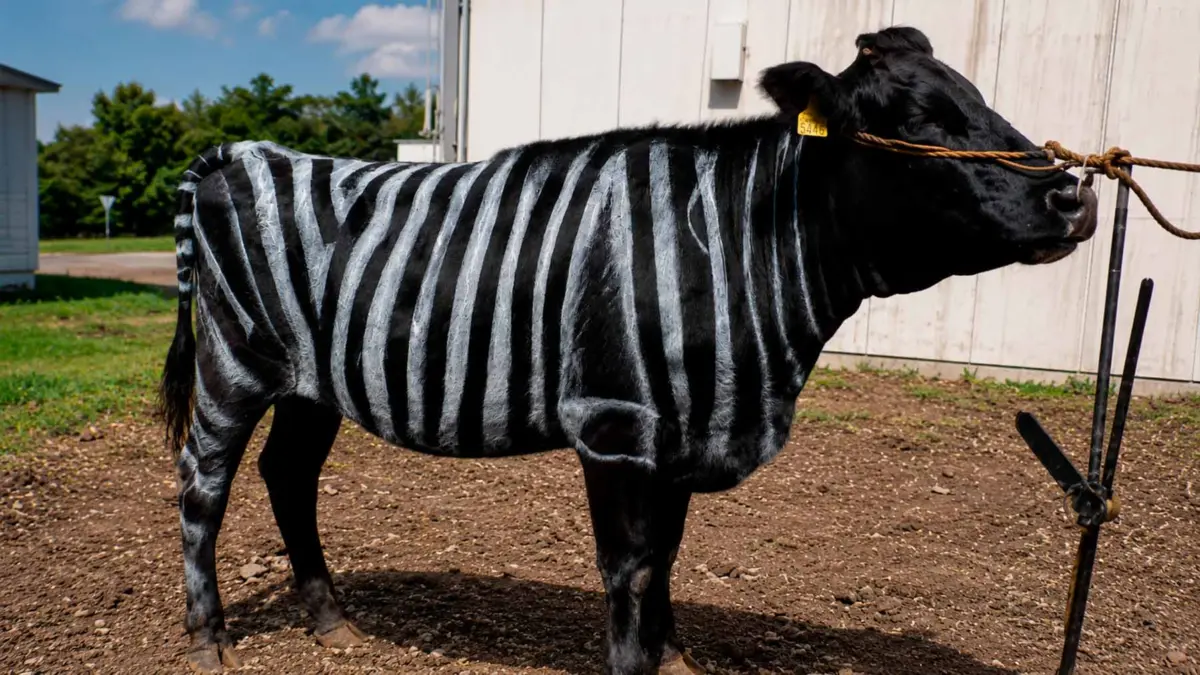
In the rolling pastures of Japan, a remarkably simple yet unconventional technique has upended decades of agricultural pest-management strategy: painting dairy and beef cattle to look like zebras. Researchers have discovered that adorning the glossy black coats of Japanese Black cattle—the premier source of world-renowned Wagyu beef—with alternating white stripes drastically reduces the number of biting insect attacks.
For years, livestock producers have relied heavily on chemical insecticides, therapeutic sprays, and pesticide-laden dips to protect their herds from blood-sucking pests like biting flies and horseflies. While these chemical interventions offer temporary relief, they come with substantial financial costs, environmental footprints, and the growing threat of chemical resistance among fly populations.
The breakthrough, born from observing nature’s own evolutionary designs, proved that cows painted with white stripes experienced less than half the fly bites of their unpainted counterparts. Furthermore, the treated animals spent significantly less time engaging in defensive behaviors, such as tail-swishing, head-tossing, and skin-twitching. This unorthodox method, which even earned an Ig Nobel Prize, has opened new horizons for sustainable, non-toxic livestock management, proving that sometimes the most sophisticated technological answers are found simply by looking at how nature solved the problem millions of years ago.
Chronology: From Evolutionary Curiosity to Agricultural Innovation
The journey from a wild theory regarding African equids to a peer-reviewed agricultural study in Japan spans years of cross-disciplinary observation and rigorous field trials.
The Zebra Paradox (Pre-2010s)
For generations, biologists and ethologists debated the evolutionary purpose of the zebra’s striking black-and-white stripes. Theories ranged from social recognition and camouflage in tall grasses to thermoregulation. However, a prominent hypothesis gained traction: the stripes serve as a visual deterrent to biting flies, particularly horseflies (tabanids) and stable flies, which carry debilitating diseases and cause immense stress to herd animals.
The Japanese Black Vulnerability and Chemical Reliance
Simultaneously, in the agricultural sector of Japan, breeders of Japanese Black cattle—the foundation of luxury Wagyu beef—faced a persistent environmental hurdle. These high-value animals possess rich, uniform black coats that absorb sunlight and make them conspicuous targets for pests. During the warmer months, swarms of biting insects descended upon the pastures. To protect their prized livestock, farmers escalated their use of chemical pesticides, establishing a cycle of high expenses and increasing ecological concerns.
The Aichi Agricultural Research Center Experiment (Late 2010s)
Seeking a sustainable alternative, a team of Japanese researchers led by Tomoki Kojima at the Aichi Agricultural Research Center decided to test the zebra hypothesis on domestic livestock. They hypothesized that if stripes could deter flies from zebras, they could theoretically do the same for cattle.
In controlled field experiments, researchers categorized the cattle into three distinct groups:
- Cows painted with white stripes (mimicking zebra patterns).
- Cows painted with black stripes (as a control to test whether the paint itself or the act of painting mattered).
- Completely unpainted control cows.
The Results and Recognition (2019–Present)
The findings, published in the scientific journal PLOS One in late 2019, stunned the agricultural community. Cows adorned with white stripes experienced a dramatic reduction in biting fly attacks—more than 50% fewer bites than the control groups. The study garnered international attention and was awarded an Ig Nobel Prize, celebrating research that "first makes you laugh, then makes you think." While hand-painting cattle remains labor-intensive for commercial-scale farming, the study catalyzed ongoing research into visual deterrent technologies, genetic coat modifications, and automated application methods.
Supporting Data: The Hidden Toll of Pests and the Science of Stripes
To understand why a coat of paint yields such dramatic results, one must examine both the physiological impact of insect harassment on cattle and the visual mechanics of how flies perceive their environment.
The Energetic Toll on Livestock
Biting insects are far more than a minor nuisance; they are severe economic and welfare liabilities. When tormented by flies, cattle alter their behavior to fend off the pests:
- Hyperactive Defense Mechanisms: Animals continuously swish their tails, stamp their feet, kick their bellies, and shudder their skin.
- Reduced Foraging Time: Constantly swatting insects interrupts grazing and rumination. Studies indicate that heavy fly pressure can reduce feeding time by up to 25%.
- Stress-Induced Aggregation: Under severe attack, cattle bunch tightly together in defensive herds. This crowding often leads to physical injuries, trampling, heat stress, and hierarchical aggression.
- Metabolic Loss: The energy expended on defensive movements and the reduction in nutrient intake directly translates to lower weight gain, diminished milk production in dairy cows, and a potential degradation in the coveted marmoled fat structure of Wagyu beef.
Why Do Stripes Work? Polarization and Perception
The mechanism behind the stripe deterrent relies on the visual biology of biting insects. Horseflies and stable flies are guided primarily by polarized light reflections and motion detectors.
- The Dark Coat Trap: Uniformly dark surfaces reflect linearly polarized light in a way that strongly attracts tabanid flies, signaling a hospitable surface for landing and feeding.
- Optical Disruption: The alternating black-and-white stripes disrupt the polarization pattern reflected off the animal’s hide. When a fly approaches a striped surface, the abrupt transition between light and dark polarization cues confuses its visual processing system, preventing it from accurately calculating distance, speed, and the proper angle for landing.
- The Control Proof: This was definitively proven during the Aichi trials when cows painted with black stripes (which maintained a dark polarization profile) experienced just as many bites as unpainted cows, confirming that the white contrast was the active deterrent.
| Parameter | Unpainted Cattle | Black-Striped Control | White-Striped Cattle |
|---|---|---|---|
| Relative Biting Frequency | High (Baseline) | High (No significant difference) | Reduced by > 50% |
| Defensive Behaviors (Swishing/Stamping) | Frequent & Constant | Frequent | Markedly Decreased |
| Foraging/Resting Time | Compromised | Compromised | Optimized |
| Chemical Pesticide Reliance | Heavy | Heavy | Minimized |
Official Responses and Industry Perspectives
The unorthodox success of the "zebra cow" experiment prompted reactions ranging from amused fascination to serious contemplation from agricultural authorities, entomologists, and livestock unions.
Tomoki Kojima, lead researcher at the Aichi Agricultural Research Center, emphasized the practical philosophy behind the study:
"We wanted to find a method that protects livestock without harming the environment or creating chemical resistance in pest populations. Nature has spent millions of years fine-tuning survival strategies; our job was simply to borrow an elegant design and test its limits in a domesticated setting."
Environmental scientists and sustainable agriculture advocates have largely championed the findings. Groups focused on reducing agricultural runoff have pointed out that decreasing reliance on chemical dips and synthetic sprays directly benefits local watersheds, soil microbiomes, and non-target beneficial insect populations, such as bees and butterflies.
Meanwhile, commercial Wagyu producers have expressed cautious optimism. While breeders acknowledge the profound welfare and productivity benefits of keeping flies away from high-value livestock, practical implementation remains a topic of debate.
- "Pintura manual (manual painting) is simply not feasible for a rancher managing hundreds or thousands of head of cattle," noted a representative from a prominent Japanese livestock association. However, the underlying science changes the conversation. If geneticists can selectively breed cattle with lighter, patterned coats, or if automated, spray-paint chute systems can be developed, this could revolutionize pasture management worldwide."
Implications: The Future of Sustainable Livestock Management
The implications of painting cows like zebras extend far beyond a quirky anecdote or an award-winning academic paper. As global agriculture faces mounting pressure to reduce its chemical footprint while feeding a growing population, low-tech, bio-inspired solutions are gaining critical momentum.
1. Reducing Chemical Resistance and Environmental Contamination
The overuse of synthetic insecticides has led to the proliferation of "super-flies"—populations of biting insects that have developed genetic resistance to standard commercial chemicals. By introducing visual deterrents like stripes, farmers can drastically cut down their application frequency, thereby preserving the efficacy of existing chemicals for extreme infestations and preventing chemical runoff into local ecosystems.
2. Advancing Animal Welfare Standards
Animal welfare is becoming an increasingly important metric for consumers, particularly in luxury markets like Wagyu beef. Minimizing chronic stress caused by biting pests improves the physiological well-being of the herd. Lower stress levels mean healthier animals, stronger immune systems, and a more humane production cycle from pasture to plate.
3. Bio-Inspired Technologies and Breeding Programs
The success of the zebra-stripe experiment is sparking innovation across multiple disciplines:
- Smart Breeding: Agricultural geneticists are exploring whether natural coat variations or lighter pigmentation traits can be selected alongside traditional Wagyu marbling traits.
- Automated Application: Engineers are conceptualizing automated "paint-gate" systems—similar to automated wash stations—where cattle can pass through and receive non-toxic, long-lasting white stripe applications with minimal human labor.
- Textile and Shelter Design: The principles of visual disruption are also being studied for application in livestock housing, shade structures, and protective netting, applying zebra-stripe optics to physical infrastructure.
Ultimately, the revelation that a simple coat of white paint can protect prized cattle serves as a humbling reminder to modern science. In an era dominated by complex biotechnology and synthetic pharmacology, the most elegant, sustainable solutions are sometimes discovered simply by stepping back, observing the natural world, and learning how evolution has solved our oldest problems.




Leave a Reply