

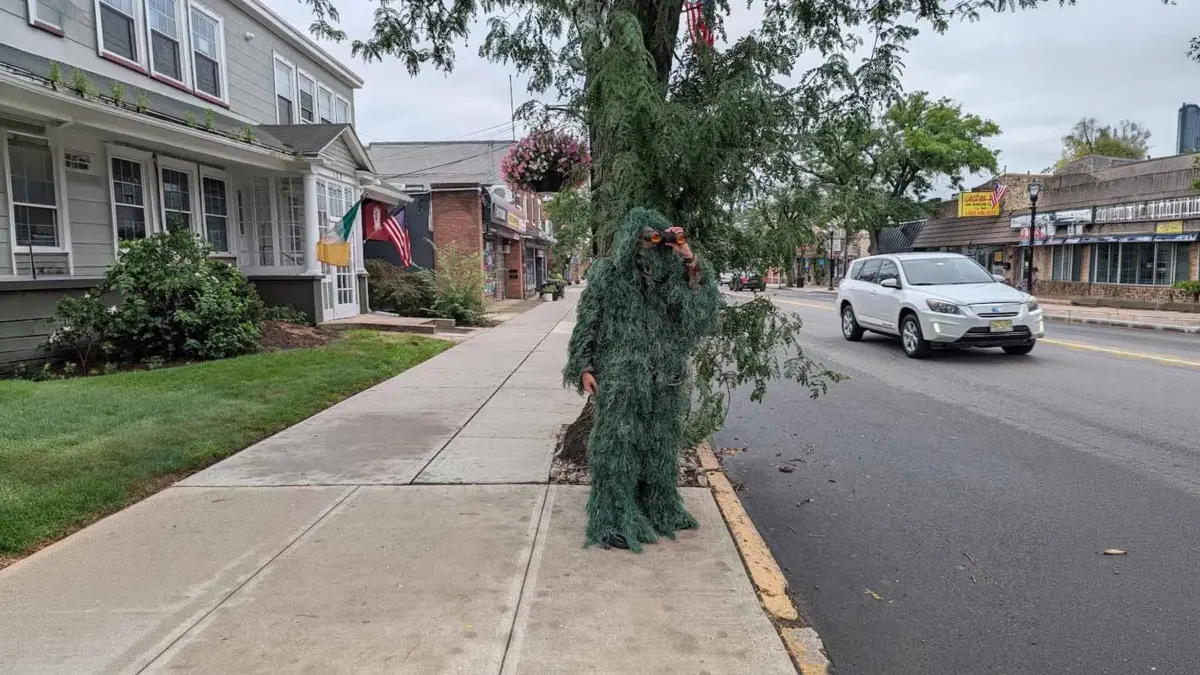
DUNELLEN, New Jersey — What initially appeared to be a viral internet prank quickly materialized into a stark, real-world lesson on the asphalt arteries of Dunellen, New Jersey. In an era where mobile device addiction routinely trumps situational awareness behind the wheel, local law enforcement decided to rewrite the manual on traffic enforcement.
Utilizing theatrical camouflage, satirical props, and an unconventional stakeout, the Dunellen Police Department executed an operation that looked like a scene straight out of a comedy sketch. Yet, beneath the viral imagery and widespread social media amusement lay a sobering, life-or-death message: checking a text message while driving creates a level of cognitive blindness so profound that motorists can drive right past a grown man disguised as a leafy shrub—and fail to notice him entirely.
1. Main Facts: The Anatomy of a High-Concept Traffic Operation
The operation, orchestrated by the Dunellen Police Department, was designed to combat a persistent and lethal traffic violation: distracted driving driven by smartphone usage. For months, local authorities noticed a predictable pattern among commuters. Motorists would quickly stash their mobile devices out of sight the moment they spotted a marked police cruiser, only to dive right back into their screens the second they believed they were out of view.
Traditional traffic stops—flashing lights, pulled-over sedans, and standard ticket issuance—were proving insufficient to break the cycle of habit. Drivers had become desensitized to the presence of standard patrol cars. To bypass this psychological blind spot, law enforcement deployed a two-man tactical team equipped with specialized, albeit bizarre, equipment:
- The "Bush" Operative: One police officer donned an elaborate, military-grade camouflage ghillie suit. Covered entirely in synthetic foliage, fabric leaves, green netting, and synthetic moss, the officer blended seamlessly into the urban shrubbery lining a local sidewalk, remaining completely motionless next to a tree.
- The Lookout Prop: A second officer stood atop a public bench, holding a tactical radio in one hand and wearing a custom t-shirt emblazoned with the unmistakable, paradoxical declaration: “I am not a cop.”
- The Communication Chain: As the camouflaged officer spotted motorists actively looking down at glowing screens in their laps, he would radio the make, model, and license plate details to a team of interceptor units stationed just down the road.
The resulting operation yielded staggering statistics that underscored just how pervasive the problem of mobile device distraction truly is on American roadways.
2. Chronology: How the Six-Hour Stakeout Unfolded
The operation was meticulously planned to target peak commuting hours when traffic density and smartphone usage historically intersect at their highest rates. While the Department has not publicly disclosed the exact date of the operation to protect future tactical initiatives, the timeline of the six-hour deployment reveals a masterclass in modern traffic enforcement.
Phase 1: Infiltration and Positioning (Hours 1–2)
Early in the morning, long before the heavy rush-hour traffic choked the thoroughfares of Dunellen, the tactical team deployed to their designated positions. The officer chosen for the camouflage assignment spent significant time ensuring his ghillie suit matched the local flora. Blending in with a mix of deciduous trees and manicured public landscaping, he took up a position mere feet from the curb.
Simultaneously, the second officer mounted a nearby concrete bench. Positioned with a clear vantage point of oncoming traffic, he adopted a casual posture while keeping his radio ready and his paradoxical warning shirt prominently displayed.
Phase 2: The Harvest of Infractions (Hours 2–5)
As morning traffic swelled, the operation began in earnest. The sheer volume of distracted motorists shocked even the seasoned veterans on the force. Within minutes of taking their positions, the "bush" officer began spotting infraction after infraction.
Drivers were observed scrolling through social media feeds, typing out lengthy text messages, navigating mapping applications, and, in some cases, holding phones directly in front of their steering wheels while traveling at substantial speeds. The camouflage proved remarkably effective. Vehicle after vehicle rolled past the leafy officer at close proximity. Drivers were so entirely consumed by the glowing rectangles in their hands that their peripheral vision effectively shut down.
When the spotter confirmed a violation, he calmly relayed the information down the block, where waiting patrol units executed swift, safe traffic stops.
Phase 3: Public Dissemination and Digital Fallout (Hour 6 and Beyond)
As the operation drew to a close, the department transitioned from physical enforcement to digital awareness. Recognizing the comedic value of a police officer dressed as a bush, authorities captured photographs and video footage of the operation.
These assets were subsequently uploaded to the official Dunellen Borough Police Department Facebook page. Within hours, the post went viral, racking up thousands of shares, comments, and reactions from across the globe. What began as a local municipal sting transformed into an international conversation piece regarding the absurdity—and danger—of modern driving habits.
3. Supporting Data: The Numbers Behind the Distraction
While the visual of a police officer in a ghillie suit provided endless internet fodder, the empirical data gathered during the operation highlights a grim reality.
During the targeted six-hour shift, 74 drivers were pulled over and issued citations specifically for distracted driving. To put that figure into perspective, officers were successfully identifying and penalizing more than 12 distracted motorists every single hour—a rate that suggests a staggering percentage of the driving population views their phones as an extension of the vehicle dashboard.
To understand the broader context of why the Dunellen police had to resort to such extreme measures, one must look at national traffic safety statistics:
- Cognitive Distraction: According to the National Highway Traffic Safety Administration (NHTSA), sending or reading a text takes a driver’s eyes off the road for an average of 5.1 seconds. At 55 mph, that is the equivalent of driving the length of an entire football field blindfolded.
- The Illusion of Multitasking: Neurological studies consistently show that the human brain cannot truly multitask; it merely switches rapidly between tasks. When a driver looks at a phone, cognitive processing power shifts away from hazard detection, reducing reaction times to levels comparable to driving under the influence of alcohol.
- Pedestrian Vulnerability: Distracted driving is a primary catalyst behind the rising tide of pedestrian and cyclist fatalities in urban and suburban environments. A driver staring at a screen will fail to process lateral movement, such as a child stepping off a curb or a cyclist entering an intersection.
4. Official Responses and Departmental Rationale
Public reaction to the Facebook post was initially split between amusement at the department’s creativity and skepticism regarding the legality or ethics of the tactic. Some social media users questioned whether dressing as a shrub constituted entrapment or unfair policing.
The Dunellen Police Department was quick to address these concerns through official statements accompanying their social media updates and subsequent interviews with regional media outlets.
Clarifying the Tactics
Department leadership emphasized that the officer in the ghillie suit did not remain concealed for the entirety of the shift, nor was the operation designed to hide speed limit signs or entrap unwitting citizens. Rather, the primary objective was to pierce the digital bubble in which modern drivers operate.
"People think they are being safe just because they slow down when they see a marked cruiser," a department spokesperson noted. "This operation proved that when your eyes are locked onto a screen, you aren’t just missing the police—you are missing your entire environment. You could drive past a walking, breathing forest, and you wouldn’t even blink."
A Shift Toward Digital Public Relations
The decision to publicize the operation online was intentional. Police administrators realized that traditional ticketing campaigns often fail to reach the demographic most prone to smartphone distraction: younger, tech-native drivers. By leaning into internet culture and utilizing self-aware humor, the Dunellen Police Department successfully amplified their safety message to an audience millions of times larger than the local population of Dunellen itself.
Legal experts weighed in on the operation, confirming that utilizing visual camouflage to observe public violations from public property falls well within the bounds of standard investigative discretion, provided citations are issued based on verifiable, observed infractions.
5. Implications: The Broader Message for Modern Motorists
The Dunellen "bush cop" saga is much more than a quirky news item to be shared and forgotten. It serves as a microscopic lens focusing on a macro-level societal crisis: our unhealthy, dangerous dependency on portable digital technology.
As vehicles become increasingly computerized and smartphones become more deeply integrated into daily life, the battle for driver attention is being lost on a daily basis. Campaigns reminding people to "put down the phone" have largely lost their edge through sheer repetition. It took a grown man wrapped in synthetic moss to finally shock the public consciousness back into reality.
The Cost of a Single Glance
Every notification, every text message, and every social media scroll represents a deliberate choice to trade safety for stimulation. The drivers in Dunellen who bypassed the bush and the "I am not a cop" sign suffered financial consequences in the form of traffic fines, but they escaped with something far more valuable: their lives, and the lives of those sharing the road with them.
A Final Warning for the Road
As municipalities across the country look for innovative ways to enforce traffic laws in the digital age, the legacy of Dunellen’s undercover shrub will undoubtedly echo in driver-education discussions for years to come.
The next time you find yourself behind the wheel, waiting at a red light or cruising down a suburban street, and feel the familiar, almost involuntary itch to check your pocket for a buzzing phone, pause for a moment. Resist the urge. Keep your eyes firmly fixed on the pavement ahead.
After all, you never truly know what—or who—might be standing quietly by the side of the road, watching to see if you are paying attention.



Leave a Reply