

By Global News Desk
Published: August 2024
Main Facts: The Seismic Reality and the Global Shift Toward Preparedness
Recent tectonic activity across South America has once again placed human vulnerability under the microscope. In a dramatic span of weeks, the earth unleashed its raw power across the region: Venezuela was rattled by powerful earthquakes measuring magnitudes 7.2 and 7.5, followed closely by a severe 7.4-magnitude tremor in Colombia with an epicenter near San José del Palmar in the department of Chocó. These high-magnitude events did not occur in isolation; they arrived amid a broader, global pattern of natural disasters that includes devastating floods, massive wildfires, prolonged blackouts, and severe health emergencies.
These crises share a common denominator: they instantly fracture the fragile infrastructure of modern life. When electricity grids fail, water treatment plants shut down, and telecommunication networks collapse, the immediate burden of survival falls squarely on the individual and the household.
In response to this escalating reality, international civil protection bodies are radically rethinking crisis response. Notably, the European Commission, through its overarching Union Preparedness Strategy, has spearheaded initiatives designed to guide populations toward maintaining a minimum of 72 hours of complete self-sufficiency. This "golden window" of three days is the critical timeframe emergency responders universally recognize as the period required for organized relief, search-and-rescue teams, and government aid to reach affected populations.
Being prepared is no longer an exercise in localized paranoia; it is a vital civic responsibility. As seismic activity demonstrates the sheer unpredictability of our planet, building a comprehensive emergency kit and understanding how to manage the first critical hours following a disaster can mean the difference between panic and survival.
Chronology: A Timeline of Recent Seismic Disruptions and Escalating Crises
To understand the urgency driving modern emergency planning, one must examine the rapid succession of natural disasters that have tested regional and international resilience over recent years.
- Early 2023 – Mid-2024 (Global Climate Anomalies): A surge in extreme weather events globally—ranging from unprecedented flash floods in Western Europe to crippling heatwaves and wildfires across North and South America—strains municipal emergency resources and forces a reevaluation of civil defense protocols.
- June 24, 2024 (The Venezuelan Shocks): Venezuela experiences back-to-back major earthquakes of magnitudes 7.2 and 7.5. The dual tremors cause widespread panic, structural damage in several states, and immediate regional power outages, exposing gaps in urban disaster response and sparking renewed debates regarding household preparedness.
- July 2024 (The European Policy Pivot): Drawing lessons from compounding global crises, the European Commission accelerates the rollout of its preparedness guidelines, formally emphasizing the 72-hour self-sufficiency rule for citizens to mitigate the initial strain on public rescue services.
- August 10, 2024 (The Colombian Quake): A formidable 74-magnitude earthquake strikes Colombia. With its epicenter located near San José del Palmar in Chocó, the tremor is felt intensely across multiple regions, triggering landslides, cutting off remote communities, and disrupting local commerce and communications.
- Present Day: Civil defense organizations, municipal governments, and international bodies intensify public awareness campaigns, shifting the narrative from reactive disaster management to proactive, household-level preparedness.
Supporting Data: The Anatomy of a 72-Hour Emergency Kit
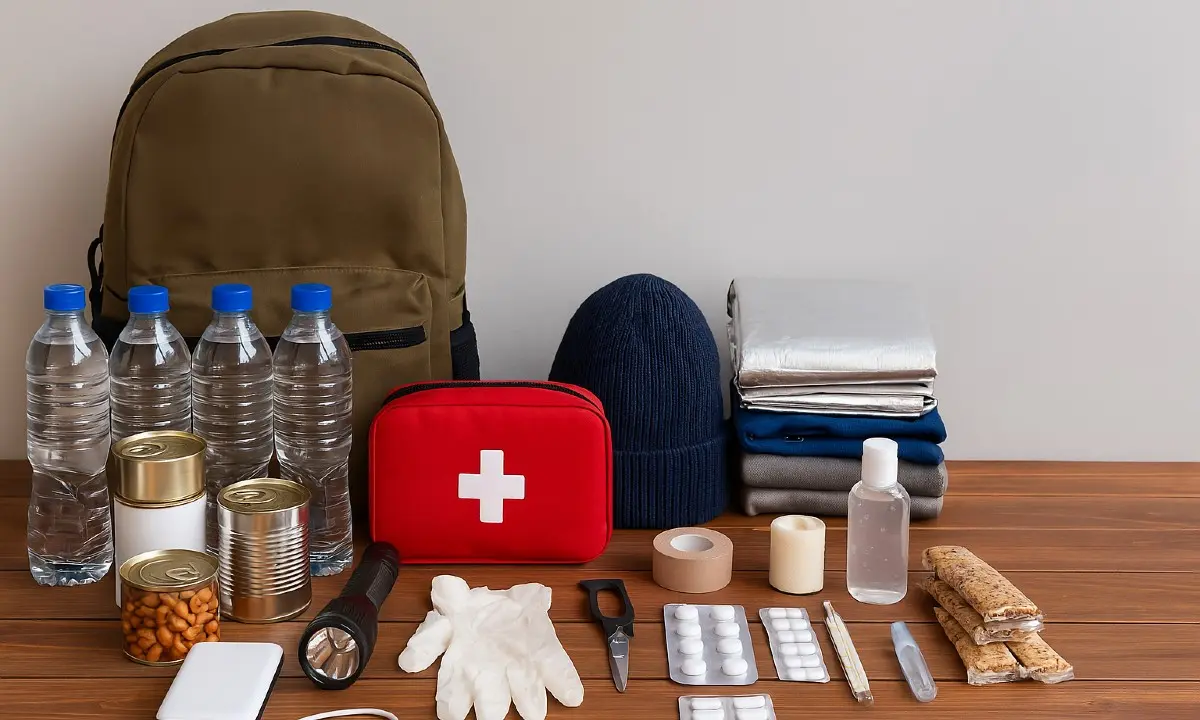
When disaster strikes, basic utilities vanish instantly. Water stops flowing from the tap, stoves fail without gas or electricity, and digital payment systems become useless in the absence of power. To survive the initial 72 hours without external assistance, households must curate a targeted, highly organized emergency kit. Experts recommend storing these supplies in a durable, waterproof backpack or container kept in an easily accessible location known to all family members.
1. Hydration: The Ultimate Priority
Water is the single most critical element of survival. While humans can survive weeks without food, dehydration sets in rapidly and impairs cognitive function within hours.
- Quantity: A general baseline is one gallon (or roughly 3.8 liters) of water per person, per day. For a 72-hour window, an individual requires a minimum of 3 gallons dedicated exclusively to drinking and basic hygiene.
- Storage: Water must be stored in clean, food-grade, heavy-duty plastic containers with tight-fitting lids. Avoid glass containers, which can shatter during seismic tremors.
- Maintenance: Stored tap water should be replaced every six months to ensure freshness, or commercially bottled water should be monitored for expiration dates.
2. Sustenance: Non-Perishable and Ready-to-Eat Foods
Cooking facilities will likely be unavailable during an emergency. Therefore, food supplies must require no refrigeration, minimal or no water, and little to no preparation.
- Recommended Items: Canned tuna, sardines, chicken, and beans; UHT (ultra-high temperature) or powdered milk; energy and protein bars; peanut butter; dried fruits and mixed nuts; and crackers.
- Nutritional Balance: Select high-calorie, nutrient-dense foods to sustain energy levels during high-stress scenarios. Include comfort foods or items familiar to children to help reduce psychological trauma.
- Rotation System: Do not simply pack food and forget it. Establish a systematic rotation every few months by consuming items nearing their expiration date and replacing them with fresh stock.
3. Illumination, Power, and Communication
Power grids are notoriously fragile during earthquakes, hurricanes, and severe storms. Relying on smartphone flashlights will quickly drain devices that are desperately needed for communication.
- Lighting: Pack multiple reliable light sources that do not rely on wall outlets. Hand-crank flashlights, solar lanterns, and battery-powered LED lamps, along with a robust supply of extra batteries, are indispensable.
- Power Banks: Keep at least one high-capacity portable power bank (fully charged) dedicated to the emergency kit. Cellular devices are lifelines for contacting relatives, checking emergency updates, or calling for rescue; battery conservation is paramount.
- Analog Communication: In a prolonged blackout, cellular towers overload or lose power entirely. A portable AM/FM radio—powered by hand-crank, solar panels, or standard batteries—ensures access to emergency broadcasts, civil defense instructions, and official government updates.
4. First Aid and Medical Preparedness
Minor injuries, cuts, and burns are common in the chaotic aftermath of a disaster. A well-stocked first aid kit can prevent minor wounds from escalating into severe infections.
- Standard Supplies: Medical tape, sterile gauze pads of various sizes, adhesive bandages, elastic wrap bandages, trauma shears, antiseptic wipes, hydrogen peroxide, disposable nitrile gloves, and face masks.
- Prescription Medications: Individuals with chronic conditions (such as hypertension, diabetes, or asthma) must maintain an emergency supply of essential medications (at least a one-to-two-week buffer) within the kit. Regularly check expiration dates and store medications according to manufacturer specifications.
- Sanitation: Include basic hygiene items such as toilet paper, wet wipes, hand sanitizer, feminine hygiene products, and heavy-duty trash bags for waste disposal.
5. Critical Documents, Cash, and Miscellaneous Tools
Physical infrastructure failures can lock individuals out of digital banking systems and electronic identification records.
- Important Documents: Store paper copies of identification cards, passports, insurance policies, property deeds, and emergency contact lists inside a sealed, waterproof bag.
- Cash Reserves: In the event of an extended power outage, ATMs and credit card dataphones will not function. Maintain a reasonable amount of physical cash, preferably in small denominations, to facilitate emergency purchases of food, water, or transport.
- Multipurpose Tools: A sturdy pocket knife or multi-tool, duct tape, a heavy-duty whistle (crucial for signaling rescue teams if trapped under rubble), and a local waterproof map complete the kit.
- Tailored Needs: Households with specific demographics must customize their supplies. Families with infants require formula, diapers, and baby wipes; pet owners must pack pet food, bowls, and leashes; elderly members may need mobility aids or specialized dietary items.
Official Responses: Institutional Shifts Toward Civil Resilience
Governments and international organizations are recognizing that municipal emergency services cannot be everywhere at once during a catastrophic, wide-scale disaster. When a major earthquake strikes, first responders prioritize search and rescue in heavily impacted structural zones, leaving outlying neighborhoods or suburban areas temporarily isolated.
The European Commission’s Union Preparedness Strategy serves as a primary example of this policy evolution. By formally advising citizens to develop plans for a minimum of 72 hours of complete self-reliance, the European Union is actively decentralizing disaster response. This model bridges the critical gap between the moment a disaster occurs and the arrival of professional state aid.
Similarly, regional disaster management agencies across Latin America—such as Colombia’s Unidad Nacional para la Gestión del Riesgo de Desastres (UNGRD) and Venezuela’s civil protection networks—continually update their public service campaigns. These agencies emphasize that government aid is finite during widespread catastrophes, making household-level resilience an indispensable component of national security. Public institutions are increasingly partnering with schools, community centers, and workplaces to conduct seismic drills and promote the mandatory assembly of home emergency kits.
Implications: Building a Culture of Prevention in an Unstable World
The string of high-magnitude earthquakes in Venezuela, Colombia, and other seismic hotspots serves as a sobering reminder that our planet is dynamic, unpredictable, and entirely indifferent to human schedules. While modern seismology has made tremendous strides in understanding tectonic fault lines, science still cannot predict the exact day, hour, or magnitude of the next major earthquake.
This inherent unpredictability carries profound implications for modern society. Waiting until the earth begins to shake to think about disaster preparedness is a dangerous gamble. True resilience requires shifting from a reactive mindset—where populations scramble for resources only after a tragedy unfolds—to a proactive culture of everyday readiness.
Adopting the 72-hour self-sufficiency standard transforms ordinary citizens from passive victims of circumstance into active agents of their own survival. By carefully assembling an emergency kit, maintaining water and food supplies, securing critical documents, and discussing family communication plans, households build a buffer against chaos.
Ultimately, preparedness is not driven by fear, but by responsibility and foresight. As seismic events continue to test the endurance of nations across the globe, investing a small amount of time and resources into emergency planning today is the most powerful insurance policy we can secure for tomorrow.
Visual Concept: A well-organized, durable emergency backpack equipped with water pouches, canned goods, a hand-crank radio, and a first-aid kit, photographed in a well-lit domestic setting.




Leave a Reply