

By Global Technology Desk
Published: September 2026
Main Facts
GoPro, the undisputed pioneer of action sports documentation, is shedding its skin. For nearly two decades, the American manufacturer’s brand name was virtually synonymous with rugged, pocket-sized cubes mounted to helmets, handlebars, surfboards, and race cars. Today, the company is dramatically expanding its horizons by crossing over into the traditional domain of high-end cinema and professional photography.
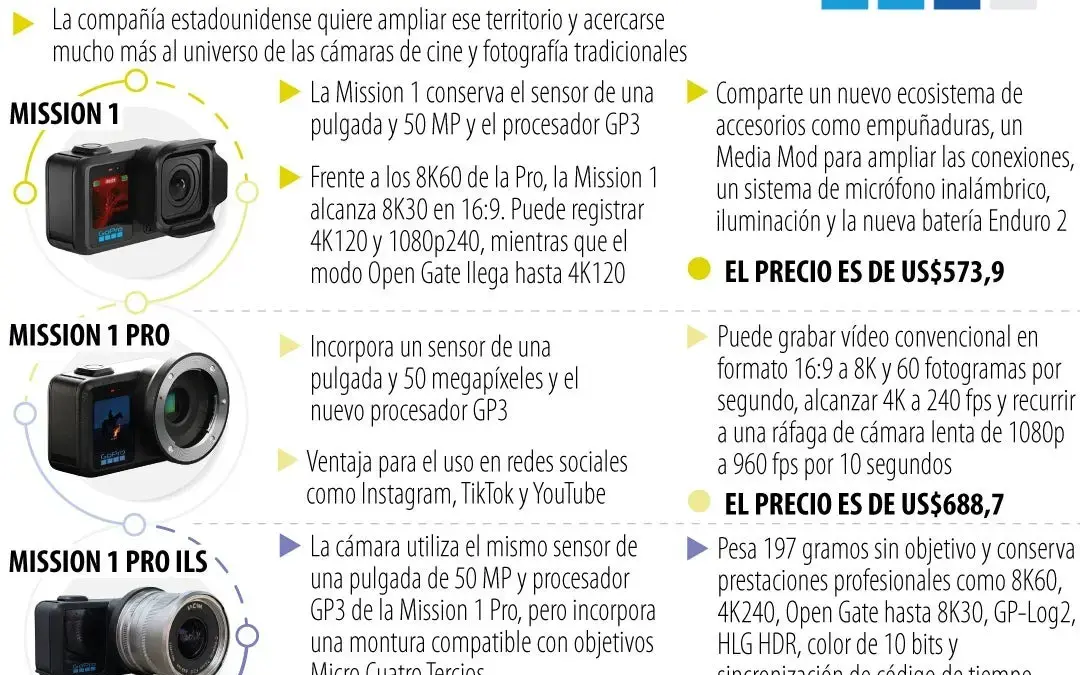
The vehicle for this paradigm shift is the brand-new Mission 1 series, a lineup consisting of three distinct models: the flagship Mission 1 Pro, the streamlined Mission 1, and the groundbreaking Mission 1 Pro ILS (Interchangeable Lens System).
At its core, the Mission 1 family preserves two foundational pillars of GoPro’s identity—compact size and rugged durability—while fusing them with professional-grade video tools, advanced post-production controls, and, most importantly, a massive physical image sensor.
The headline specifications across the range include:
- A New Optical Engine: A large 1-inch, 50-megapixel image sensor coupled with GoPro’s custom-built GP3 processor.
- Resolution Extremes: Capability ranging from conventional 16:9 8K video at 60 frames per second to ultra-high-framerate 4K at 240 fps, and a staggering 1080p slow-motion burst mode at 960 fps.
- Open Gate Versatility: Advanced Open Gate recording formats allowing creators to capture in native full-sensor aspect ratios, facilitating instantaneous resizing for horizontal, vertical, or square delivery platforms like YouTube, Instagram, and TikTok.
- Professional Color & Sync: 10-bit color depth, HLG HDR, GP-Log2 profiles, timecode synchronization, and robust bitrates hitting up to 240 Mbps.
- Pricing Strategy: The Mission 1 launches at $573.90 USD, the Mission 1 Pro at $688.70 USD, and the interchangeable-lens Mission 1 Pro ILS at $803.50 USD.
Rather than abandoning the action camera market that built its empire, GoPro is attempting to translate its core competitive advantages—portability, structural resilience, and mount-anywhere versatility—into a sector historically dominated by bulky, delicate cinema rigs.
Chronology: The Evolution of a Paradigm Shift
To understand the weight of the Mission 1 release, it is necessary to trace the trajectory of GoPro’s market positioning over the last decade and the specific timeline that led to this September 2026 announcement.
Phase 1: The Action Cam Monopoly (2010–2018)
During the peak of the action camera boom, GoPro dominated extreme sports, tourism, and adventure vlogging. Devices like the Hero series were engineered specifically for durability and simplicity. However, as smartphone cameras evolved to match or exceed small-sensor action cameras in standard lighting, and competitors entered the market with aggressive pricing, GoPro faced the limits of its niche.
Phase 2: Diversification and Software Pivots (2019–2024)
Recognizing that the everyday consumer was less inclined to buy a dedicated action cam when their phone sufficed, GoPro diversified. They introduced subscription services, cloud editing software (Quik), and specialized hardware iterations like the MAX line for 360-degree capture. Yet, high-end independent filmmakers, documentary crews, and commercial directors still treated GoPro as a "crash cam"—a secondary or tertiary tool used exclusively where placing an expensive RED or ARRI camera would be suicidal.
Phase 3: The Mission 1 Development and Launch (2025–September 2026)
Rumors circulated in early 2025 regarding a secret project inside GoPro aimed at building a cinematic tool that retained form-factor advantages. By mid-2026, industry leaks pointed to a complete architectural redesign centered around a 1-inch sensor.
The definitive turning point arrived on September 2, 2026, when GoPro officially unveiled the Mission 1 family. The introduction of the Mission 1 Pro ILS broke a nearly twenty-year company taboo by offering a GoPro with a removable lens mount, signaling a direct challenge to compact mirrorless cameras from Sony, Canon, and Fujifilm.
Supporting Data & Deep Dive into the Lineup
The Mission 1 series is not a monolithic release; it is carefully tiered to target different segments of the content creation ecosystem, from high-end solo shooters to professional studio production teams.
1. Mission 1 Pro: The Technological Showcase
The Mission 1 Pro ($688.70 USD) is the crown jewel of the new generation. Moving far beyond the limitations of historical action cams, its 1-inch 50 MP sensor paired with the GP3 processor vastly improves light-gathering capabilities.
- Dynamic Range & Low Light: The larger physical area of the sensor drastically improves dynamic range and performance in low-light environments—historically the Achilles’ heel of smaller sensors.
- Frame Rates: It handles 8K video at 60 fps in 16:9, drops to 4K at 240 fps, and features the jaw-dropping 1080p/960fps burst mode for 10-second ultra slow-motion captures.
- Open Gate Integration: Its 8K30 and 4K120 Open Gate modes use the maximum vertical and horizontal real estate of the sensor. This is a game-changer for modern multi-platform creators who must output cinematic 16:9 deliverables for YouTube alongside vertical 9:16 assets for Reels and TikTok without cropping out vital image information.
- Ergonomics: Available in a Grip Edition, the camera features a specialized handgrip that doubles as a protective cage with diverse mounting points, bridging the gap between a handheld compact camera and a rigged cinema setup.
2. Mission 1: The Streamlined Professional Choice
Priced at $573.90 USD, the base Mission 1 is designed for creators who require the pristine image quality of the 1-inch sensor and the power of the GP3 processor, but do not need the extreme frame rates or maximum resolutions of the Pro tier.
- Shared DNA: It retains the exact same 50 MP sensor and processing engine as its more expensive sibling, ensuring uniform color science and photographic capability.
- Strategic Reductions: Video capabilities are capped at 8K30 in 16:9 (instead of 8K60), and Open Gate tops out at 4K120. Slow-motion extremes are similarly reigned in.
- Value Proposition: For documentary filmmakers or travel creators working within standard broadcast framerates, the Mission 1 offers roughly 90% of the Pro’s visual fidelity at a more accessible price point.
3. Mission 1 Pro ILS: Breaking the Rules with Interchangeable Lenses
Representing the most radical departure in GoPro’s history, the Mission 1 Pro ILS ($803.50 USD) eliminates the fixed lens entirely.
- Micro Four Thirds (MFT) Mount: By integrating a native MFT lens mount, the ILS allows users to swap between ultra-wide primes, telephotos, macro lenses, and specialized cinema optics using adapters.
- Creative Control: Filmmakers can now achieve genuine optical depth-of-field (bokeh) and subject separation—traits previously unattainable on a standard GoPro without heavy digital filters.
- Form Factor: Weighing a mere 197 grams (without a lens attached), it functions as an ultracompact mirrorless cinema camera. It retains all professional data specs, including 8K60, GP-Log2, and timecode syncing, though it requires manual focus and aperture adjustments from the operator.
Comprehensive Ecosystem Support
To support this hardware evolution, GoPro has completely overhauled its ecosystem. The new line introduces:
- The Enduro 2 high-capacity battery.
- A new modular Media Mod for expanded audio/video input/output.
- A dedicated wireless microphone system.
- Modular studio lighting accessories tailored for independent creators.
Official Responses and Industry Reactions
Reaction from the broader photographic and cinematic community has been a mixture of astonishment and cautious optimism.
In an official press statement accompanying the launch, GoPro’s executive leadership emphasized that the company is not abandoning its roots, but rather liberating its core technology from physical constraints.
"For twenty years, we taught the world how to capture action from perspectives never thought possible," stated GoPro’s Head of Product Development during the keynote address. "With the Mission 1 series, we are asking a different question: What happens when you take that indestructible, highly portable design philosophy and pair it with a cinematic sensor? We are no longer just capturing stunts; we are capturing cinema anywhere on Earth."
Industry analysts have noted that this move positions GoPro directly against established compact cinema ecosystems, such as Sony’s FX line, the DJI Osmo Cinema initiatives, and Blackmagic Design’s pocket cinema cameras.
Early feedback from beta-testing cinematographers highlights the utility of the Open Gate workflow and the surprise performance of the GP3 processor in handling high bitrates without thermal throttling—a common hurdle in ultra-compact metal-chassis cameras. However, traditionalists have raised questions regarding how well manual MFT lenses will balance on lightweight gimbals when paired with the Mission 1 Pro ILS.
Implications for the Future of Content Creation
The launch of the GoPro Mission 1 series carries profound implications for multiple tiers of the media production industry:
1. The Death of the "B-Cam" Compromise
Historically, documentary and indie film crews accepted a drop in image quality when cutting from an A-camera (like an ARRI or RED) to a crash-cam or action-cam B-roll shot. With the Mission 1 Pro and ILS matching color profiles (via GP-Log2 and 10-bit color) and utilizing a 1-inch sensor, matching footage between a primary cinema rig and a secondary GoPro-mounted angle will become seamless. Color grading workflows will require significantly less manual correction.
2. The Rise of the Hybrid Solo Creator
For solo journalists, travel documentarians, and high-end wedding videographers, gear weight is a primary enemy. The Mission 1 Pro ILS, weighing under 200 grams body-only, offers the expressive power of interchangeable glass without the back-breaking weight of traditional cinema rigs. Creators can pack multiple specialized lenses into a small pouch while retaining high-end 8K capture capabilities.
3. Vertical Video Optimization
As social media platforms continue to prioritize vertical and square formats, the inclusion of robust Open Gate recording across the Mission 1 family removes a major friction point in modern editing workflows. Creators no longer need to compromise composition by cropping into a rigid 16:9 frame; they can shoot once and reframe dynamically in post-production.
4. A Cultural Pivot for GoPro
Culturally, this move marks GoPro’s graduation from an action-sports toy manufacturer to a serious contender in the professional imaging space. While the bright orange or blue mounting fingers and rugged rubberized casings still nod to the past, the inclusion of timecode sync, professional log profiles, and interchangeable mounts proves that GoPro is ready to play in the big leagues.
As the Mission 1, Mission 1 Pro, and Mission 1 Pro ILS hit shelves worldwide this autumn, the conversation around what constitutes a "professional camera" has fundamentally shifted. Size is no longer a proxy for capability, and GoPro has proven that it is willing to reinvent itself to secure its future in the modern media landscape.




Leave a Reply