

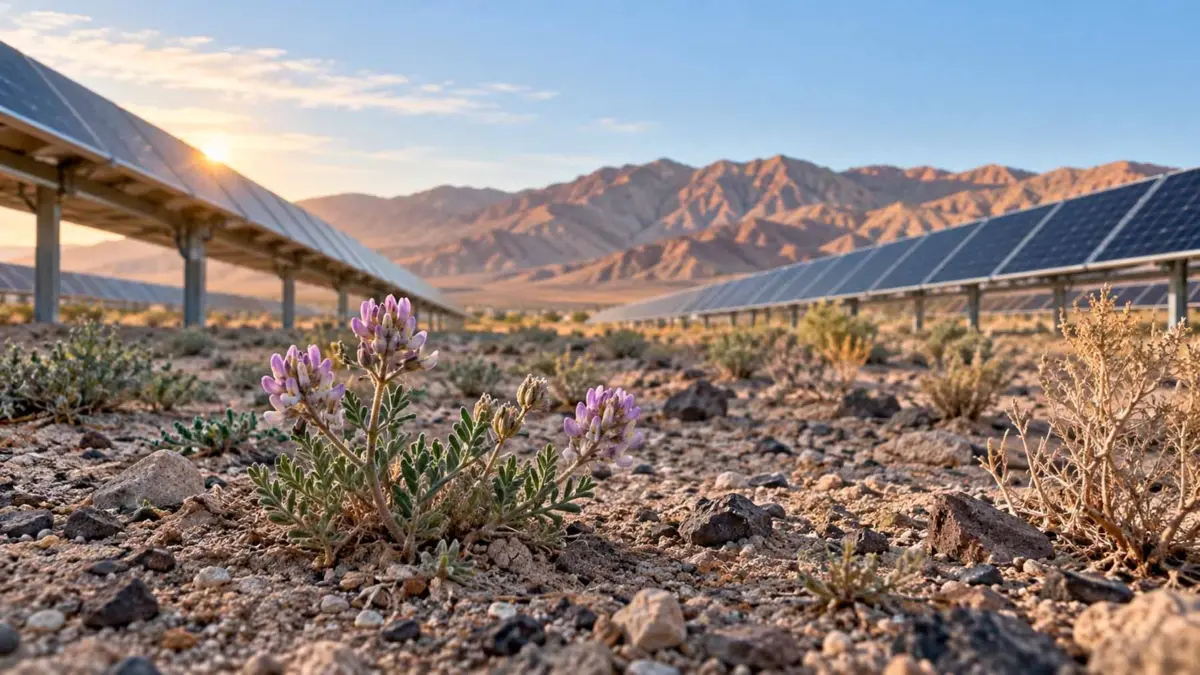
LAS VEGAS, NV — The intersection of renewable energy infrastructure and fragile desert ecosystems has long been fraught with tension. For decades, the rapid expansion of utility-scale solar farms across the American Southwest presented a stark dichotomy: combat global climate change by harnessing abundant desert sunlight, or protect delicate, localized arid ecosystems from heavy industrial disruption.
However, a groundbreaking scientific evaluation of the massive Gemini Solar Project in Nevada’s Mojave Desert is challenging conventional wisdom. The study reveals that with careful construction planning, massive clean energy installations and critically endangered endemic plant species might not just coexist—they could potentially find a way to thrive side by side.
Main Facts: The Gemini Solar Project and the Endangered Milkvetch
At the center of this ecological surprise is the Gemini Solar Project, one of the largest photovoltaic installations in the United States, sprawling across thousands of acres of federal land in the Mojave Desert just northeast of Las Vegas.
Before construction broke ground, environmental surveys identified a formidable obstacle: the presence of the three-cornered milkvetch (Astragalus geyeri var. triquetrus). This diminutive annual legume is categorized as critically endangered and is strictly protected under Nevada state regulations. In 2018, pre-construction baseline surveys identified a mere 12 individual milkvetch plants scattered across six distinct locations within the planned footprint of the facility.
The conservation dilemma was stark. Traditional utility-scale solar construction typically involves "blading"—a destructive earthmoving process that strips the landscape of all vegetation, completely levels the topsoil, and eradicates the native seed bank buried beneath. Executing traditional blading at Gemini would have meant virtually wiping out the local population of a critically endangered species protected by law.
Faced with this regulatory and environmental roadblock, the project’s developers and environmental consultants pivoted. Instead of leveling the earth, they implemented low-impact grading techniques designed to preserve the integrity of the topsoil, retain existing native vegetation patches, and protect the underground seed bank.
Six years later, when a team of researchers returned to the site to assess the ecological fallout, they were astonished to discover 93 individual plants spread across 44 separate locations within the surveyed area.
Chronology: From Pre-Construction Baseline to Post-Installation Discovery
To understand how the Mojave Desert landscape adapted to the arrival of gigawatt-scale energy production, scientists have meticulously documented the timeline of the Gemini site, tracing the trajectory of the milkvetch from initial jeopardy to unexpected resilience.
2018: The Pre-Construction Baseline
Prior to any industrial activity, environmental consultants mapped the prospective solar arrays. Out of thousands of acres destined for panel installation, intensive botanical surveys located only 12 specimens of the three-cornered milkvetch across six spots. The plant, known for its extreme sensitivity to environmental fluctuations and reliance on specific winter rainfall patterns, appeared on the brink of local extirpation should construction proceed conventionally.
2019–2021: Low-Impact Construction Phase
Rather than deploying heavy bulldozers to clear the terrain completely, the Gemini project utilized modified construction methodologies. Vegetation was mowed or trimmed rather than uprooted wholesale where feasible, and topsoil blading was strictly minimized to preserve the underlying particulate structure and seed reserves. Pile-driving techniques were employed to mount the solar panels directly into the ground without extensive grading.
2024: The Post-Installation Ecological Audit
A research team—comprising scientists from leading academic and ecological institutions—returned to the operational solar facility to conduct comprehensive demographic surveys. Far from vanishing under the panels or succumbing to habitat fragmentation, the milkvetch population had expanded exponentially in both numbers and geographic distribution, surging from 12 observed plants to 93.
Supporting Data: An Unexpected Botanical Growth Spurt
The numerical increase in plant count was only part of the surprise. Upon closer biological inspection, the researchers noticed that the milkvetch specimens growing within the boundaries of the Gemini solar facility displayed distinctly superior physical characteristics compared to control populations sampled in untouched natural areas nearby.
The data paints a fascinating portrait of desert resilience:
- Height and Width: Milkvetch specimens found within the solar facility footprint were visibly taller and structurally wider than their wild counterparts outside the fence.
- Biomass: Plants inside the installation exhibited significantly more dense clusters of leaves and thicker main stems.
- Reproductive Success: Perhaps most astonishingly, the facility-associated plants produced approximately eight times more flowers and ten times more fruit pods than plants in the natural control sites.
- Phenological Shift: Furthermore, the facility plants initiated fruit production roughly 2.7 weeks earlier in the season than those in undisturbed desert environments.
The Panel Paradox: Location, Location, Location
Naturally, initial hypotheses assumed that the photovoltaic panels themselves were directly responsible for these biological anomalies. Researchers theorized that the shade cast by the massive solar arrays might mitigate the punishing Mojave heat, reducing moisture evaporation from the soil and creating a localized microclimate favorable to the delicate legumes.
However, a spatial analysis of the survey data quickly dismantled that neat narrative.
Of the 93 milkvetch plants identified during the 2024 survey:
- Only one single plant was growing directly underneath a photovoltaic panel.
- Only four plants were found in the immediate drip-line zones where rainwater runoff sheds off the lower edges of the panels.
- An overwhelming 86 plants were discovered flourishing in the wide-open, unshaded alleys between the rows of solar arrays.
- The final two plants were located within the facility property boundaries, but completely outside the active solar matrices.
Statistical testing revealed no significant correlation between a plant’s physical dimensions (or its flower and fruit yield) and its physical distance to the nearest solar panel. Consequently, scientists ruled out panel-induced shade as the primary driver behind the plants’ superior growth and proliferation.
Official Responses and Scientific Caution
While renewable energy developers and environmental advocates have seized upon the study as a proof-of-concept for harmonious land sharing, the scientific community maintains a cautious, evidence-based stance.
Lead researchers of the study—whose findings were published in the journal Frontiers in Ecology and Evolution (Pereira et al., 2025)—emphasize that these encouraging results must be contextualized within the limitations of desert ecology.
"While our data suggests that mitigating aggressive soil disturbance helps rare endemic species persist within utility-scale energy footprints, we must exercise caution," the study’s authors note. "The detailed demographic monitoring data currently reflects a single exceptionally favorable year—one featuring adequate precipitation conditions required for this annual desert plant to germinate en masse."
Desert annuals like the three-cornered milkvetch are notoriously opportunistic. Their life cycles are inextricably linked to episodic winter and spring rainfall events. Seeds can remain dormant in the subterranean soil bank for years, waiting for the precise hydrological trigger to wake.
Ecologists warn that a single year of high observation numbers does not guarantee long-term population stability, particularly when the region cycles back into multi-year extreme droughts—a frequent reality in the contemporary American Southwest. Furthermore, the researchers explicitly caution against generalizing that utility-scale solar farms are inherently beneficial to desert flora; rather, the success at Gemini points specifically to the benefits of restraint during site preparation.
Implications: A New Blueprint for Green Energy Infrastructure?
The implications of the Gemini Solar Project study extend far beyond a single rare legume in Nevada. As global demand for clean, decarbonized electricity accelerates, clean energy developers face mounting pressure to secure vast acreage for solar farms. The American West, with its high solar irradiance and vast open spaces, is Ground Zero for these land-use conflicts.
Traditionally, environmental impact statements for solar projects have pitted energy developers against conservationists, resulting in protracted legal battles, delayed climate initiatives, or the needless destruction of fragile desert habitats.
The findings from the Mojave Desert suggest a compelling middle ground:
- Re-evaluating Grading Standards: The study demonstrates that traditional "blading" and total landscape sterilization are not absolute engineering prerequisites for utility-scale solar construction. By pivoting to low-impact earthwork, developers can preserve the native soil matrix and protect delicate underground seed banks.
- Coexistence over Exclusion: Proving that endangered flora can persist in the open inter-row spaces of an active solar facility opens the door to smarter, more adaptive spatial planning. Instead of writing off entire project zones as ecological dead zones, developers can design facilities that accommodate ecological corridors.
- Regulatory Evolution: State and federal wildlife agencies may utilize these insights to update permitting requirements, incentivizing renewable energy corporations to adopt gentle-touch construction methods in exchange for streamlined approvals or compensatory mitigation credits.
Looking Ahead
As researchers plan subsequent years of monitoring at the Gemini site—crucially tracking how the milkvetch population weathers upcoming drought cycles—the project stands as an evolving case study in industrial-ecological coexistence.
The three-cornered milkvetch may not owe its survival to the cooling shade of the photovoltaic panels above, but rather to the wisdom of what was left undisturbed beneath its roots. In the grand challenge of transitioning the global economy to renewable energy while preserving the fragile natural world, the Gemini experiment suggests that sometimes, the most revolutionary engineering decision a company can make is simply to disturb the earth a little less.
Reference:
Pereira, T. J., Karban, C. C., Kobelt, L. A., & Munson, S. M. (2025). Rare milkvetch (Astragalus) persistence at a utility-scale solar energy facility in the Mojave Desert. Frontiers in Ecology and Evolution, 13, 1697878. DOI: 10.3389/fevo.2025.1697878



Leave a Reply