

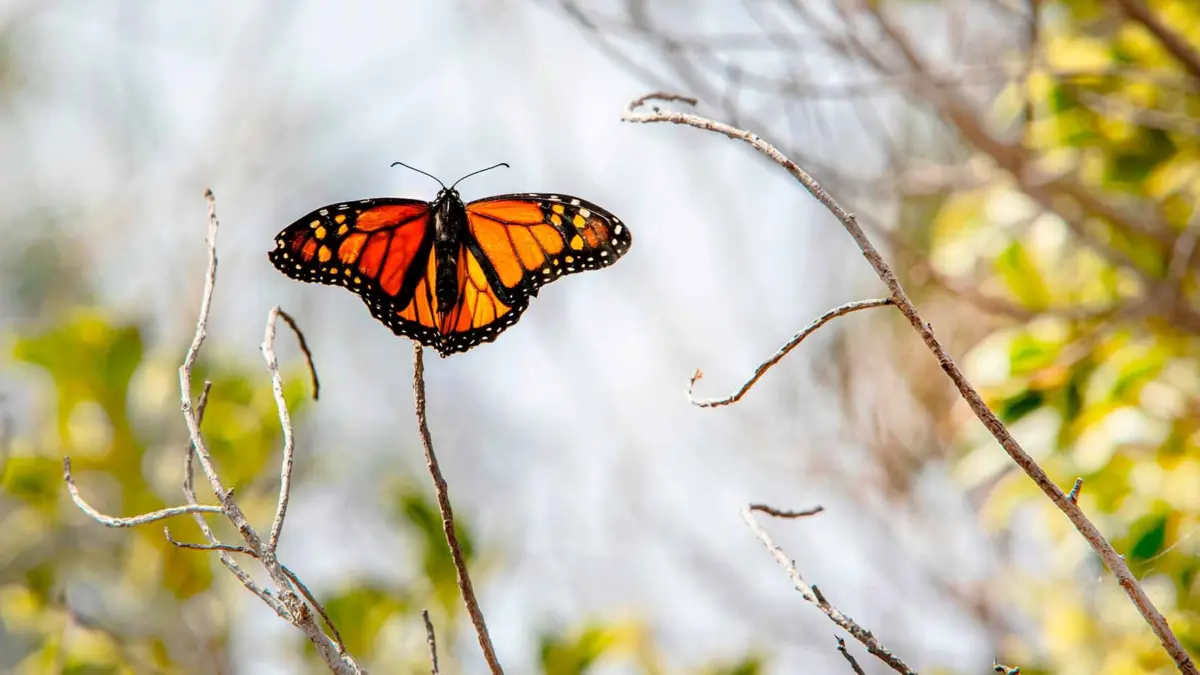
TEXAS — Every autumn, one of the natural world’s most astonishing spectacles unfolds across the North American continent. Millions of monarch butterflies (Danaus plexippus) embark on a multi-generational, thousands-of-mile journey from their breeding grounds in the northern United States and Canada to the oyamel fir forests of central Mexico.
For the vast majority of these resilient insects, this epic journey funnels directly through Texas. Acting as a massive geographical bottleneck, the Lone Star State serves as the ultimate highway for the southward migration. However, according to the Texas Parks and Wildlife Department (TPWD) and the Texas Nature Trackers program, this journey is far from a uniform, predictable parade. Shaped by shifting weather fronts, regional wind patterns, and two distinct migratory corridors, the Texas monarch migration is a dynamic, ever-changing ecological event.
Main Facts: The Texas Bottleneck and Dual Corridors
Texas occupies a critical geopolitical and ecological chokepoint in the monarch’s migratory lifecycle. To the north lie the sprawling summer breeding grounds; to the south sit the winter sanctuaries in Michoacán, Mexico. In between lies Texas, a massive landscape that compresses millions of migrating butterflies into two primary flyways: the Interior Corridor and the Coastal Corridor.
[Northern Breeding Grounds]
          │
          ▼
┌──────────────────┐
│  TEXAS BOTTLENECK│
│  ├─ Interior Flyway (Wichita Falls to Eagle Pass)
│  └─ Coastal Flyway  (Corpus Christi & Lower Rio Grande)
└──────────────────┘
          │
          ▼
[Winter Sanctuaries: Michoacán, Mexico]
These are not rigid lines drawn on a map, but rather broad geographic bands where observations consistently concentrate.
- The Interior Flyway: Spanning a massive 300-mile-wide strip roughly bounded by Wichita Falls in the north and Eagle Pass in the south, this corridor handles the bulk of the early-to-mid autumn movement.
- The Coastal Flyway: Operating largely independently from or slightly behind the interior route, this path hugs the Gulf of Mexico, occasionally yielding staggering concentrations of butterflies as they navigate coastal breezes.
According to long-term observational data tracked by citizen scientists and state biologists, the butterflies do not move in a steady, continuous stream. Instead, their migration occurs in "pulses." These surges are intensely dependent on atmospheric conditions—particularly cold fronts and prevailing northern or southern winds that either accelerate their flight or force them to ground.
Chronology: The Timeline of Passage
Understanding when to look for monarchs in Texas requires recognizing that the state is too vast for a single calendar. The timeline varies significantly depending on whether you are tracking the interior plains or the Gulf Coast.
Late September: The First Wave In the Interior
The first whispers of the migration typically appear in the northern and interior regions of Texas by late September. These early arrivals mark the beginning of a window that will steadily intensify throughout October. While individual butterflies trickle in early, they do not arrive in a synchronized wave; rather, they test the waters as temperatures begin to dip slightly across the plains.
October: Peak Movement and Central-West Concentrations
By the second and third weeks of October, the interior migration hits its stride. Observers frequently record high volumes of monarchs along a diagonal strip running through San Angelo, Brackettville, and Eagle Pass. River systems—specifically the Devils, Llano, Frio, and Sabinal rivers—act as vital ecological lifelines during this period, providing both water and rich riparian habitats.
Historical anomalies highlight how explosive this month can be. In October 2006, the passage of a severe cold front pushed thousands of monarchs southward, leading to breathtaking reports from Del Rio and Eagle Pass where watchers estimated rates of up to 500 butterflies per minute. While such numbers represent rare meteorological alignments rather than annual guarantees, they underscore the volatile nature of peak season.
November and Beyond: The Coastal Finale and Overwintering
As November begins, activity in the interior corridor starts to wane as the vast majority of those butterflies cross the Rio Grande into Mexico. However, the Coastal Corridor is often just hitting its stride. Ranging from late October through mid-November, the coastal route can host massive late-season movements.
For instance, autumns like 2007 saw tens of thousands of monarchs concentrated heavily north of Corpus Christi. Furthermore, TPWD records show that a small number of resilient or delayed individuals may linger in the Lower Rio Grande Valley through December, with some even attempting to overwinter near the Gulf Coast.
Supporting Data: Variability, Roosts, and Historical Precedents
Data compiled by the Texas Nature Trackers emphasizes that sighting maps are visualizations of historical observations, not absolute predictive schedules. A single oak or pecan tree in Seymour or the South Llano River State Park might be laden with hundreds of roosting monarchs one evening, only to be completely empty by sunrise if a sudden shift in wind allows the colony to resume its journey.
Stopover Ecology: Fuel and Shelter
Monarchs traveling through Texas face immense metabolic demands. During daylight hours, they swarm native nectar plants—such as frostweed (Verbesina virginica)—to refuel. At dusk, they seek out structural shelter.
State parks like South Llano River State Park provide textbook examples of stopover habitats, where monarchs blanket the branches of pecan trees to conserve energy overnight. These temporary roosts are critical survival mechanisms, protecting the insects from overnight drops in temperature and avian predators.
The Critical Distinction: Milkweed vs. Nectar Plants
A common point of confusion among conservation-minded gardeners involves the role of milkweed (Asclepias spp.) versus nectar-producing plants during the autumn migration.
- Nectar Plants: Adult monarchs require continuous caloric energy to fuel their grueling flight south. Flowers that bloom deep into October and November (such as asters, goldenrods, and native sunflowers) are absolute necessities for traveling adults.
- Milkweed: While milkweed is famous for being the exclusive host plant upon which female monarchs lay their eggs and caterpillars feed, its role shifts during the fall. While some breeding may still occur in southern Texas during autumn, the primary drivers for southward-bound adults are high-energy nectar sources, whereas milkweed takes center stage during the spring northward return.
Official Responses and Conservation Frameworks
State agencies, academic institutions, and conservation groups have ramped up collaborative efforts to protect and monitor the monarch flyway. The TPWD heavily emphasizes public participation through programs like Texas Nature Trackers, urging citizens to log observations to help biologists map shifting migration patterns over decades.
At the same time, conservation organizations coordinate tagging initiatives—such as those associated with Monarch Watch. Parks like Goose Island State Park periodically host public tagging events, allowing trained volunteers and park rangers to carefully apply tiny, lightweight adhesive tags to the discal cell of a monarch’s wing. These tags provide vital data points if the butterfly is recovered at an overwintering site in Mexico or spotted by another researcher along the route, shedding light on flight speeds, survival rates, and corridor fidelity.
Official management recommendations also strongly emphasize the preservation of native Texas habitats. With more than 35 native species of milkweed documented in the state—including Asclepias tuberosa (butterfly weed), Asclepias asperula (antelope horns), Asclepias viridis (green antelopehorn), and Asclepias oenotheroides (zizotes milkweed)—state officials stress that protecting these native populations is vital for the broader health of North American pollinators.
Implications for Gardeners, Observers, and Ecosystems
The sheer breadth of the Texas monarch migration carries profound implications not just for wildlife enthusiasts, but for urban planners, landscapers, and everyday homeowners.
What Urban Gardens Can Do
As natural wild spaces face increasing fragmentation due to urban sprawl and agricultural changes, backyard gardens play an increasingly critical role as stepping stones. Homeowners within the Texas flyways can transform their yards into vital refueling stations by integrating regionally native plants that bloom precisely when the butterflies are passing through.
- Recommended Nectar Sources: Incorporating native perennials such as Lantana, sage species (Salvia), black-eyed Susans (Rudbeckia hirta), purple coneflower (Echinacea purpurea), gayfeather (Liatris), and frostweed ensures a reliable, high-energy food supply through October and November.
- Emphasizing Native Milkweeds: Gardeners are strongly encouraged to plant native milkweed species rather than non-native tropical varieties (such as Asclepias curassavica). Non-native milkweeds can linger too long into the winter, potentially disrupting natural migratory cues and harboring the deadly protozoan parasite Ophryocystis elektroscirrha (OE).
Responsible Observation
For eco-tourists and nature photographers, observing the migration requires patience and restraint. Wildlife experts recommend a "look, don’t touch" approach. Capturing or handling monarchs outside of authorized tagging programs can damage their delicate scales and wings, impairing their ability to complete the journey.
Before traveling to state parks or known flyway hotspots, visitors are advised to contact local park rangers to check real-time migration reports. Because the journey is so intimately tied to fleeting weather patterns, historical arrival dates can only narrow down the window; checking ahead ensures that observers witness the magic at its peak.
Ultimately, the Texas monarch migration is a powerful reminder of nature’s interconnected fragility and resilience. By understanding the timing, geography, and ecological needs of these iconic travelers, Texans can help ensure that the skies above the Lone Star State continue to shimmer with orange and black for generations to come.




Leave a Reply