

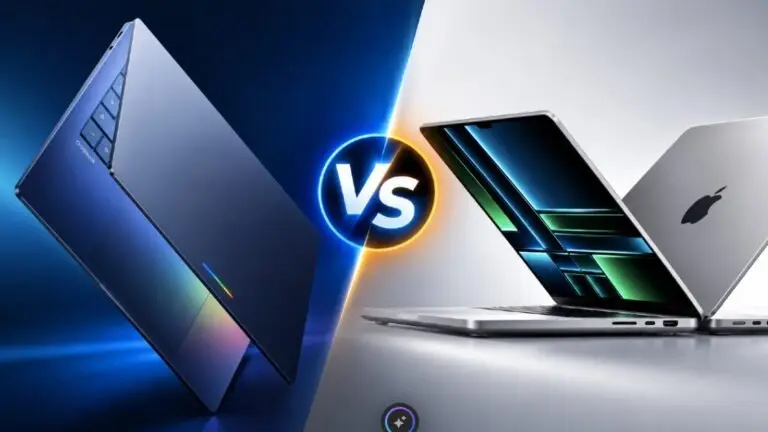
Choosing a new laptop is no longer just a matter of weighing processors, battery life, and random-access memory (RAM). With Google’s official rollout of its new, high-end laptop category—built on an advanced platform that merges Android elements with desktop tools and native Gemini AI integration—the marketplace has entered a fascinating new paradigm. Pitting these multi-brand machines against Apple’s iconic MacBook lineup reveals a fierce battle for software dominance, hardware form factors, and, above all, ecosystem loyalty.
While Apple commands the market with entry-level offerings like the $599 MacBook Neo, mid-tier workhorses, and professional-grade devices that climb significantly higher in price, Google’s hardware partners are entering the ring with base configurations starting at $899.
However, when comparing Google’s new devices directly to Apple’s standard-bearer—the 13-inch MacBook Air (equipped with the M5 chip starting at $1,099)—the differences transcend raw silicon. Touchscreens, AI architecture, software availability, and whether your pocket holds an Android or an iPhone are quickly becoming the definitive deciding factors for modern consumers.
Main Facts
The current landscape of premium computing is defined by a fierce clash of philosophies, hardware standards, and pricing strategies between two tech titans:
- Google’s New Laptop Ecosystem: Developed across multiple manufacturing partners (including Acer, Lenovo, Dell, ASUS, and HP), these new machines start at $899 for the Acer variant and climb up to $1,299 for high-end configurations from ASUS and HP. Impressively, even the base models in the United States launch with robust standard configurations: 16 GB of RAM and 512 GB of solid-state storage (SSD).
- The Apple Counterpart: Apple’s lineup spans from the budget-friendlier MacBook Neo—priced at $599 with a reduced specification sheet of 8 GB RAM and 256 GB storage—to the 13-inch MacBook Air M5, which matches Google’s baseline storage and memory at $1,099.
- Form Factor and Interaction: A glaring physical difference lies in the display. Four of Google’s initial five offerings feature tactile OLED panels, while the Dell XPS variant utilizes a touch-responsive LCD. Apple’s MacBooks rely exclusively on non-touch Liquid Retina displays.
- Artificial Intelligence Integration: Google centers its platform around Gemini, backed by an onboard Neural Processing Unit (NPU) boasting between 45 and 49 TOPS. Apple relies on Apple Intelligence, powered by the Neural Engines embedded within its custom M-series and A-series silicon.
Chronology of a Paradigm Shift
To understand how we arrived at this pivotal crossroad in personal computing, it is essential to trace the historical trajectory that led Google and Apple to their current positions.
The Evolution of Mobile-Desktop Convergence
For over a decade, Google’s hardware identity in the laptop space was defined almost entirely by Chromebooks—lightweight, cloud-reliant machines primarily targeted at the education sector and budget-conscious consumers. Meanwhile, Apple refined macOS, gradually tightening the loop between its desktop operating system and iOS via proprietary communication protocols like AirDrop and Universal Clipboard.
As mobile processors grew exponentially more powerful, the boundary between smartphones and computers began to blur. Apple made history by transitioning its Mac lineup away from Intel processors and toward its own custom Apple Silicon (beginning with the M1 and evolving rapidly through subsequent generations), unifying mobile and desktop architectures under a single umbrella.
Recognizing this shift, Google altered its strategy. Instead of relying solely on browser-based operating systems, the tech giant engineered a new, premium category of laptops designed to bridge the gap between Android and traditional desktop computing. By partnering with major hardware manufacturers—Acer, Lenovo, Dell, ASUS, and HP—Google successfully shifted its hardware narrative from low-cost educational tools to premium productivity powerhouses.
Supporting Data & Comparative Metrics
A side-by-side technical evaluation reveals that specs alone do not tell the whole story. However, laying out the baseline numbers clarifies where each ecosystem stands.
| Feature | Googlebook Ecosystem | MacBook Air M5 (13”) | MacBook Neo |
|---|---|---|---|
| Starting US Price | $899 | $1,099 | $599 |
| Base RAM | 16 GB | 16 GB | 8 GB |
| Base Storage | 512 GB | 512 GB | 256 GB |
| Processors | Intel Core Ultra 5 / Snapdragon X Elite | Apple M5 | Apple A18 Pro |
| Display Type | OLED or LCD Touch (Depending on model) | Liquid Retina (13.6”) | Liquid Retina (13”) |
| Touchscreen | Yes | No | No |
| Announced Battery Life | Up to 19 hours (Model dependent) | Up to 18 hours | Up to 16 hours |
| Mobile Integration | Android | iPhone | iPhone |
| Integrated AI | Gemini | Apple Intelligence | Apple Intelligence |
The Pricing Equation
While Google initially positioned itself as an economical alternative, its pricing structure for this new hardware category complicates that narrative. The entry point belongs to the Acer variant at $899. However, prices quickly scale upward: the Lenovo model starts at $1,099, the Dell XPS version hits $1,199, and ASUS and HP variants command $1,299.
This means that high-end Google-powered laptops directly overlap with—and in some cases surpass—the pricing of the baseline 13-inch MacBook Air M5 ($1,099). Conversely, Apple captures the budget-conscious consumer looking for premium build quality via the MacBook Neo, which drops down to $599 (though handicapped by 8 GB of RAM and 256 GB of storage).
Hardware Versatility vs. Uniform Design
One of the most striking differences in the hardware sphere is manufacturing philosophy. Apple maintains absolute control over its hardware design, ensuring uniform build quality, trackpad response, and aluminum chassis finishes across the board.
Google, by contrast, relies on an ecosystem of third-party original equipment manufacturers (OEMs). This yields incredible variety in physical dimensions and weight:
- ASUS and Dell XPS units hover around a featherlight 2.2 pounds (roughly 1 kilogram).
- Acer reaches 2.51 pounds.
- HP scales up to 2.74 pounds.
- Lenovo tops out the group at 2.84 pounds.
When matched against the 13-inch MacBook Air M5—which weighs approximately 1.23 kg—Google’s partners offer choices that range from ultra-portable featherweights to traditional desktop replacements. Furthermore, four of the five initial Google-powered models incorporate gorgeous, touch-sensitive OLED panels, giving users an interactive canvas that Apple stubbornly refuses to bring to its laptop line, favoring instead the iPad ecosystem for touch input.
Official Responses and Ecosystem Integration
Hardware specifications are ultimately secondary to how seamlessly these devices integrate into a user’s daily digital life. Here, the choice between the two platforms hinges almost entirely on the smartphone in your pocket.
The Android-Google Connection
Google designed its new laptop category to act as an organic extension of the Android operating system. Users can effortlessly pick up tasks started on their mobile devices, access files stored locally on their phones, and run native mobile applications directly from the computer interface.
The Apple Continuity Loop
Apple has long set the gold standard for device interoperability. Features like AirDrop for instant file sharing, Universal Clipboard for copying text on an iPhone and pasting it onto a MacBook, and Continuity Camera—which transforms an iPhone into a high-end webcam—create a closed-loop ecosystem that users find exceptionally difficult to leave.
The Battle of the Intelligences: Gemini vs. Apple Intelligence
Artificial intelligence has become the primary battleground for modern operating systems. Google’s platform leans heavily on Gemini, integrating it directly into the desktop experience through innovative features:
- Magic Pointer: Allows users to select any element on the screen to instantly query, compare, or generate content using AI.
- Rambler: Intelligently transforms spoken ideas into cleanly organized notes.
- Create Your Widget: Empowers users to build personalized interface components via natural language text prompts.
These capabilities are powered by onboard NPUs delivering 45 to 49 TOPS. On the other side of the aisle, Apple Intelligence relies on the Apple Neural Engine within its M-series and A-series processors. Industry analysts note, however, that comparing TOPS (Tera Operations Per Second) or core counts directly between these platforms is misleading. Due to fundamentally different hardware architectures and proprietary machine-learning models, raw spec sheets do not translate into a definitive performance winner; user experience remains the ultimate judge.
Implications: Software Availability and Regional Limitations
When deciding where to invest your hard-earned money, software compatibility and geographic availability may ultimately override processor benchmarks and AI capabilities.
The Software and Workflow Dilemma
While Google’s platform grants access to an expansive library of applications through Google Play, web-based extensions, and specialized productivity tools, it does not mirror the exact software environment of macOS.
Professionals whose workflows depend on industry-standard software packages—such as Apple’s proprietary Final Cut Pro or Logic Pro—will find themselves tethered to the Mac ecosystem. Conversely, users deeply entrenched in Google Workspace, Android mobile tools, and cloud-first workflows will find the new laptops far more frictionless.
Gaming presents another stark divide. Both platforms feature distinct libraries and cloud-gaming capabilities, making it imperative for buyers to check specific title availability rather than assuming compatibility based on raw processing power.
Geographic Rollout and Global Availability
A critical factor for international consumers—particularly in regions like Latin America—is market availability. In its initial launch phase, Google has restricted the direct commercial rollout of these new laptops to select primary markets, leaving many regions without official distribution.
Apple, by contrast, maintains a robust, globally established distribution network that ensures day-one availability across a vast array of international territories. Until Google formalizes its global supply chain, consumers outside the initial launch zones must rely on US pricing models as a baseline reference for future purchasing decisions.
Final Verdict
Choosing between Google’s new high-end portables and a MacBook is no longer a simple equation of price versus performance. It is a fundamental lifestyle choice. If your daily workflow revolves around an Android smartphone, tactile OLED touchscreens, and deep Gemini AI integration, Google’s multi-brand platform offers a compelling, highly versatile alternative. If, however, you are anchored to the seamless continuity of an iPhone, the refined architecture of macOS, and industry-standard creative applications, Apple’s ecosystem remains the undisputed king of the hill.



Leave a Reply