

By Tech & Enterprise News Desk
Published: September 28
The paradigm of human-computer interaction in the corporate environment is undergoing a fundamental shift. For the past few years, generative artificial intelligence has largely operated within a reactive framework: a worker opens a chat window, types a prompt, waits for a response, and copies the output into a separate document or email. It is a transactional, episodic relationship—powerful, yet fundamentally tethered to human initiation at every single step.
Microsoft is moving aggressively to shatter that limitation. Unveiled on September 25, a sweeping new evolution of the Copilot ecosystem signals a definitive departure from the traditional chat interface. Microsoft’s strategy is no longer just about providing a smart assistant that answers questions; it is about building an autonomous ecosystem capable of organizing workflows, engineering bespoke enterprise solutions, and executing multi-step tasks independently over extended periods.
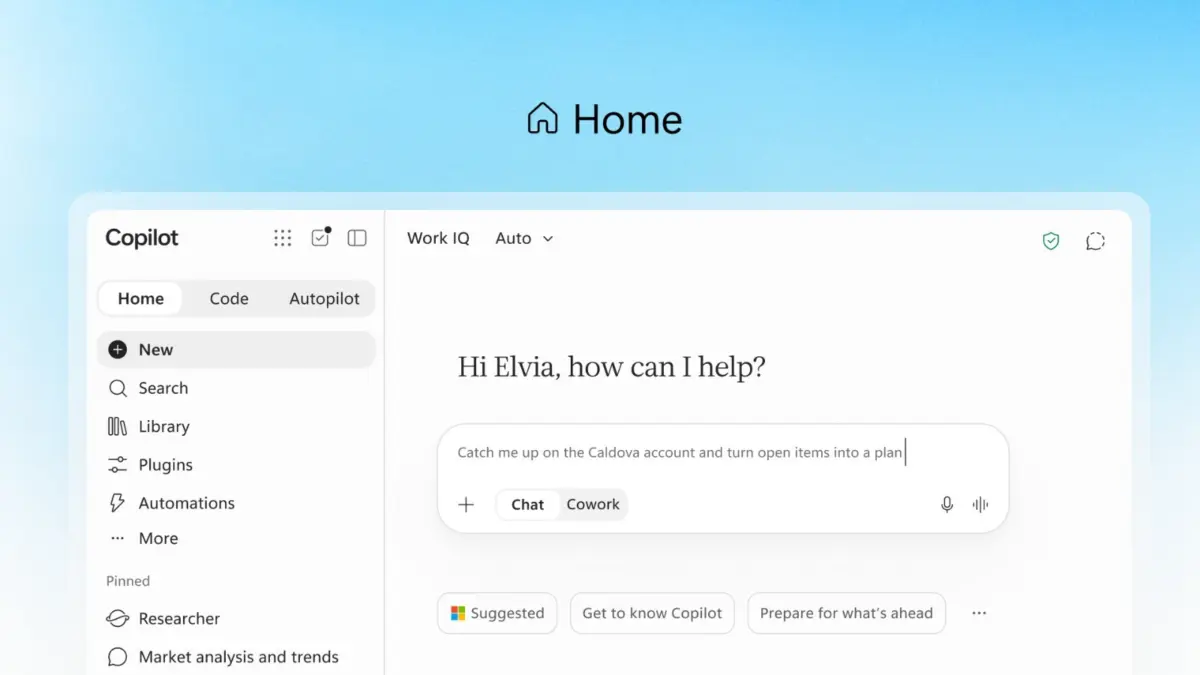
This comprehensive rollout centers on three major architectural pillars: Home, Code, and Autopilot. While each component serves a distinct function within the enterprise stack, together they illustrate Microsoft’s ultimate vision for its flagship AI assistant—transforming it from a passive lookup tool into an active, persistent participant in complex, long-running business processes.
1. Main Facts: The Anatomy of the New Copilot Ecosystem
The late-September announcements from Microsoft represent the most ambitious update to the Microsoft 365 AI ecosystem since its inception. Rather than simply rolling out incremental feature upgrades or tweaking underlying large language models (LLMs), Microsoft has restructured how users interact with intelligence across their entire digital workspace.
At its core, the update bridges the gap between passive assistance and active collaboration. The introduction of Home centralizes fragmented workflows, serving as a unified command center where tools like Chat and Cowork live alongside real-time data feeds from corporate emails, calendar events, active documents, and collaborative communications.
Simultaneously, Code democratizes software development within organizations, allowing non-technical employees to build functional applications, automated workflows, and interactive dashboards using natural language.
Finally, the crown jewel of the announcement—Autopilot (formerly known as Scout)—introduces true agentic capabilities to the enterprise. By allowing users to assign roles, goals, and behavioral boundaries, Autopilot transforms Copilot from a tool that waits for commands into an autonomous agent capable of tracking projects, monitoring communications, and executing recurring duties without constant human supervision.
2. Chronology of the Shift: From Reactive Chatbots to Proactive Agents
To understand the magnitude of Microsoft’s latest move, it is necessary to examine the rapid evolutionary timeline of workplace artificial intelligence over the past three years.
- Late 2022 – 2023: The Generative Boom and the "Prompt Box" Era. The launch of modern generative AI introduced businesses to the era of the conversational assistant. Tools like ChatGPT and early iterations of Microsoft Copilot proved that LLMs could draft emails, summarize lengthy documents, and write code snippets. However, these interactions were strictly session-based. Every task required a fresh prompt, and the AI retained little to no persistent awareness of broader project lifecycles.
- 2023 – Mid 2024: Deep Integration into Productivity Suites. Microsoft integrated Copilot natively into Word, Excel, PowerPoint, and Teams. While this drastically reduced friction—allowing users to generate a presentation from a Word document with a click—the AI remained constrained within individual application silos. A user still had to manually orchestrate data moving from an email chain into an Excel sheet, and then into a PowerPoint deck.
- September 2025: The Agentic Leap. Microsoft’s latest unveiling marks the transition from assistance to agency. By introducing persistent workspaces (Home), natural-language application generation (Code), and goal-oriented autonomous agents (Autopilot), Microsoft has eliminated the boundaries of the traditional chat window. The AI is no longer waiting for a single prompt; it is integrated directly into the fabric of daily organizational operations, maintaining memory, identity, and context across extended time horizons.
3. Supporting Data and Technological Architecture
Underpinning these new user-facing features is a complex, deeply integrated technological foundation designed to ensure security, scalability, and contextual relevance within large organizations.
The Engine of Context: Microsoft IQ, Fabric IQ, and Work IQ
An AI agent is only as effective as the data it can access and understand. To prevent Copilot from operating in an informational vacuum, Microsoft has anchored its new features to its advanced enterprise data frameworks:
- Microsoft IQ: Serves as the foundational layer that maps enterprise relationships, organizational structures, and institutional knowledge, giving Copilot deep contextual awareness of who works with whom and what documents matter.
- Fabric IQ: Already integrated into Chat and Cowork, this layer connects Copilot directly to analytical and data-engineering pipelines, allowing users to query and manipulate large data reservoirs conversationally.
- Work IQ: Set to roll out shortly, Work IQ will ingest and synthesize data, workflows, and automated logic from Dynamics 365 and the Power Platform, bridging customer relationship management (CRM) with day-to-day productivity tasks.
Code and GitHub Copilot Integration
The Code feature is built directly upon the robust, industry-tested technology of GitHub Copilot, but tailored specifically for enterprise business users. Operating within a secure, isolated organizational sandbox, Code allows employees with zero programming background to construct custom internal tools. By describing a business logic bottleneck in plain language—such as "Build me an interactive dashboard that tracks weekly regional sales discrepancies and flags inventory shortages"—the user initiates an automated generation pipeline that delivers a functional, secure application ready for deployment within the team.
Unified Daily Management: The "Today" Experience
Complementing Home is Today, a specialized dashboard experience designed to combat digital fatigue. Today aggregates unread emails, upcoming meetings, pending action items, and relevant chat threads into a single, curated interface. Rather than forcing workers to context-switch across dozens of open tabs and applications, Today acts as a personalized morning briefing and operational runway.
4. Official Responses and Industry Perspectives
The announcement has triggered widespread discussion among industry analysts, enterprise leaders, and technology ethicists regarding the future of work and software design.
Speaking on the strategic vision behind Home and Autopilot, corporate representatives emphasized that the primary goal of modern enterprise software is to reduce "cognitive overhead." Modern knowledge workers spend an estimated 20% to 30% of their workday simply searching for information, reconciling data across conflicting applications, and managing status updates rather than engaging in high-value strategic execution.
"For decades, software has demanded that humans act as the glue between applications," noted one senior enterprise product lead during the briefing. "We copy data from the email client, paste it into the spreadsheet, update the project management board, and notify the team on chat. With Autopilot and our new integrated architecture, the AI becomes that organizational glue. The human sets the intent, establishes the guardrails, and evaluates the outcomes. The system handles the tedious mechanics of execution."
Enterprise software analysts have similarly praised the move, noting that Microsoft is successfully answering the market demand for "AI agents." While competitors have experimented with standalone agentic applications, Microsoft’s unique advantage lies in its ubiquitous enterprise footprint—seamlessly blending these powerful new autonomous capabilities directly into the Microsoft 365 environments where hundreds of millions of people already work every day.
5. Implications: Redefining the Workplace and the Knowledge Worker
The shift from reactive chat tools to proactive, autonomous agents carries profound implications for the structure of modern businesses, the nature of corporate productivity, and the evolving role of the human worker.
From Doing Tasks to Managing Systems
As tools like Autopilot assume responsibility for monitoring projects, running recurring processes, and synthesizing cross-channel communications, the daily job description of the knowledge worker is bound to change. The skill set required to thrive in an AI-augmented workplace is shifting away from mechanical execution (such as formatting reports or sorting data) toward governance, system design, and strategic oversight.
Workers will increasingly act as managers of digital workforces. Just as mid-level managers oversee human teams by setting objectives, defining boundaries, and reviewing performance metrics, future knowledge workers will manage fleets of specialized Copilot agents tailored to specific departmental needs.
Democratizing Software Development
The introduction of the Code environment heralds a massive leap forward for the "citizen developer" movement. Historically, if a department needed a custom workflow automation or an interactive tracking dashboard, they had to submit a ticket to the IT department and wait months for allocation.
By empowering non-technical personnel to generate functional applications using natural language within a secure, isolated corporate framework, Microsoft is effectively decentralizing software creation. Marketing teams can build their own lead-tracking panels, human resources can automate onboarding document verification, and logistics teams can spin up real-time inventory dashboards—all without writing a single line of traditional code, and all while maintaining strict compliance under IT oversight.
The Challenge of Oversight and Trust
Naturally, the transition to autonomous AI agents brings significant governance and trust challenges. When an AI is merely drafting an email that a human reviews before sending, the risk of catastrophic failure is low. However, when an autonomous agent is given the authority to track projects, execute multi-step workflows, and interact with internal communication channels without constant supervision, the stakes rise exponentially.
Organizations will need to establish rigorous frameworks for defining the "limits" mentioned in Microsoft’s Autopilot architecture. Setting clear behavioral boundaries, auditing agent actions, and ensuring data privacy within isolated enterprise sandboxes will become core responsibilities for Chief Information Security Officers (CISOs) and compliance officers worldwide.
Conclusion: A Permanent Shift in Office Culture
Microsoft’s September 25 announcements mark a definitive turning point in the commercial history of artificial intelligence. The message is clear: Copilot is no longer a peripheral browser window or a floating toolbar widget summoned only when inspiration fails or a quick calculation is needed.
By embedding persistent workspaces, conversational application development, and goal-driven autonomous agents directly into the corporate nervous system, Microsoft is carving out a permanent, proactive seat for artificial intelligence at the center of human enterprise. The question for businesses is no longer how to use AI, but rather how to lead alongside it.



Leave a Reply