

By Architectural News Desk
Published: September 27, 2026
Main Facts
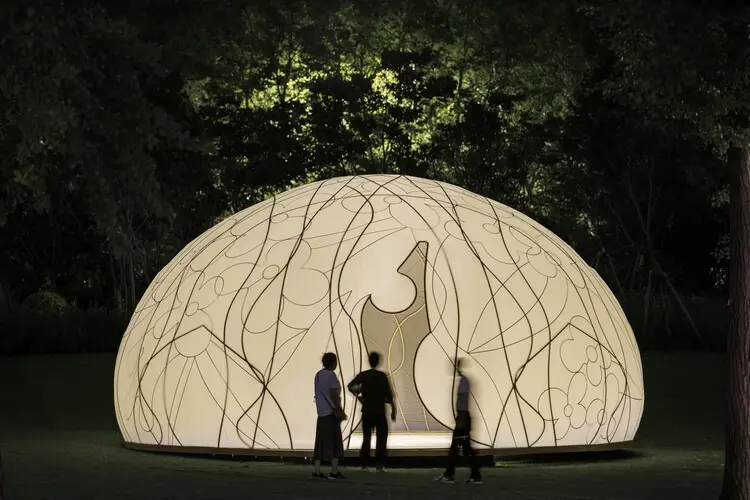
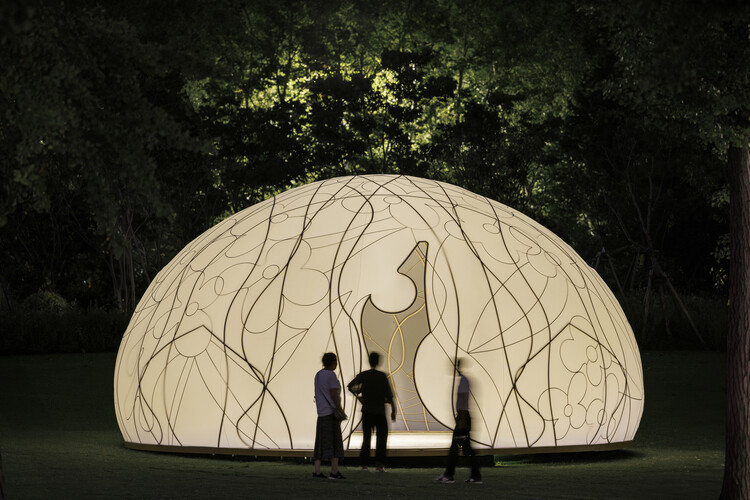
In celebration of China’s traditional Mid-Autumn Festival, architectural and design practice HCCH Studio has unveiled Osmanthus Moon, a striking temporary public art installation that bridges spatial design, cultural heritage, and contemporary art. Curated by Han Shuang, the project serves as a physical and metaphorical projection of the revered osmanthus flower—an iconic botanical symbol and autumnal flavor deeply embedded in Chinese folklore.

Rather than relying solely on conventional festive decorations, HCCH Studio integrated its spatial intervention with the expressive action paintings of folk artists practicing "Zao Hua" (literally translated as "stove flower" or nature’s creation), a recognized intangible cultural heritage tradition. Captured through the lens of architectural photographer Guowei Liu, the installation transforms a public urban site into an ephemeral landscape of scent, memory, light, and shadow. Osmanthus Moon stands as a testament to how contemporary temporary architecture can activate public spaces while maintaining a profound dialogue with ancestral craft and seasonal rituals.
Chronology
The realization of Osmanthus Moon followed a rigorous conceptualization, design, and construction timeline leading up to the Mid-Autumn Festival:
- Early Conceptualization (Spring 2026): HCCH Studio initiates preliminary discussions regarding a public art intervention for the upcoming Mid-Autumn Festival. The design team focuses on core autumnal motifs, eventually selecting the osmanthus flower due to its sensory richness and cultural resonance.
- Heritage Integration and Collaboration (Late Spring 2026): Studio principals collaborate with practitioners of "Zao Hua," exploring traditional action painting techniques. Workshops are organized to translate the spontaneous, expressive gestures of folk artisans into spatial cues and structural parameters.
- Design Development and Prototyping (Summer 2026): HCCH Studio finalizes the architectural geometry of the installation, balancing structural safety for public interaction with lightweight, temporary material assemblies. Lighting strategies are mapped out to simulate the ethereal glow of an autumn moon.
- On-Site Construction and Installation (September 2026): Prefabricated components are transported to the site. The assembly process is carefully coordinated to minimize disruption while maximizing the visual and sensory impact of the spatial intervention.
- Unveiling and Public Opening (September 27, 2026): Osmanthus Moon officially opens to the public, coinciding with peak autumn festivities. The installation immediately draws crowds, sparking widespread critical acclaim across architectural and cultural platforms.
Supporting Data
While temporary installations often prioritize visual ephemera over structural depth, Osmanthus Moon relies on a sophisticated framework of design metrics, material selection, and cultural data:
- Project Identity: Osmanthus Moon (Luna de Osmanto)
- Design Firm: HCCH Studio
- Curator: Han Shuang
- Photography: Guowei Liu
- Primary Cultural References: The Mid-Autumn Festival, the osmanthus flower (autumn flora/flavor), and "Zao Hua" intangible cultural heritage action painting.
- Project Typology: Temporary public art installation, pavilion design, urban intervention.
- Publication Date: September 27, 2026
- Source Reference: ArchDaily (ISSN 0719-8914)
Official Responses and Curatorial Insights
The creative rationale behind Osmanthus Moon highlights a deliberate effort by HCCH Studio to merge vernacular art forms with contemporary spatial theory. Curatorial notes provided by Han Shuang elaborate on the conceptual layers embedded within the project:

"Osmanthus Moon is not merely a seasonal decoration; it is an architectural translation of memory and sensory perception," notes the project team. "By drawing upon the motif of the osmanthus—which signals the arrival of autumn through both its visual presence and its distinct fragrance—we wanted to create a spatial envelope that encourages visitors to slow down and experience the environment multi-sensory-wise."
The integration of "Zao Hua" action painting was a pivotal turning point in the design process. According to HCCH Studio, traditional folk arts often risk being relegated to museum glass cases or fading away entirely. By embedding these dynamic, expressive painting techniques into the structural and surface treatment of the installation, the studio provided a living, breathing canvas for intangible heritage.
"The collaboration with ‘Zao Hua’ artists allowed us to break away from rigid, purely digital geometries," HCCH Studio explains. "The spontaneity of the folk paintings injected an organic, human-centric rhythm into the architecture, ensuring that the installation feels both rooted in history and strikingly modern."
Implications
The debut of Osmanthus Moon carries significant implications for the future of temporary public architecture, urban placemaking, and the preservation of intangible cultural heritage.

1. Revitalizing Intangible Cultural Heritage Through Architecture
In an era dominated by rapid globalization and digital media, traditional crafts like "Zao Hua" face severe existential threats. HCCH Studio’s project demonstrates a viable methodology for preserving such traditions: rather than treating heritage as a static artifact to be preserved behind glass, architecture can act as an active host, giving traditional techniques new life in public, contemporary contexts. This approach invites younger generations to engage with ancestral practices in a relevant, visually compelling environment.
2. The Power of Temporary Urban Interventions
Permanent civic architecture often requires years of planning, bureaucratic approval, and massive capital investment. Osmanthus Moon highlights the agility and potency of temporary installations. By transforming public squares into immersive narrative spaces over the course of a few weeks, architects can test bold ideas, foster community engagement, and inject vitality into urban nodes without long-term structural commitments.

3. Multi-Sensory Design in the Public Realm
Modern urban design frequently prioritizes the visual sense, often neglecting the olfactory, tactile, and emotional dimensions of space. By invoking the osmanthus flower—a symbol deeply tied to seasonal scent and emotional memory—HCCH Studio sets a precedent for architecture that engages the human body on multiple sensory levels. This holistic approach paves the way for future public spaces that actively contribute to urban psychological well-being and seasonal connection.
As cities continue to grapple with the tension between hyper-modernity and historical roots, Osmanthus Moon stands as a luminous example of how thoughtful, poetic design can harmonize the past with the present, transforming transient celebrations into enduring cultural memories.

Leave a Reply