

By Global Technology Desk
Published: October 2023
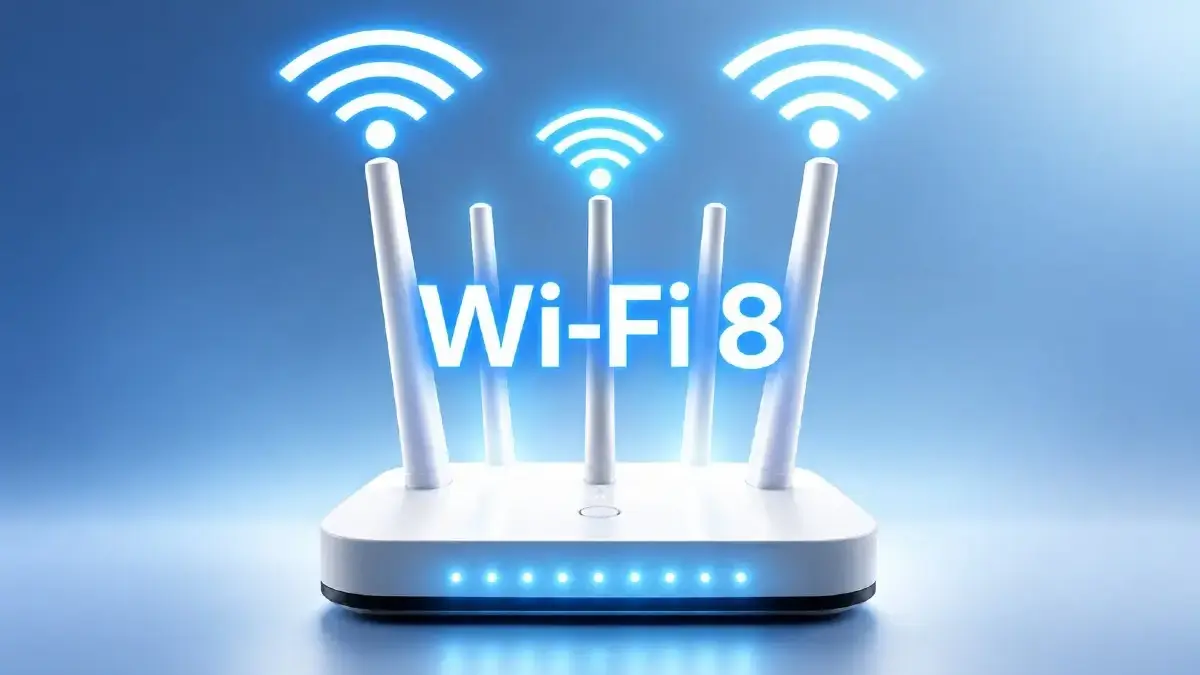
Image Source: ENTER.CO / AI-Generated via ChatGPT
Main Facts
The next generation of wireless networking is stepping over the horizon, shifting the conversation away from raw, laboratory-tested speeds toward practical, everyday reliability. While previous iterations of the IEEE 802.11 standards focused aggressively on pushing bandwidth boundaries—allowing users to download massive files in mere seconds—Wi-Fi 8 pivots toward solving the most persistent frustrations of modern domestic and commercial networking.
Rather than chasing higher data throughput ceilings under optimal conditions, the incoming standard targets signal degradation across distance, severe channel interference in dense urban environments, and network congestion when dozens of smart devices compete simultaneously for airtime.
Key takeaways regarding the transition to Wi-Fi 8 include:
- A Shift in Priorities: Wi-Fi 8 moves from speed maximization (the hallmark of Wi-Fi 7) to reliability, consistency, and latency reduction in adverse conditions.
- Targeting Dead Zones: The technology is engineered to fortify connections in remote rooms, behind thick structural walls, and across multi-floor residences.
- Backward Compatibility: Upgrading to a Wi-Fi 8 router will not instantly render existing hardware obsolete. Smartphones, laptops, and smart TVs running Wi-Fi 6, 6E, or 7 will continue to function seamlessly.
- Coexistence and Gradual Rollout: The first compatible routers have been announced, but widespread adoption will happen gradually, resulting in a multi-generation ecosystem in most households for years to come.
- Contextual Necessity: Households with robust existing coverage and low interference will see marginal immediate gains, whereas homes plagued by dropouts, buffering, and congestion will benefit most.
Chronology: The Evolution of Wireless Standards
To understand why Wi-Fi 8 represents a fundamental philosophy shift, it is essential to trace the historical trajectory of wireless networking standards. For decades, the Wi-Fi Alliance and the Institute of Electrical and Electronics Engineers (IEEE) prioritized one primary metric: speed.
The Era of Foundation and Expansion (Wi-Fi 4 to Wi-Fi 6)
- Wi-Fi 4 (802.11n – 2009): Introduced MIMO (Multiple-Input, Multiple-Output) technology, allowing multiple antennas to transmit and receive data simultaneously, fundamentally changing home networking.
- Wi-Fi 5 (802.11ac – 2014): Focused heavily on the 5 GHz band, dramatically increasing multi-station throughput and making video streaming viable across multiple devices.
- Wi-Fi 6 and 6E (802.11ax – 2019/2020): Addressed network density through technologies like OFDMA (Orthogonal Frequency-Division Multiple Access) and MU-MIMO, ensuring that homes with dozens of connected devices did not choke the network. The 6E variant opened up the interference-free 6 GHz spectrum.
The Speed Peak (Wi-Fi 7)
- Wi-Fi 7 (802.11be – 2024): Widely adopted across high-end smartphones and computing hardware, Wi-Fi 7 maximized the potential of the 6 GHz band. It introduced 320 MHz channels and 4K QAM (Quadrature Amplitude Modulation), vastly increasing the volume of data a wireless network could handle at any given microsecond. It was, by all accounts, a triumph of data throughput.
The Turn Toward Reliability (Wi-Fi 8 and Beyond)
- Wi-Fi 8 (IEEE 802.11bn / Ultra High Reliability – Projected mid-to-late 2020s): Recognizing that raw gigabit speeds are meaningless if a user is two rooms away and experiencing packet loss, the IEEE initiated work on the Ultra High Reliability (UHR) study group. Instead of pushing data caps higher, Wi-Fi 8 focuses on ultra-low latency, seamless multi-access point coordination, and resilience against interference.
Supporting Data & Technical Context
The architectural differences between Wi-Fi 7 and the emerging Wi-Fi 8 framework highlight a maturing technology market. While average household internet plans rarely exceed 1 gigabit per second (Gbps)—though multi-gigabit fiber is expanding—Wi-Fi 7 routers were already capable of theoretical throughputs exceeding 40 Gbps. The bottleneck was no longer the airwaves inside the home; it was the physics of radio frequency (RF) propagation, environmental obstacles, and network congestion.
The Physics of RF Propagation
Radio waves degrade predictably as they travel. Higher frequencies (such as the 6 GHz band introduced in Wi-Fi 6E and utilized heavily in Wi-Fi 7) offer incredible speed but suffer from poor range and severe attenuation when encountering physical barriers like concrete, brick, and metallic insulation.
Wi-Fi 8 incorporates advanced beamforming and spatial recognition algorithms designed to mitigate these physical barriers. While it cannot violate the laws of physics, it utilizes smarter routing protocols to maintain data integrity when a signal has been bounced, weakened, or partially blocked.
Urban Density and Co-Channel Interference
In high-density residential areas—such as apartment complexes, high-rise condominiums, and tightly packed suburban neighborhoods—dozens of independent Wi-Fi routers broadcast on overlapping channels. This creates "co-channel interference," where networks effectively shout over one another, driving up latency and causing packet drops.
Wi-Fi 8 introduces refined dynamic coordination mechanisms. Neighboring access points can negotiate airtime more efficiently, reducing packet collisions and stabilizing connections in environments where the airwaves are crowded.
+-------------------------------------------------------------------------+
|                  Wi-Fi Generation Comparison Matrix                     |
+------------------+--------------------------+---------------------------+
| Metric           | Wi-Fi 7 (The Speed King) | Wi-Fi 8 (The Stabilizer)  |
+------------------+--------------------------+---------------------------+
| Primary Focus    | Maximum Data Throughput  | Reliability & Consistency |
| Channel Width    | Up to 320 MHz            | Optimized Coordination    |
| Latency Control  | Standard Improvements    | Ultra-Low Latency Focus   |
| Wall Penetration | Moderate (High loss at 6GHz)| Enhanced Beam/Routing  |
| Mesh Hand-offs   | Standard Roaming         | Advanced Multi-AP Sync    |
+------------------+--------------------------+---------------------------+
Official Perspectives and Industry Insights
Networking hardware manufacturers and standards organizations emphasize that Wi-Fi 8 should not be viewed as an urgent consumer replacement cycle, but rather as a corrective evolution of wireless architecture.
Industry analysts note that consumer fatigue regarding router upgrades is real. For years, marketing campaigns have convinced users that buying a new router every two to three years is mandatory for basic internet browsing, video conferencing, and 4K streaming. Wi-Fi 8 breaks this cycle by acknowledging that for a vast majority of users, Wi-Fi 7 or even Wi-Fi 6 hardware is already overpowered for their actual tasks.
A spokesperson for networking research bodies remarked during recent standards committee drafts:
"We have reached a point in wireless engineering where adding more zeroes to the maximum speed rating solves virtually zero real-world consumer problems. The average user does not need a 40 Gbps connection to stream a movie or attend a Zoom call. What they need is for that connection not to stutter when someone turns on a microwave, walks to the backyard, or when twenty apartment neighbors hop online at 8:00 PM."
Furthermore, infrastructure providers stress that network stability directly impacts emerging technologies like augmented reality (AR), virtual reality (VR), cloud gaming, and smart-home automation. These applications are acutely sensitive to latency spikes and jitter, making the reliability focus of Wi-Fi 8 vital for the next decade of consumer tech.
Practical Implications for the Consumer
For the average household, the arrival of Wi-Fi 8 raises immediate practical questions regarding purchasing decisions, device compatibility, and home network architecture.
Do You Need to Upgrade Immediately?
No. If your current network—whether powered by Wi-Fi 6, 6E, or 7—delivers stable coverage, handles your household device load without dropping packets, and maintains consistent speeds across your living space, the arrival of Wi-Fi 8 offers little mandatory incentive to switch.
Routers are long-term investments. A high-end Wi-Fi 7 mesh system or standalone router will continue to operate at peak efficiency for years after Wi-Fi 8 hardware hits shelves.
The Coexistence Reality
Because Wi-Fi standards maintain rigorous backward compatibility, the transition period will be frictionless for end-users.
- Old devices on new routers: Your current smartphone, older laptop, smart thermostat, and legacy security cameras will connect to a Wi-Fi 8 router without issue, operating at the maximum capability supported by their internal network cards.
- New devices on old routers: If you purchase a future smartphone equipped with Wi-Fi 8 capabilities down the line, it will function perfectly fine on an older Wi-Fi 7 or Wi-Fi 6 router, though it will not tap into the advanced multi-AP coordination and interference-mitigation features of the new standard.
Consequently, households will feature mixed ecosystems for years. There is zero requirement to simultaneously replace every connected gadget in your home.
When Will an Upgrade Actually Matter?
You should consider adopting Wi-Fi 8 hardware when it becomes commercially viable if you fall into specific use-case categories:
- Persistent Dead Zones: You live in a home with difficult architectural layouts (thick stone walls, multiple floors) where traditional mesh systems struggle to maintain a clean hand-off between nodes.
- High-Density Interference: You reside in an apartment building where Wi-Fi congestion causes frequent latency spikes during peak evening hours.
- Mission-Critical Low Latency: You engage in competitive cloud gaming, professional live-streaming, or utilize extensive real-time smart-home ecosystems that demand absolute packet integrity.
Ultimately, Wi-Fi 8 represents a mature industry pivoting from vanity metrics to functional excellence—ensuring that the invisible infrastructure holding our digital lives together finally works reliably, no matter where we are standing in the house.




Leave a Reply