


BOGOTÁ — In the rapidly evolving landscape of Latin American fintech, few success stories rival Nubank’s regional expansion. Operating locally as Nu Colombia, the digital institution has onboarded millions of users with the promise of frictionless digital banking, transparent terms, and accessible credit. However, a recent viral social media post has thrust the company—and the broader neo-banking sector—into the center of a fierce economic debate.
At the heart of the controversy is a fundamental question: When does financial inclusion cross the line into over-indebtedness?
What began as a LinkedIn critique of a routine loan simulation has snowballed into a sophisticated public discourse concerning high interest rates, the legal definitions of predatory lending, the boundaries of regulatory compliance, and whether offering formal credit at the legal maximum truly benefits the financially underserved.
1. Main Facts: The Catalyst and the Core Conflict
The controversy erupted following a LinkedIn publication by strategic advisor Jorge Hernán Nieto Botero. Nieto shared a public simulation of a financial product offered by Nu Colombia—specifically, their "Préstamo Ligero" (Light Loan)—and questioned the real-world value of a financial inclusion model that relies on maximum allowable interest rates.
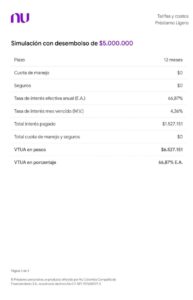
The simulation distributed by Nieto detailed a consumer loan scenario:
- Principal Amount: $5,000,000 Colombian Pesos (COP)
- Repayment Term: 12 months
- Monthly Interest Rate (Periodic): 4.36% month-over-month (vencido)
- Effective Annual Rate (EA): 66.87%
- Total Interest Accrued: $1,527,151 COP
- Total Repayment Amount: $6,527,151 COP
- Additional Fees: $0 for management fees (cuota de manejo) or mandatory insurance packages.
While these figures represent a specific simulation and do not dictate the uniform pricing offered to every applicant, they immediately triggered alarms. Nieto argued that an effective annual rate hovering near 67% carries the severe risk of trapping vulnerable consumers in a perpetual cycle of debt. He further contrasted these figures with the products typically offered by traditional brick-and-mortar commercial banks, which often advertise rates at roughly half—or less—of Nu’s simulated ceiling.
Nu Colombia swiftly defended its product. The institution emphasized that the Préstamo Ligero is a fully regulated, low-value consumer credit instrument explicitly designed to pull unbanked or underbanked populations out of the informal lending shadows—specifically targeting predatory street lenders, colloquially known in Colombia as "gota a gota."
2. Chronology of the Debate
To understand how a routine loan simulation escalated into a macroeconomic talking point, it is vital to trace the timeline of events:

- Initial Launch and Market Positioning: Over preceding quarters, Nu Colombia aggressively expanded its footprint, rolling out savings accounts and low-value credit options designed to capture segments ignored or underserved by traditional financial institutions. The company projected massive multi-billion-peso investments in technology and regional scaling.
- The LinkedIn Publication: Strategic advisor Jorge Hernán Nieto Botero publishes a critical review of Nu Colombia’s credit model on LinkedIn. By analyzing the terms of the Préstamo Ligero simulation, he raises ethical and structural questions about the true meaning of "financial inclusion" when paired with high interest rates.
- Viral Spread and Public Engagement: The post quickly gains traction across professional and financial networks in Colombia. Fintech founders, economists, and everyday consumers begin debating the merits and dangers of digital credit expansion.
- Nu Colombia’s Defense: Representatives and digital statements from Nu clarify that the product operates completely within legal frameworks, provides essential transparency with zero hidden fees, and serves as a legitimate stepping stone into the formal financial ecosystem.
- Regulatory Examination: Financial analysts, legal experts, and media outlets begin dissecting the exact mechanics of Colombian financial regulations, specifically examining how the Superintendencia Financiera calculates annual banking interest rates and usury caps for low-value consumer loans.
- The Ongoing Aftermath: The debate matures from a direct critique of a single fintech into a broader national dialogue regarding household sustainability, consumer financial literacy, and the regulatory responsibilities of digital lenders.
3. Supporting Data and Regulatory Frameworks
To contextualize the debate, one must examine the legal parameters governing consumer credit in Colombia. The core of the legal argument rests on how the state defines, categorizes, and caps interest rates for various types of loans.
Regulatory Classification: Decree 2555 of 2010
Colombian financial law does not treat all consumer credit equally. Under Decree 2555 of 2010, low-value consumer credit is regulated under specialized provisions. Article 2.1.16.1.3 explicitly mandates that financial institutions offering this specific modality must rigorously control and monitor the total indebtedness balance of the applicant at the moment of loan origination.
The Legal Boundaries of Usury
Interest rate caps in Colombia are bound by two foundational legal instruments:
- Article 884 of the Commercial Code: Establishes the use of the Interés Bancario Corriente (Current Banking Interest)—certified monthly by the Superintendencia Financiera—as the baseline reference for financial transactions.
- Article 305 of the Penal Code: Defines the crime of usury (usura). It dictates that anyone who loans money and charges interest exceeding one-half (50%) above the certified current banking interest rate for the corresponding period and modality commits a criminal offense.
The Numbers in September 2026
Data from the Superintendencia Financiera illustrates the precise mathematical foundation behind Nu Colombia’s simulated rate:
- For low-value consumer credit, the certified Current Banking Interest Rate stood at 44.58% Effective Annual (EA).
- Applying the statutory 50% margin allowed by the Penal Code established the usury ceiling at 66.87% EA.
- By comparison, general consumer and ordinary credit products maintained a significantly lower certified cap of 29.24% EA.
This statistical reality confirms that the rate featured in the viral simulation precisely matched the legal maximum permitted for low-value consumer credit during that period.
4. Official Responses and Institutional Perspectives
The clash between Nieto’s critique and Nu Colombia’s defense highlights two contrasting philosophies regarding credit accessibility.
The Critic’s Perspective: Is Formal Inclusion Always Beneficial?
Jorge Hernán Nieto Botero and supporting market analysts argue that simply granting access to formal credit is insufficient if the financial terms are inherently punishing. Their primary contentions include:
- The Debt Trap: High monthly payments and steep interest accruals can easily overwhelm low-income borrowers, transforming a short-term liquidity solution into long-term financial insolvency.
- The Traditional Banking Contrast: While traditional institutions often reject high-risk applicants, those who do qualify enjoy significantly lower interest rates. Critics question whether digital neo-banks are shifting an unfair risk burden onto the most vulnerable segments of the population.
- The Definition of Inclusion: True financial inclusion, critics argue, must encompass financial education, sustainable repayment structures, and progressive rate reductions for reliable borrowers, rather than merely maximizing profitability under the umbrella of regulatory compliance.
Nu Colombia’s Perspective: A Stepping Stone Against Informal Extortion
Nu Colombia maintains that its financial architecture is built on transparency, user empowerment, and systemic transformation. Their official stance emphasizes:
- Regulatory Compliance and Transparency: The Préstamo Ligero features zero hidden fees, no management charges, and no mandatory insurance packages. Borrowers know the exact financial commitment upfront.
- Target Audience and Risk Pricing: The product is intentionally engineered for individuals who are beginning to build or actively repair their credit histories. Because these users lack robust credit scores, pricing must reflect the elevated risk profile. Furthermore, individual rates are dynamically adjusted based on verified user profiles.
- The Alternative is Worse: Nu positions its regulated product as a vital shield against informal, illegal loan sharks—the notorious "gota a gota" networks.
To evaluate this claim, market data provides stark context. According to estimates compiled by ANIF (National Association of Financial Institutions) in collaboration with Colombia Fintech, informal predatory loans in Colombia can exact catastrophic annualized rates—reaching up to 382% for individual borrowers. Against such predatory informal mechanisms, a regulated 67% EA product represents a vastly superior, legal alternative. However, analysts quickly note that proving a formal loan is better than loan sharking does not automatically prove it is sustainable for an individual household.
5. Broader Implications for the Fintech Ecosystem
The debate sparked by Nu Colombia and Jorge Hernán Nieto serves as a microcosm for the future of digital finance across Latin America. As neo-banks scale up, several systemic implications emerge:
1. The Maturity of the Neo-Banking Model
The early days of the fintech boom were characterized by uncritical celebration of user acquisition metrics. As these platforms mature, regulators, investors, and civil society are demanding deeper accountability. The conversation has shifted from "How many millions of accounts did you open?" to "What is the financial health of the average user after three years on your platform?"
2. Regulatory Scrutiny and Consumer Protection
As digital lenders push closer to legal interest rate ceilings to manage portfolio risk, financial regulators will likely face increased pressure to re-evaluate how low-value consumer credit is supervised. Policymakers must walk a delicate tightrope: setting rates too low could force neo-banks to withdraw services from high-risk populations, driving those users straight back to informal lenders; conversely, allowing maximum rates unchecked risks fueling a wave of structural household over-indebtedness.
3. The Imperative of Financial Education
Both critics and defenders of digital finance largely agree on one critical missing pillar: financial literacy. Providing digital tools and instant credit lines without commensurate educational frameworks creates an asymmetric relationship where algorithms understand consumer risk better than consumers understand compound interest. Moving forward, the success of inclusive banking will depend heavily on proactive measures to teach borrowers how to manage debt sustainably.
Conclusion
The debate initiated on LinkedIn is far more than a localized social media dispute—it is a defining moment for the maturation of Latin America’s digital economy. Nu Colombia operates well within the strict bounds of the law, offering a transparent alternative to the devastating cycles of informal loan sharking. Yet, the critique leveled against its pricing underscores a sobering truth: legality does not automatically equate to affordability, and access to credit is only truly inclusive when it empowers, rather than overwhelms, the borrower. As the industry looks toward the future, the ultimate challenge for fintech leaders will be proving that profitability and genuine consumer well-being can coexist in the same financial ecosystem.




Leave a Reply