

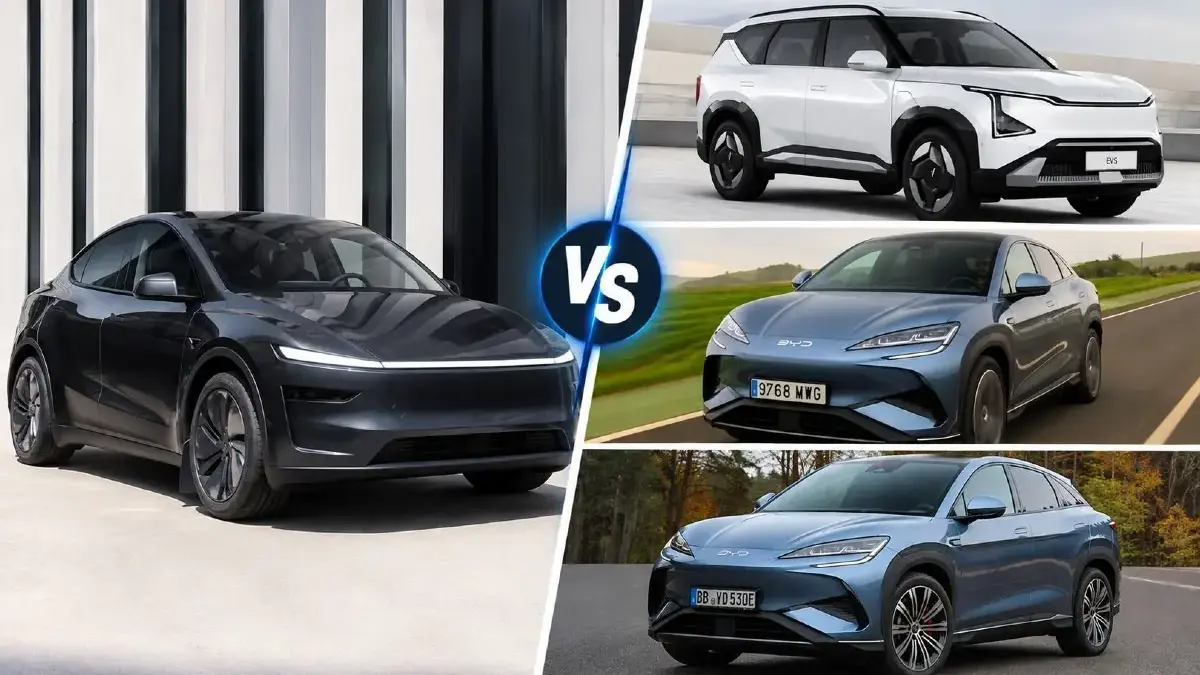
BOGOTÁ — The arrival of high-profile electric vehicles (EVs) in Colombia has fundamentally altered the domestic automotive landscape, challenging long-held assumptions about luxury, utility, and cost. Chief among these transformations is the arrival of the Tesla Model Y, which has upended traditional pricing and feature matrices. However, a higher price tag in the burgeoning Colombian EV market does not automatically translate to superior range or utility.
As buyers navigate showrooms in Bogotá, Medellín, and Cali, they are increasingly forced to weigh competing philosophies from Tesla, Kia, and BYD. While Tesla aggressively stretches the range-per-peso equation, competitors like Kia lean heavily into family-oriented ergonomics, and BYD channels its budget into sheer powertrain performance. Understanding what each vehicle offers relative to its cost—and whether those features align with daily driving realities—has become the central challenge for prospective buyers.
Main Facts: The Current State of the Colombian Electric SUV Market
The electric vehicle segment in Colombia is no longer an exclusive playground for early adopters with deep pockets. Entry points now hover around the $120 million COP mark, but significant divergences in range, interior architecture, charging speeds, and performance mean that no two vehicles in this class serve the exact same master.
The baseline of the market has been violently redrawn by Tesla’s official entry into Colombia. The brand introduced the Model Y Rear-Wheel Drive (RWD) at an introductory price of $119,990,000 COP, offering an impressive 466 kilometers of range under the Worldwide Harmonized Light Vehicles Test Procedure (WLTP). For buyers willing to stretch their budget to $144,990,000 COP, the Long Range All-Wheel Drive (AWD) variant pushes that envelope to 600 kilometers WLTP, introducing dual-motor traction and faster charging capabilities.
In parallel, established players have adjusted their rosters. The Kia EV5 enters the fray as a dedicated family transport, with the baseline "Light" trim starting at $139,990,000 COP (delivering roughly 400 km WLTP) and the upgraded "Light+" pushing range to 555 km WLTP for $155,990,000 COP.
Occupying the high-performance and stylistic apex of this comparison is the BYD Sealion 7. A coupe-styled SUV from a higher dimensional tier, the Sealion 7 prioritizes explosive acceleration and muscular architecture over raw mileage efficiency. With estimated market prices stretching from $169,990,000 COP to over $209,990,000 COP, it demands a steep financial commitment in exchange for sports-car-rivaling dynamics.
Chronology of Market Disruption: How Tesla and Competitors Shaped the Landscape
The inflection point for Colombia’s electric vehicle market occurred with Tesla’s long-awaited official entry, which bypassed traditional third-party import channels and introduced direct-to-consumer pricing paradigms.
- Pre-2024: The Colombian EV market was characterized by high acquisition costs, limited charging infrastructure outside major metropolitan corridors, and legacy automakers offering low-volume compliance cars. Brands like BYD built early trust through electric buses, taxis, and accessible crossover models, while Kia established a strong foothold with hybrid and early electric architectures.
- The Tesla Launch Event: Tesla announced its official commercial landing in Colombia, slashing psychological pricing barriers. The Model Y RWD debuted at $119,990,000 COP, directly undercutting legacy luxury EVs and putting immediate pressure on traditional dealerships.
- The Competitor Response: In response to Tesla’s aggressive pricing and packaging, established networks like Kia highlighted localized service advantages, vehicle financing partnerships, and family-centric configurations. Concurrently, high-end challengers like BYD accelerated the rollout of premium offerings such as the Sealion 7 to capture buyers unimpressed by Tesla’s minimalist interior design.
- Present Day: The market sits at a fascinating crossroad. Buyers are no longer simply asking, "How far can it go?" Instead, the conversation has matured into a nuanced evaluation of charging infrastructure, domestic electrical upgrades, after-sales networks, and resale values.
Supporting Data: Comparative Specifications
To evaluate these vehicles objectively, industry analysts rely on standardized WLTP metrics, pricing brackets, and intended use cases. However, real-world conditions—such as Bogotá’s notorious altitude and congestion, or highway climbs through the Andes—frequently alter these laboratory figures.
| Model | Reference Price (COP) | WLTP Range | Key Performance & Utility Highlights | Best Suited For |
|---|---|---|---|---|
| Tesla Model Y RWD | $119,990,000* | 466 km | 16-inch central display, 2,138L max cargo (seats folded), rear-wheel drive. | Reducing initial acquisition cost while maintaining strong daily range. |
| Kia EV5 Light | $139,990,000** | 400 km | 4.61m length, traditional control layout, 513L boot capacity. | Urban families prioritizing spatial ergonomics and conventional interior layout. |
| Tesla Model Y Long Range AWD | $144,990,000* | 600 km | Dual motors, AWD, 0-100 km/h in 4.8s, up to 250 kW fast charging. | Frequent long-distance travelers needing maximum inter-city autonomy. |
| Kia EV5 Light+ | $155,990,000** | 555 km | Smart cruise control, lane-keeping assist, wireless charging, power driver’s seat. | Buyers seeking a balance of family comfort, active safety tech, and extended range. |
| BYD Sealion 7 | $169,990,000 – $209,990,000*** | 456 km | Dual motors yielding 523 hp (390 kW), 0-100 km/h in 4.5s, 4.83m length, 58L front trunk (frunk). | Drivers prioritizing raw acceleration, striking coupe-SUV styling, and high power output. |
*Prices announced during Tesla’s official Colombian launch; subject to configuration changes.
**Reference prices provided by Kia Colombia; subject to commercial adjustments.
**Estimated market range; official pricing must be confirmed directly with BYD distributors.
Official Responses and Strategic Positioning
Automotive manufacturers operating in Colombia are keenly aware that specifications on a datasheet do not tell the whole story. Each brand has formulated a distinct strategic narrative to capture the imagination—and wallet—of the Colombian consumer.
Tesla: The Digital Ecosystem Approach
Tesla’s commercial posture rests on software-driven value and infrastructure disruption. By concentrating navigation, climate control, entertainment, and vehicle telemetry into a massive 16-inch central interface, Tesla positions the Model Y not merely as an automobile, but as a rolling smart device capable of Over-The-Air (OTA) updates. Executives emphasize that the Model Y’s efficiency yields unmatched kilometers per peso, minimizing the psychological friction of long-distance driving in a developing charging network.
Kia: The Pragmatic Family-First Strategy
Kia’s positioning acknowledges that technical specs do not live in a vacuum. Representatives for the brand emphasize that the EV5 is designed from the ground up to accommodate the realities of family life. By retaining physical and tactile control buttons, offering conventional seating ergonomics, and embedding robust active safety systems (ADAS) directly into mid-tier trims, Kia targets buyers who find Tesla’s minimalist cabin austere or distracting. Furthermore, Kia leverages its extensive, pre-existing dealership and service network across Colombia as a primary selling point against newer digital entrants.
BYD: High-Performance and Premium Presence
BYD approaches the upper tier of the market with an emphasis on engineering prowess and luxury styling. The Sealion 7 does not try to out-range the Tesla Model Y Long Range; instead, it out-powers it. Delivering 523 horsepower and sprinting from 0 to 100 km/h in a blistering 4.5 seconds, the Sealion 7 targets performance enthusiasts. BYD’s local representatives highlight the vehicle’s generous dimensions (4.83 meters long) and dual-trunk utility (including a practical 58-liter "frunk" for charging cables) to justify its elevated price tier.
Implications: Beyond the Showroom Floor
For the average Colombian buyer, choosing between these electric SUVs extends far beyond comparing range numbers on a brochure. Several hidden variables will ultimately dictate whether a purchase proves satisfying over years of ownership.
1. The Real Cost of Charging Infrastructure
Boasting a 600 km WLTP range sounds liberating, but it comes with a technical asterisk. The Tesla Model Y Long Range AWD can accept up to 250 kW at DC fast-charging stations, but that speed is entirely theoretical unless the driver can locate a local charging station capable of delivering that output. In Colombia, rapid-charging corridors are expanding along major routes like the Bogotá-Girardot highway, but coverage remains inconsistent.
Furthermore, relying on public charging infrastructure undermines the primary economic benefit of owning an EV. To maximize savings, owners must install a domestic wall-box charger. This requires factoring in supplemental electrical engineering expenses, home meter upgrades, and the cost of the hardware itself—costs that must be added to the vehicle’s initial purchase price alongside mandatory comprehensive insurance (seguro todo riesgo) and periodic maintenance.
2. Service Networks and Post-Purchase Support
While Tesla relies on its proprietary ecosystem, remote diagnostics, and streamlined digital service appointments, traditional legacy networks like Kia and BYD offer the security of physical workshops distributed across Colombia’s major urban centers. Prospective buyers must carefully weigh warranty terms—particularly regarding high-voltage lithium-ion battery degradation and thermal management guarantees—against the proximity and reliability of authorized repair centers. A minor body panel repair or sensor recalibration can become an exercise in frustration if spare parts must be shipped from overseas without localized stock.
3. Real-World Driving Dynamics vs. Laboratory Metrics
Laboratory tests like WLTP provide a standardized baseline, but they cannot fully account for the unique topography of the Andes. Driving from sea level up to Bogotá (2,600 meters of elevation) or navigating steep mountain passes demands intense battery output, while regenerative braking recovers energy on the descent. Similarly, driving speeds, ambient temperatures, and heavy use of climate control systems will consistently eat into a vehicle’s estimated range.
Conclusion: Which Electric SUV Makes the Most Sense?
Ultimately, the choice among the Tesla Model Y, Kia EV5, and BYD Sealion 7 comes down to a clear-eyed assessment of personal priorities:
- Choose the Tesla Model Y RWD if your primary goal is minimizing your initial financial outlay while securing a highly efficient, digitally integrated daily driver for urban and suburban environments.
- Choose the Tesla Model Y Long Range AWD if frequent inter-city road trips are a regular part of your lifestyle and you require maximum range between stops, combined with brisk dual-motor performance.
- Choose the Kia EV5 (Light or Light+) if your household demands traditional interior ergonomics, intuitive physical controls, comprehensive family-focused safety tech, and the backing of a deeply established national dealer network.
- Choose the BYD Sealion 7 if you view your vehicle as a statement of high performance and athletic design, prioritizing 523-horsepower acceleration and expansive physical dimensions over absolute mileage efficiency.
The electric vehicle market in Colombia has matured past the point where buyers must accept compromises just to drive emission-free. By looking past showroom marketing and aligning vehicle specifications with actual daily routines, Colombian motorists can find an electric SUV that justifies every single peso spent.




Leave a Reply