

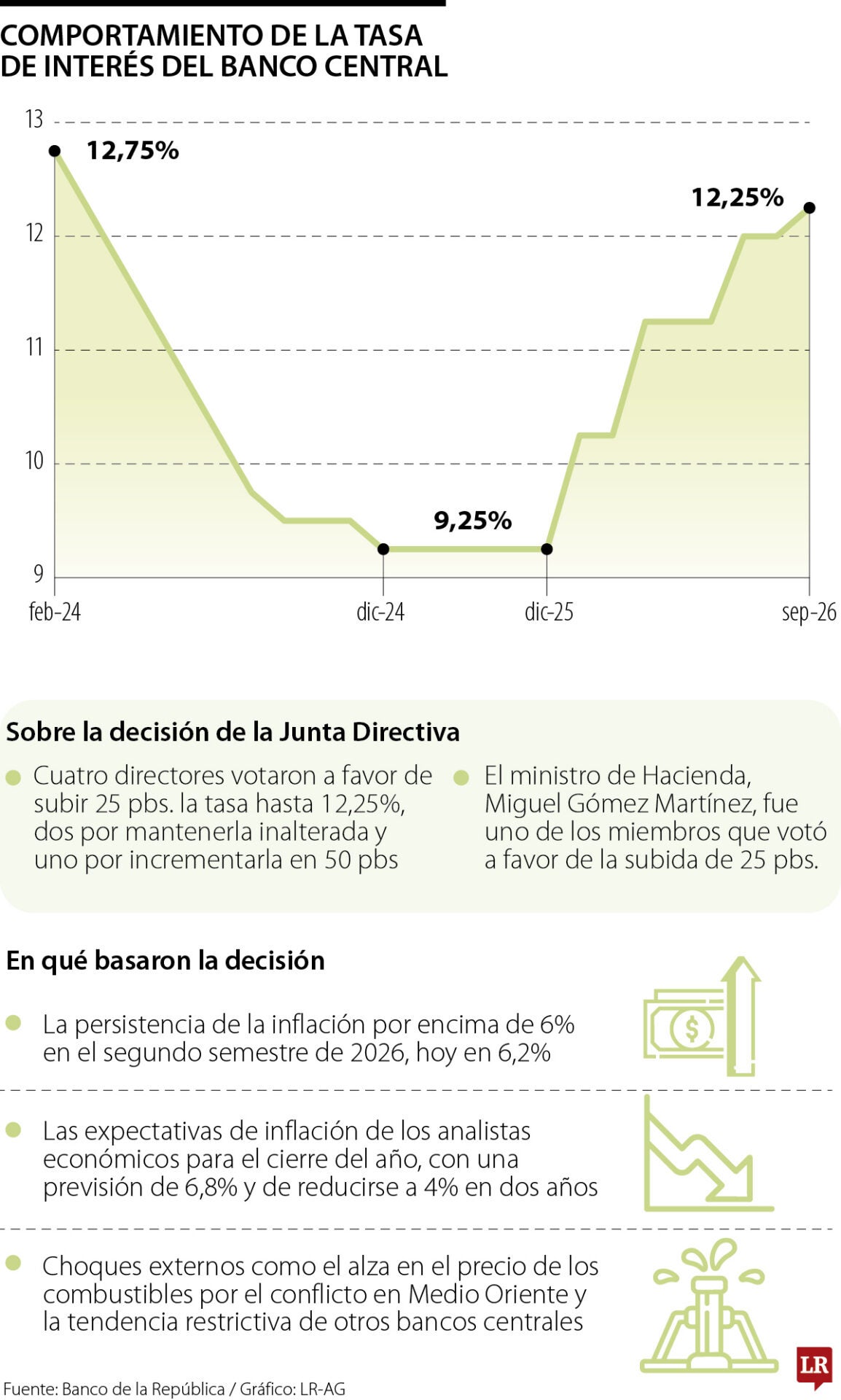
In an unexpected move that has sent ripples through Latin American financial markets, Colombia’s central bank, Banco de la República, has raised its benchmark intervention interest rate by 25 basis points to 12.25%. This decision marks a significant pivot toward a highly restrictive monetary stance, bringing borrowing costs close to their highest levels in a quarter-century.
The policy meeting also marked the debut of the newly appointed Minister of Finance, Miguel Gómez, on the central bank’s Board of Directors (Junta Directiva). The decision to tighten monetary policy caught the majority of market analysts off guard, as most had anticipated a period of stability to support a cooling economy. Instead, the central bank chose to prioritize the defense of its inflation target, signaling deep concern over sticky consumer prices, deteriorating inflation expectations, and looming climate-related supply shocks.
Main Facts of the Policy Decision
The interest rate hike to 12.25% represents the most restrictive policy environment in Colombia since early 2024. The move edges the benchmark rate closer to the 21st-century peak of 13.25%, a level maintained during the aggressive tightening cycle between April and December 2023.
A Highly Divided Board
The decision to raise rates was far from unanimous, revealing deep divisions within the seven-member Board of Directors regarding the trajectory of the Colombian economy:
- Four members voted in favor of the 25-basis-point increase.
- Two members voted to keep the rate unchanged at 12.00%.
- One member advocated for an even more aggressive 50-basis-point hike to 12.50%.
In a departure from the traditional confidentiality that shrouds the individual votes of the board, Minister of Finance Miguel Gómez publicly disclosed that he voted with the majority in favor of the 25-basis-point increase.
Direct Transmission to Borrowing Costs
The central bank’s benchmark rate is the primary reference point used by commercial banks to price their own credit products. Consequently, this rate hike will immediately begin filtering through the financial system, raising the cost of:
- Consumer Credit: Credit cards, personal loans, and overdrafts will see higher annual percentage rates (APRs).
- Housing Loans: Mortgages, both fixed and variable, will become more expensive, further cooling an already sluggish real estate market.
- Corporate Debt: Business loans and credit lines used by enterprises for capital expenditure and working capital will face steeper interest burdens, potentially dampening private investment.
Chronology of Colombia’s Monetary Policy
To understand the gravity of the latest rate hike, it is essential to trace the trajectory of Colombia’s monetary policy over the last few years. The country has transitioned through several distinct economic phases, characterized by post-pandemic recovery, historic inflation, a brief easing cycle, and the current return to hawkishness.
[April - Dec 2023]        [Jan - Aug 2024]          [Sept 2026 Decision]
Rate at Peak (13.25%) ---> Gradual Easing (12.00%) ---> Hike to 12.25%
(To combat 13%+ inflation)  (Amid slowing GDP growth)   (Driven by El Niño & Fed)
1. The Post-Pandemic Inflation Shock (2021–2023)
Following the COVID-19 pandemic, Colombia experienced a massive surge in aggregate demand, fueled by fiscal stimulus, historic currency depreciation, and global supply chain bottlenecks. By early 2023, headline inflation had soared past 13%, forcing Banco de la República to execute one of the most aggressive tightening cycles in its history. The benchmark rate was pushed to a peak of 13.25% in April 2023, where it remained anchored for eight months to suppress demand-pull inflation.
2. The Brief and Cautious Easing Cycle (2024)
As inflation began to slowly recede toward the high single digits and economic growth decelerated sharply, the central bank initiated a highly cautious easing cycle. By early 2024, the rate was lowered to 12.00%. During this period, the business community and various government officials consistently lobbied for faster rate cuts to stimulate a stagnant economy.
3. The Pivot Back to Tightening (Late 2026)
The latest policy meeting represents a dramatic halt to the easing cycle and a return to monetary tightening. This policy pivot was triggered by a confluence of adverse factors: inflation stalling above 6% (double the bank’s official 3% target), rising inflation expectations for the end of 2026, a highly volatile exchange rate, and the looming threat of the El Niño climate phenomenon on food and energy prices.
Supporting Data and Market Disconnect
The central bank’s decision represents a stark departure from the consensus views of the private sector and financial analysts.
The Citi Survey Disconnect
According to the September Citi Survey, which polls the country’s leading financial institutions and economic research departments:
- 18 out of 23 surveyed institutions projected that the board would keep the rate stable at 12.00%.
- Only two institutions—the National Association of Financial Institutions (Anif) and Banco Popular—correctly predicted a 25-basis-point hike.
- Three institutions—Bancóldex, Corficolombiana, and Credicorp Capital—had anticipated an even larger 50-basis-point increase.
This pronounced disconnect highlights a misalignment between market expectations of economic weakness and the central bank’s laser focus on inflation risks.
| Institution | September Rate Forecast | Actual Decision |
|---|---|---|
| Market Consensus (18 Banks) | 12.00% (Hold) | 12.25% (Hike) |
| Anif / Banco Popular | 12.25% (+25 bps) | 12.25% (Hike) |
| Corficolombiana / Credicorp / Bancóldex | 12.50% (+50 bps) | 12.25% (Hike) |
Key Macroeconomic Indicators Driving the Decision
The Board of Directors based its hawkish decision on several critical macroeconomic data points:
- Persistent Inflation: Headline inflation remains stubbornly stuck above the 6.0% threshold, showing high resistance to downward adjustments, particularly in the services and regulated sectors.
- Deteriorating Expectations: Year-end inflation expectations among economic analysts rose to 6.8%, moving further away from the bank’s 3.0% target. However, two-year-ahead expectations remained anchored at 4.0%.
- Anemic Economic Growth: The economic activity indicator (ISE) grew by a weak 1.1% in July, pointing to a highly fragile domestic demand environment.
- External Pressures: High interest rates in the United States, dictated by the Federal Reserve’s "higher for longer" stance, have limited the room for emerging markets like Colombia to cut rates without risking severe capital flight and currency depreciation.
Official Responses and Policy Statements
The statements following the meeting shed light on the strategic thinking of Colombia’s economic leadership. They reveal a delicate balancing act between managing immediate inflationary pressures and preventing a complete economic standstill.
Leonardo Villar: Guarding Inflation Expectations
Leonardo Villar, the General Manager of Banco de la República, emphasized that the central bank’s primary mandate is to prevent inflation from becoming structurally entrenched.
"The inflation expectations of economic analysts for December registered a new increase, situating themselves at 6.8%. While it is encouraging that the two-year horizon expectations reduced to 4.0%, we must act decisively to ensure that short-term pressures do not de-anchor long-term expectations," Villar stated.
Miguel Gómez: A Pragmatic Debut
The participation of the new Minister of Finance, Miguel Gómez, was highly anticipated. Typically, finance ministers favor lower interest rates to ease the government’s debt servicing costs and stimulate economic growth. However, Gómez adopted a highly pragmatic, stability-first approach in his first vote.
"We deemed it prudent to send a clear signal because inflation continues to rise. However, we do not want to overreact or anticipate ourselves until we have more precise data on the behavior of prices in the coming weeks and months," Gómez explained. He added that a moderate 25-basis-point increase was the most responsible course of action while the board gains clarity on the duration and intensity of current inflationary shocks.
Implications for the Colombian Economy
The central bank’s decision to enter highly restrictive territory will have profound implications across the Colombian macroeconomic landscape, affecting consumers, businesses, and government fiscal planning.
1. Credit Squeeze and the Usury Rate Paradox
While the central bank is raising its policy rate, the Superintendencia Financiera (the financial regulator) announced that the maximum interest rate that banks can legally charge on loans—known as the usury rate (tasa de usura)—will drop to 28.59% for October. This is a decline of 65 basis points compared to September’s rate of 29.24%.
This apparent paradox is explained by the backward-looking nature of the usury rate formula, which is calculated based on the average interest rates of commercial credit disbursements over the preceding weeks. Consequently, the usury rate does not yet reflect the central bank’s latest hike.
Analysts warn that this temporary relief for credit card holders will be short-lived. As commercial banks adjust their pricing models to the new 12.25% benchmark, lending rates will rise, and the usury rate will likely climb again in the coming months, further squeezing consumer wallets.
2. Consumer Behavior and Corporate Stagnation
With real interest rates remaining highly positive (the policy rate of 12.25% minus inflation of ~6% yields a restrictive real rate of over 6%), household consumption is expected to contract. Consumers are projected to prioritize short-term, essential transactional purchases and avoid taking on new long-term debt.
For corporations, the high cost of capital poses a severe headwind. Industries that are highly sensitive to interest rates, such as construction, manufacturing, and retail, will likely delay expansion plans. This could prolong the period of low economic growth, keeping GDP expansion close to the sluggish 1.1% recorded in July.
3. The Climate Wildcard: El Niño’s Structural Threat
A primary driver behind the central bank’s hawkish turn is the anticipated impact of the El Niño weather phenomenon. Colombia is highly vulnerable to this climate pattern, which causes severe droughts, directly impacting:
- Agriculture: Lower crop yields drive up domestic food prices.
- Energy Generation: Colombia relies heavily on hydroelectric power. Droughts deplete reservoirs, forcing the country to rely on expensive thermal power generation, which drives up regulated electricity tariffs for households and industries.
The National Association of Financial Institutions (Anif) has warned that El Niño could add between 60 and 70 basis points to headline inflation. This supply-side shock is largely immune to monetary policy; raising interest rates cannot make it rain. However, the central bank is raising rates to prevent these inevitable food and energy price hikes from spilling over into secondary price-setting mechanisms and wages.
4. Divergent Analyst Perspectives
The financial sector remains deeply divided on whether the central bank made the right call.
César Pabón, Director of Economic Research at Corficolombiana, viewed the hike as a positive and necessary step to maintain institutional credibility.
"The board is reaffirming its commitment to inflation control in a context of resilient activity, a depreciated exchange rate, and restrictive external conditions. We will likely see further increases if risks like El Niño, Brent oil price volatility, and exchange rate depreciation materialize," Pabón noted.
Conversely, Laura Clavijo, Director of Economic Research at Bancolombia, expressed concern that the central bank might be over-tightening. She argued that the board gave excessive weight to external risks, ignoring the domestic economic slowdown and the stabilizing effect of the Colombian peso’s recent appreciation.
"The future path of the interest rate will remain highly dependent on the speed of inflation convergence and the materialization of internal and external risks. However, we must be careful not to choke off the fragile economic recovery," Clavijo cautioned.
As Colombia navigates this high-interest-rate environment, the coming months will be critical. The central bank has made it clear that it will not hesitate to keep rates elevated—or raise them further—to defend its inflation target, even if it means accepting a period of economic stagnation.


Leave a Reply