

Main Facts
In the modern corporate landscape, sustainability is frequently measured by carbon offsets, energy efficiency, and waste diversion metrics. However, forward-thinking organizations are discovering that environmental stewardship can transcend ecological impact to address profound social challenges. At the forefront of this movement is Unicentro Bogotá, a leading commercial hub in Colombia’s capital, which has pioneered an innovative model linking industrial recycling directly to employee welfare.
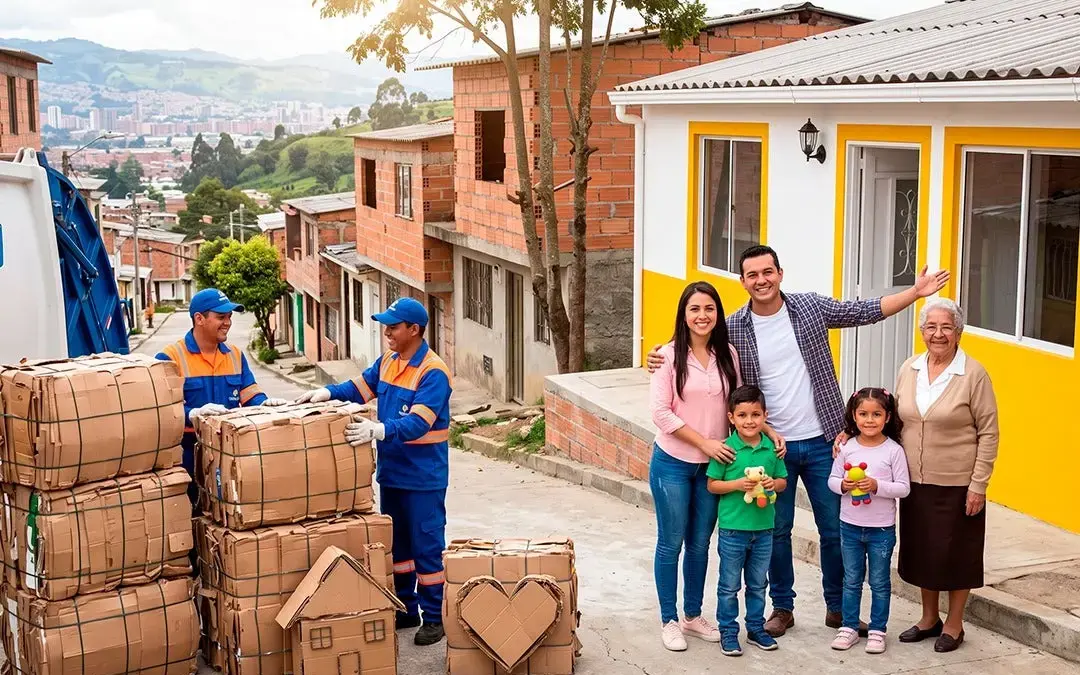
Through its flagship initiative, aptly named "Ruta de Vivienda" (Housing Route), Unicentro Bogotá transforms approximately 16 tons of collected cardboard each month into a tangible lifeline for its administrative personnel. By systematically capturing, sorting, and commercializing this recyclable material, the organization generates a steady stream of capital dedicated entirely to housing subsidies. These financial aids are strategically designed to help operational and administrative collaborators bridge the gap on the down payments for their very first homes, or to execute critical structural and sanitary upgrades required to make their current living spaces habitable.
This initiative redefines the traditional approach to waste management. Instead of treating cardboard purely as a commodity for disposal or standard recycling revenue, the administration views it as a catalyst for human dignity. By channeling the economic value of waste into the most pressing baseline human need—housing—the organization successfully bridges the gap between environmental responsibility and social equity, setting a benchmark for corporate citizenship in Latin America.
Chronology of an Impactful Initiative
The journey from a conventional waste management protocol to a transformative social program did not happen overnight. It represents a systematic evolution in organizational philosophy, operational integration, and community commitment.
Phase 1: The Environmental Baseline (Pre-2023)
For years, major commercial complexes like Unicentro Bogotá generated vast quantities of recyclable materials, driven by high consumer traffic, retail packaging, and administrative operations. Initially, waste management was handled through standard regulatory compliance frameworks: segregating cardboard, paper, plastics, and organic waste, and handing them over to authorized third-party waste managers. While this fulfilled basic environmental mandates and reduced landfill dependency, the economic returns from selling recyclables were typically funneled back into general operational budgets or offset waste-hauling fees, leaving the broader social potential of the materials untapped.
Phase 2: Conceptualizing the Nexus (Early 2023)
Recognizing that sustainability must incorporate a robust social pillar (the "S" in ESG—Environmental, Social, and Governance frameworks), sustainability leaders and administrative directors at Unicentro Bogotá began asking a critical question: Can the economic byproduct of our environmental footprint directly alleviate the socioeconomic vulnerabilities of our workforce?
Internal surveys and demographic profiling of the administrative and operational staff revealed a recurring vulnerability: despite stable employment, many workers struggled with the prohibitive costs of housing in Bogotá’s competitive real estate market, often trapped in cycles of informal renting or substandard living conditions.
Phase 3: The Birth of "Ruta de Vivienda" (Late 2023 – 2024)
The administration formalized the "Ruta de Vivienda" program. This required restructuring the logistical supply chain of waste within the complex:
- Intensified Segregation: Retail partners and internal logistics teams were trained to optimize the collection of high-grade cardboard, preventing contamination and ensuring maximum market value upon sale.
- Strategic Commercialization: The administration forged direct agreements with authorized recycling processors, cutting out predatory middlemen and negotiating top-tier market rates for the 16 monthly tons of cardboard.
- Establishment of Governance: A dedicated committee was established to oversee the transparent allocation of funds, setting clear, merit- and need-based criteria for how collaborators could access the housing subsidies.
Phase 4: Full Deployment and Cultural Integration (2025–Present)
By 2025, the program reached steady-state operations. The predictable monthly revenue generated from the 16 tons of cardboard began consistently funding housing interventions. The program shifted from an experimental administrative project into a core component of the organization’s cultural identity, fostering unprecedented levels of employee loyalty, institutional pride, and operational alignment.
Supporting Data: The Broader Context of Housing and Waste in Colombia
To fully understand the weight of Unicentro Bogotá’s initiative, one must examine the macroeconomic backdrop of Colombia regarding waste management capabilities and national housing deficits.
The Recycling Landscape: Cardboard and Paper Dominance
According to data compiled by the Superintendencia de Servicios Públicos and reported through the Sistema Único de Información (SUI) in 2024, paper and cardboard materials accounted for an impressive 45.1% of all utilized and recovered waste tons nationwide. This high market share underscores why cardboard is uniquely positioned to generate meaningful commercial revenue. Unlike complex polymers or contaminated plastics, clean cardboard enjoys a stable, liquid secondary market, making it an ideal financial engine for social programs.
The National Housing Deficit: Quantitative and Qualitative Realities
While industrial recycling yields strong economic inputs, the social crisis it targets remains vast. Data from the Departamento Administrativo Nacional de Estadística (DANE) through its National Quality of Life Survey highlights the gravity of the housing challenge in Colombia:
- Quantitative Deficit: Households suffering from structural housing deficits shifted from 26.8% in 2024 to 25.6% in 2025. Although this represents a positive 1.2 percentage point reduction, the absolute numbers remain alarming: approximately one in every four households in the country still inhabits a dwelling with severe structural deficiencies, critical space shortages, or unacceptable habitation conditions.
- Qualitative Deficit: DANE’s 2025 metrics revealed that 19.3% of households lived in properties requiring urgent physical upgrades to achieve basic standards of livability. This qualitative deficit highlights that building new homes is only half the battle; repairing, expanding, and modernizing existing stock is critical to ensuring that families—particularly those with children and senior citizens—live in safe, secure, and dignified environments.
+-------------------------------------------------------------------------+
|                  DANE Housing Deficit Metrics (2025)                    |
+-------------------------------------------------------------------------+
|  Total Households Experiencing Structural Deficits:       25.6%         |
|  Households Requiring Qualitative Upgrades/Remodeling:    19.3%         |
+-------------------------------------------------------------------------+
Official Perspectives and Public Health Implications
The imperative to improve housing conditions extends far beyond real estate economics; it is fundamentally a public health priority backed by global health authorities.
The World Health Organization (OMS) Framework
The connection between substandard housing and human well-being is heavily documented by the World Health Organization (OMS). Guidelines established by the organization outline direct correlations between inadequate living environments and physical, mental, and emotional health crises. Key risk factors identified by the OMS include:
- Overcrowding: Directly linked to the rapid transmission of communicable diseases and heightened psychological stress.
- Inadequate Indoor Temperatures: Contributes to chronic respiratory and cardiovascular illnesses, particularly among vulnerable populations such as the elderly and young children.
- Domestic Accidents: Faulty infrastructure, poor lighting, and makeshift stairwells or kitchens elevate the risk of severe domestic injuries.
- Accessibility Barriers: Prevent disabled or aging individuals from moving safely within their own homes, leading to social isolation and loss of autonomy.
Furthermore, the OMS recognizes that chronic housing instability and poor physical living conditions are major contributors to clinical anxiety, depression, and generalized psychological distress. When an organization like Unicentro Bogotá steps in to help an employee secure a down payment or finance essential home repairs, it is simultaneously mitigating these public health risks at the individual and family level.
Corporate Responsibility and Institutional Leadership
Industry experts note that while private enterprises cannot single-handedly solve macro-level housing deficits, localized interventions carry disproportionate value. When a corporation invests in the living conditions of its own workforce, the return on investment transcends traditional metrics.
As administrative spokespersons for Unicentro Bogotá have emphasized, pairing environmental sustainability with direct human support fundamentally alters the corporate culture. It transforms employees from passive executors of tasks into recognized stakeholders whose personal well-being is valued by the enterprise.
Implications: The Future of ESG and Circular Social Models
The success of the "Ruta de Vivienda" initiative offers profound implications for the future of sustainability management, corporate social responsibility (CSR), and human resources across Latin America and beyond.
1. Elevating the "S" in ESG
For years, Environmental, Social, and Governance (ESG) strategies have suffered from compartmentalization. Environmental teams focus on carbon accounting and waste diversion, while Human Resources handles employee wellness, and corporate foundations manage community outreach. Unicentro Bogotá’s model demonstrates the power of convergence. By utilizing an environmental output (cardboard waste) to solve a social crisis (housing vulnerability), the initiative proves that sustainability can be structurally unified.
2. Strengthening Organizational Resilience and Employee Retention
In competitive urban labor markets, employee turnover among operational and administrative support staff is a persistent challenge. Traditional retention strategies rely heavily on marginal salary adjustments or generic benefits. However, addressing foundational life hurdles—such as homeownership or structural home repair—creates deep psychological safety and institutional loyalty. Collaborators who achieve the dream of a dignified home through the joint effort of their employer and their daily work ethic develop an unbreakable bond with the organization.
3. Scalability Across Sectors
The operational architecture of "Ruta de Vivienda" is inherently scalable. Any industry generating consistent streams of high-value recyclables—including retail centers, manufacturing plants, logistics hubs, universities, and large hospitality complexes—can replicate this model. The formula requires three straightforward components:
- Rigorous waste segregation to maximize commodity value.
- Transparent commercialization partnerships to secure fair market returns.
- Strict, needs-based governance to ensure funds are funneled directly to the workers who need them most.
Conclusion
Unicentro Bogotá’s "Ruta de Vivienda" serves as a powerful reminder that corporate sustainability does not need to exist in an abstract realm of global metrics and distant carbon offsets. By looking inward at the daily realities of its workforce and outward at the untapped value of its waste stream, the organization has forged a virtuous cycle. Every ton of cardboard collected is no longer just diverted from a landfill; it is transformed into bricks, mortar, security, and dignity—proving that the most effective environmental strategies are those that ultimately serve humanity.



Leave a Reply