

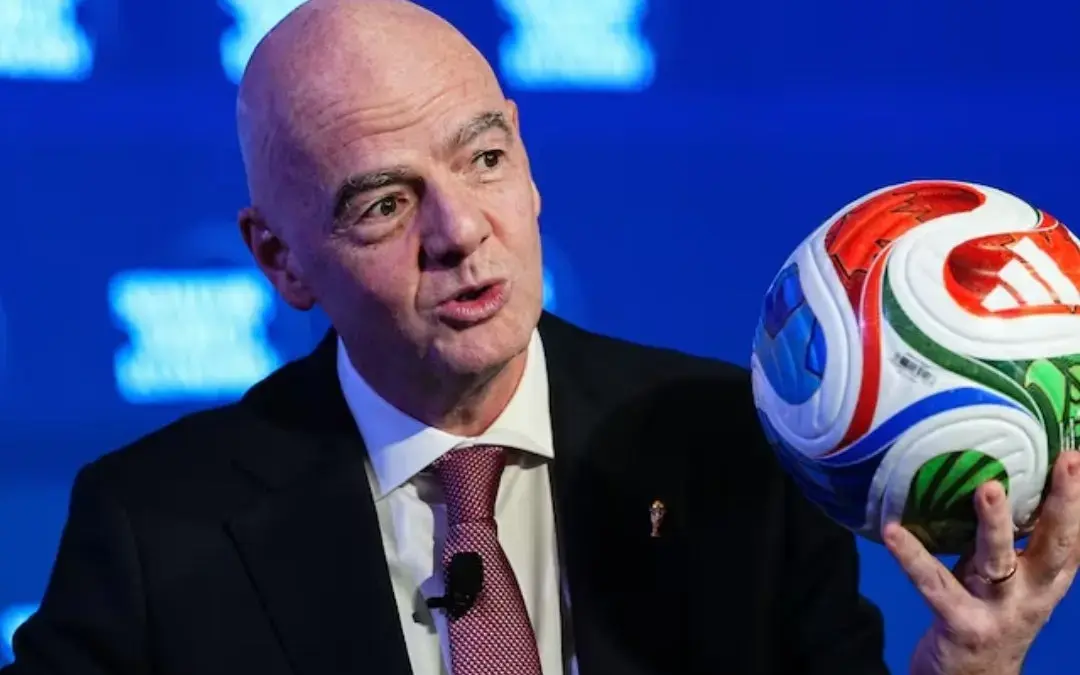
ZURICH, Switzerland — Gianni Infantino is bracing for the most turbulent confrontation of his tenure as president of the Fédération Internationale de Football Association (FIFA). This Thursday, the 56-year-old Swiss-Italian administrator will sit face-to-face with high-ranking football officials demanding his resignation. This high-stakes summit in Zurich marks Infantino’s first official meeting with the sport’s elite leadership since the dramatic collapse of his ambitious, yet highly controversial, commercial restructuring plan known as "FIFA Forward Enterprise" (FFE).
The fallout from the failed FFE initiative has exposed deep, unhealable fractures within the architecture of global football governance. Leaders from three major continental confederations—Aleksander Čeferin of UEFA (Europe), Sheikh Salman bin Ebrahim Al Khalifa of the AFC (Asia), and Victor Montagliani of Concacaf (North and Central America and the Caribbean)—have openly called for Infantino’s departure. Representatives from these powerful bodies are descending upon Zurich determined to either unseat the sitting president or systematically strip away his executive powers.
Despite the intense cross-continental opposition, Infantino remains a formidable political operator. As the clock ticks toward the November 18 deadline for official presidential candidacies ahead of the March 2027 election, the embattled FIFA chief has been aggressively shoring up support across the Global South. While the battle lines are firmly drawn, the outcome of Thursday’s 37-member FIFA Council meeting could permanently alter the balance of power within international sports administration.
Main Facts: The Anatomy of FIFA’s Current Crisis
The extraordinary friction currently paralyzing FIFA’s upper echelons stems from a convergence of financial overreach, governance disputes, and contested geopolitical alignments.
At the center of the storm is the defunct FIFA Forward Enterprise (FFE) project. Unveiled by Infantino in July, the plan sought to sell a minority equity stake in a newly created commercial subsidiary of FIFA to private investors. The capital injection was intended to fund global football development, but the identity of the primary financial backer alarmed traditionalists: a firm founded by Joshua Kushner, brother of Jared Kushner and son-in-law of former U.S. President Donald Trump.
Critics argued that privatizing portions of FIFA’s commercial apparatus—particularly assets tied to marquee tournaments like the World Cup—represented a dangerous commodification of the sport’s public trust. Facing fierce pushback, Infantino was forced to scrap the FFE proposal mere days after its announcement.
However, the damage was already done. The initiative acted as a catalyst for a coordinated challenge from UEFA, the AFC, and Concacaf, whose leaders publicly declared that global football requires a profound leadership reset.
Simultaneously, the agenda for the Zurich summit extends far beyond the post-mortem of the FFE. The 37-member council is set to debate:
- FIFA’s Financial Reserves and Distribution Models: A direct collision over how capital is allocated to the 211 member associations.
- Institutional Governance and Disciplinary Frameworks: Proposals aimed at curtailing presidential overreach and imposing independent oversight.
- The FIFA Peace Prize: A controversial accolade that was famously awarded last year to Donald Trump, drawing widespread domestic and international criticism.
Chronology of Events: From the FFE Announcement to the Zurich Showdown
To understand how FIFA arrived at this precipice, it is necessary to trace the rapid escalation of tensions over recent months:
- July: Gianni Infantino shocks the sports world by announcing the "FIFA Forward Enterprise" (FFE) plan, proposing the sale of minority shares in FIFA’s commercial subsidiaries to private equity, anchored by Joshua Kushner’s investment firm.
- Late July: Following immediate, intense resistance from major European and regional stakeholders, Infantino is forced to abandon the FFE project entirely.
- September / October: Leadership figures from UEFA, the AFC, and Concacaf—Čeferin, Al Khalifa, and Montagliani—issue joint critiques, signaling that the time has come for a change at the helm of world football. In a counter-proposal, UEFA and Concacaf urge FIFA to allocate a direct $10 million to each of its 211 member associations, bypassing complex private equity schemes.
- Early November: Infantino embarks on a diplomatic tour to consolidate his power base. He receives a rapturous standing ovation during a meeting with African football leaders in Cape Verde, while simultaneously securing crucial backing from blocks of Arab nations within the AFC and anticipated support from CONMEBOL (South America).
- Mid-November: Former Swiss international and Tottenham Hotspur defender Ramón Vega announces his intention to run against Infantino in the March 2027 elections, though questions remain regarding whether he can secure the mandatory nominations from five national federations before the November 18 deadline.
- This Thursday: The FIFA Council convenes in Zurich for a high-tension summit where anti-Infantino factions plan to challenge his leadership, interrogate the defunct FFE, and debate structural reforms.
Supporting Data and Financial Stakes
The ideological battle within the FIFA Council is underpinned by massive financial stakes and starkly contrasting visions for global wealth distribution in football.
Under Infantino’s scrapped FFE framework, the pitch to member associations was alluring yet commercially risky: participating federations could potentially access up to $20 million in development funds, supplemented by an additional $20 million through private-equity-backed channels. For smaller associations struggling with infrastructural deficits, the promise of cash liquidity has historically been a powerful tool for securing political loyalty.
Conversely, the counter-strategy advanced by UEFA and Concacaf focuses on stability and transparency through direct capital allocation. Last month, these confederations formally pressed FIFA to distribute a guaranteed $10 million flat sum to each of its 211 member nations directly from existing reserves, removing the need for external private equity intervention.
Furthermore, FIFA’s financial health remains robust, buoyed by the upcoming expanded formats of the men’s and women’s World Cups. However, critics argue that accumulating massive reserves while centralizing financial control in the hands of the presidency undermines the democratic autonomy of regional confederations.
Official Responses and Stakeholder Perspectives
The ideological divide within the sport has prompted sharp commentary from global sports administrators, governance experts, and legal minds.
The Opposition: UEFA, Concacaf, and the AFC
For Aleksander Čeferin, Sheikh Salman, and Victor Montagliani, the FFE debacle laid bare what they perceive as an autocratic management style that bypasses traditional consultative processes. Their constituents argue that Infantino’s unilateral approach to commercializing core assets threatens the integrity and public-interest mandate of global football.
The Incumbent: Infantino’s Counter-Mobilization
Infantino has countered the European and North American pressure by solidifying alliances across Africa, South America, and parts of Asia. His recent reception in Cape Verde—where African football leaders gave him a standing ovation—demonstrates that his extensive development investments across the Global South continue to yield profound political capital. He is expected to enter the upcoming 2027 election cycle with a robust coalition of developing nations firmly in his corner.
Independent Observers and Governance Experts
External watchdogs have expressed cautious skepticism regarding whether Thursday’s meeting will produce meaningful institutional change or merely serve as a superficial exercise in damage control.
Emanuel Medeiros, founder and global CEO of the Sport Integrity Global Alliance (SIGA), emphasized the necessity of absolute transparency during the Zurich sessions.
"The eyes of the world are posted on them," Medeiros stated. "The world of football expects to see a council that takes this unique opportunity to carry out a truly independent, exhaustive, and comprehensive governance review… Without a doubt, we wish to see a new momentum, a new dynamic."
However, darker assessments have been voiced by legal and political figures familiar with FIFA’s internal mechanics. Miguel Maduro, a prominent legal scholar and former chair of FIFA’s Governance Committee who was dismissed by Infantino in 2016, expressed deep skepticism regarding the likelihood of genuine reform.
"They may announce the creation of a working group or even an independent review of FIFA’s governance, but the credibility of any such initiative will be very limited given FIFA’s track record," Maduro warned.
"An initiative of this kind, if not truly independent and enforceable, could be more of the same: a window-dressing measure simply designed to reduce public pressure and claim they have already addressed whatever problems existed."
Implications for the Future of Global Football
As the FIFA Council takes its seats in Zurich, the ramifications of this internal power struggle extend far beyond administrative politics. They touch upon the core identity of football as a global cultural heritage versus its trajectory as an increasingly financialized, private-equity-driven enterprise.
- The March 2027 Elections: While challengers like Ramón Vega attempt to assemble the necessary political backing before the November 18 deadline, Infantino’s firewall of support across Africa, South America, and Asia makes him the prohibitive favorite to secure another term.
- The Decentralization of Power: If anti-Infantino factions fail to force his resignation, their secondary objective—limiting his executive powers—will become the defining narrative of his potential next term. A neutered presidency could lead to a more fragmented FIFA, where regional confederations assert greater autonomy over tournament structures and commercial rights.
- The Shadow of Private Equity: The collapse of the FFE plan serves as a cautionary tale regarding the appetite for private equity in international sports governance. While sports bodies are perpetually cash-hungry, the fierce pushback from traditional power centers indicates a growing resistance to the dilution of institutional sovereignty.
Ultimately, Thursday’s summit will test whether FIFA’s current governance model can withstand internal insurrection or whether it will continue down a path of centralized, conflict-ridden administration under Gianni Infantino. As Emanuel Medeiros noted, the world is watching—and the decisions made behind closed doors in Zurich will reverberate across every pitch on the planet for years to come.

Leave a Reply