

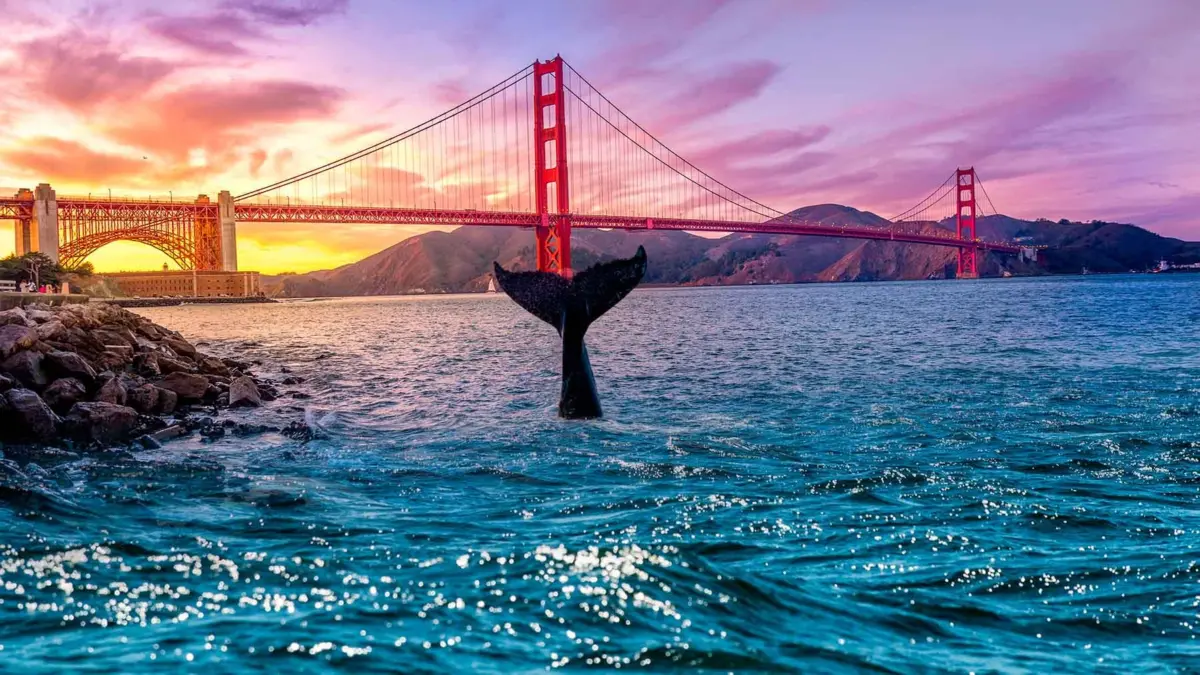
SAN FRANCISCO, CALIFORNIA — For marine biologists and coastal residents alike, spotting a humpback whale (Megaptera novaeangliae) cruising through the chilly, saline waters of the San Francisco Bay during the late summer is a welcome, albeit familiar, sight. As seasonal upwelling draws rich nutrients and abundant krill close to the California coast, these magnificent marine mammals frequently venture into the bay to feed, drawing crowds of onlookers from the Golden Gate Bridge to the piers of Fisherman’s Wharf.
However, what began as a routine seasonal sighting in mid-September quickly evolved into a gripping wildlife mystery. A lone humpback whale, pushing far past the bustling metropolitan bay, continued its relentless northward journey deep inland, navigating a labyrinth of narrow waterways until it reached the Sacramento-San Joaquin Delta.
For an animal whose evolutionary history, physiological adaptations, and foraging behaviors are fine-tuned for the vast expanse of the open ocean, the murky, freshwater-influenced channels of the Delta represent an alien and potentially hazardous landscape. As scientists from The Marine Mammal Center and partner organizations mobilized to monitor the unexpected visitor, the event reignited memories of historical whale detours, sparked debates over human intervention versus natural wildlife autonomy, and ultimately shed light on the complex, interconnected lives of migratory cetaceans along the Pacific coast.
Main Facts
The extraordinary sequence of events unfolded over several days in September, captivating marine scientists and capturing the public imagination.
- The Subject: The whale in question was identified through photographic tail-fluke matching as CRC-11620, an adult humpback affectionately known to researchers as "Rio."
- The Location: After entering the San Francisco Bay, Rio traveled past the Antioch Bridge and deep into the Sacramento-San Joaquin Delta—a massive inland estuary located roughly 80 miles inland from the Pacific Ocean.
- The Precedent: While highly unusual, Rio’s inland expedition was not entirely unprecedented. The Delta has historically acted as a geographical trap for lost cetaceans, most famously in 1985 with a humpback named Humphrey, and again in 2007 with a mother-and-calf pair named Delta and Dawn.
- The Response: Eschewing aggressive rescue orherding operations, marine mammal experts opted for a hands-off approach: monitoring Rio’s movements remotely, issuing mandatory public guidelines to maintain a wide berth, and allowing the animal the autonomy to find its own way back to the sea.
- The Identification: Thanks to an extensive multi-decade photo-identification catalog maintained by West Coast researchers, scientists quickly realized that Rio was no newcomer to California waters, having been documented across a 24-year span ranging from the cold waters of the Pacific Northwest down to the breeding lagoons of Baja California.
Chronology of an Inland Migration
Understanding how an ocean-faring leviathan ends up dozens of miles inland requires a careful look at the timeline of events. Marine authorities and independent observers meticulously tracked Rio’s movements as the narrative unfolded.
Mid-September: The Initial Incursion
Humpback whales are frequent visitors to the central California coastline between spring and autumn. They utilize the San Francisco Bay as a temporary feeding ground, often taking advantage of dense schools of anchovies and sardines.
On September 15, however, monitors tracking coastal marine life noted that a particular humpback had not turned back toward the Pacific after foraging in the bay. Instead, the animal forged eastward, passing under major suspension bridges, negotiating heavy commercial and recreational maritime traffic, and entering the complex web of artificial channels, sloughs, and river systems that make up the Sacramento-San Joaquin Delta.
By the time confirmation reached The Marine Mammal Center, Rio was already navigating the freshwater-dominated expanses near Rio Vista—a small city located deep within the agricultural heartland of Solano County.
Assessment and Non-Intervention
Upon confirming the whale’s location, marine biologists faced a critical management decision: Should they intervene immediately, or should they wait and observe?
Unlike dolphins or smaller pinnipeds, attempting to physically capture, sedate, or transport a 40-ton adult humpback whale out of shallow inland waters is an immensely perilous undertaking. Such operations carry severe risks of stressing the animal to the point of cardiac arrest, inflicting severe physical trauma, or inadvertently driving the whale further into danger.
Biologists assessed Rio’s physical condition through telephoto lenses and drone footage. There were no immediate signs of net entanglement, ship-strike lacerations, severe emaciation, or signs of disorientation indicative of acute neurological trauma or toxic algal poisoning. While the possibility of an underlying illness or navigational error could not be entirely ruled out, Rio appeared to be breathing normally, moving with purpose, and showing no signs of immediate distress.
Consequently, experts made the calculated decision to let nature take its course, establishing a strict perimeter to protect the animal from the hazards of localized boat traffic.
September 18: The Turning Tide
The anxiety gripping the marine science community began to lift on September 18. Aerial and surface observations confirmed that Rio had executed an about-face and was actively swimming in a westward direction, retracing its route back down the Delta toward the brackish mixing zones of Suisun Bay and the broader San Francisco Bay.
For researchers, this directional shift was the most promising indicator possible. It suggested that whatever internal compass or exploratory impulse had driven Rio inland had either subsided or resolved, and that the whale’s natural instinct to seek the open ocean had taken over.
As of late September, however, final confirmation of Rio’s safe exit past the Golden Gate Bridge and back into the open Pacific remained unverified by official tracking sources, leaving scientists cautiously optimistic while keeping a vigilant watch along the coast.
Supporting Data: Historical Precedents in the Delta
To contextualize Rio’s journey, marine biologists turned to historical archives. The Sacramento-San Joaquin Delta is a hydraulic maze of freshwater rivers, agricultural levees, and tidal marshes. It is entirely unsuited for baleen whales, which rely on vast expanses of deep water and massive schools of pelagic prey. Yet, over the last four decades, the Delta has proven to be a recurring site of unexpected cetecian detours.
The Legend of Humphrey (1985)
The most famous precursor to Rio’s journey occurred in October 1985, when a humpback whale dubbed Humphrey entered San Francisco Bay and swam nearly 69 miles inland, stopping near Rio Vista.
Humphrey’s ordeal gripped the international media for 26 days. The whale suffered from skin lesions caused by prolonged exposure to fresh water, which strips away vital protective mucus layers and alters osmotic balance in marine mammals. As public concern mounted, a complex and unprecedented rescue operation was launched. Biologists famously played recordings of killer whale sounds behind a flotilla of boats to drive Humphrey backward, while playing the sounds of happy feeding humpbacks ahead to lure him toward the sea.
The operation succeeded, and Humphrey safely exited into the Pacific, though he made a brief, less dramatic encore appearance in the Bay in 1990.
Delta and Dawn (2007)
Twenty-two years later, lightning struck twice. In May 2007, an adult female humpback named Delta and her dependent calf, Dawn, wandered into the same inland waterways.
Unlike Humphrey, this mother-calf pair faced additional peril: both whales sustained superficial scrapes and propeller-like lacerations from encounters with commercial vessels in the busy shipping channels. Furthermore, the calf was dependent on nursing, raising concerns about milk production in an environment devoid of their normal biological requirements.
Biologists attempted to treat the pair with antibiotics using specialized dart delivery systems while monitoring their behavior. After roughly 20 days of wandering near the Port of Sacramento, Delta and Dawn finally navigated the gauntlet of locks, bridges, and shipping lanes, eventually making their way back to the ocean under their own power.
The Lessons of History
These historical cases provided The Marine Mammal Center with a crucial blueprint for handling Rio. The data demonstrated that:
- Freshwater Tolerance: Humpbacks can survive short-term exposure (weeks) to fresh water, though prolonged stays lead to dermatological degradation.
- Navigational Competence: Whales that enter the Delta are frequently capable of finding their own way out, provided they are not panicked or blocked by human vessels.
- Behavioral Disturbance: Human interference during Humphrey and Delta’s ordeals often exacerbated their stress levels, validating the modern preference for a passive, low-disturbance monitoring strategy.
Official Responses and Conservation Science
The management of Rio’s inland excursion highlights the evolution of marine mammal rescue protocols over the past several decades. Rather than rushing in with heavy machinery and flotillas of noisy vessels, modern marine biology relies heavily on non-invasive monitoring, public education, and individual animal identification.
The Role of The Marine Mammal Center
Headquartered in Sausalito, California, The Marine Mammal Center is the largest marine mammal hospital in the world. During the Rio incident, the organization acted as a central hub for coordination, working alongside state and federal agencies including the National Oceanic and Atmospheric Administration (NOAA) Fisheries.
In official statements, NOAA representatives emphasized the importance of the public adhering to the Marine Mammal Protection Act (MMPA). Observers, kayakers, and recreational boaters were legally and ethically mandated to maintain a distance of at least 100 yards (roughly 90 meters) from the whale at all times.
"When a whale is in a confined space like the Delta, every boat engine, jet ski, and curious onlooker adds a layer of acoustic stress," noted one marine biologist involved in the tracking effort. "Whales navigate and communicate primarily through sound. Crowding them essentially blinds them and induces panic, which can cause them to beach themselves or crash into underwater infrastructure."
The Power of Fluke Catalogs: Unveiling "Rio"
Perhaps the most scientifically rewarding aspect of the entire event was the rapid identification of the whale. Humpback whales possess unique pigmentation patterns, scars, and serrations on the underside of their tail flukes—features as distinct and reliable as human fingerprints.
By cross-referencing photographs taken by field biologists and local photographers against the comprehensive Happy Whale and regional West Coast fluke identification databases, researchers uncovered an astonishing life history for CRC-11620 (Rio):
- First Documentation: Rio was first cataloged off the coast of California in 2002.
- Prolific Traveler: Over the intervening 24 years, Rio had been sighted 15 distinct times across a vast migratory corridor stretching from the rich feeding grounds of California and the Pacific Northwest down to the warm calving and breeding lagoons of Baja California, Mexico.
- Recent History: Rio’s most recent documented sighting prior to the Delta detour occurred in Baja California in February 2026.
This deep archival data transformed Rio from an anonymous "lost animal" into a known individual with a well-documented migratory history, proving that this particular whale had successfully navigated the complexities of the California coastline for nearly a quarter of a century.
Implications: Why Do Whales Enter the Delta?
The recurring phenomenon of humpbacks wandering into the Sacramento-San Joaquin Delta raises a persistent biological question: Why do they make such a catastrophic navigational error?
Marine scientists point to several contributing factors, none of which are mutually exclusive:
1. Shifts in Prey Distribution
In recent years, changing oceanographic conditions—driven by marine heatwaves, shifting El Niño/La Niña cycles, and climate-related fluctuations in coastal upwelling—have profoundly altered the distribution of forage fish. Dense schools of anchovies, sardines, and krill occasionally push deep into bays and estuaries chasing nutrient plumes or avoiding offshore predators. A humpback whale engaged in lunge-feeding may follow a school of prey right through the Golden Gate and simply fail to register that the water is narrowing and freshening until it is too late.
2. Navigational and Magnetoreception Errors
Cetaceans rely on a combination of topography, echolocation, memory, and geomagnetism to navigate vast oceanic distances. However, geological formations, underwater noise pollution from commercial shipping, and localized magnetic anomalies within estuarine systems can temporarily scramble a whale’s internal mapping systems, leading them into dead-end aquatic traps.
3. Juvenile Curiosity and Exploration
Younger or exploratory adults may simply exhibit wanderlust, testing the boundaries of their range. While Rio is a mature adult with decades of experience, individual behavioral quirks and exploratory drives remain powerful motivators throughout a cetacean’s lifespan.
Conclusion: A Test of Patience and Coexistence
The story of Rio the humpback whale serves as a powerful reminder of the complex intersections between wildlife and human-modified ecosystems. While the industrial sprawl, agricultural runoff, and concrete levies of the Sacramento-San Joaquin Delta are worlds away from the open pelagic realm, they remain porous boundaries where wild nature can unexpectedly break through.
As researchers await definitive confirmation that Rio has safely cleared the San Francisco Bay and rejoined the deep blue currents of the Pacific, the event stands as a testament to the maturation of modern conservation science. Eschewing sensationalist rescue spectacles in favor of patient, respectful distance, scientists and citizens alike demonstrated a growing maturity in how we share our coastal environment with its original inhabitants.
For now, Rio remains a symbol of the wild, resilient spirit of the Pacific—a wandering giant that, against the odds, is trusted to find its own way home.


Leave a Reply