

In the hyper-competitive realm of ultra-premium smartphones, raw numbers on a spec sheet are often treated as gospel. Yet, experienced tech consumers and industry analysts know a fundamental truth: having the largest battery or the highest megapixel count does not automatically crown a device as the definitive market leader.
When evaluating modern heavyweights, the equation expands far beyond simple hardware metrics. Software ecosystems, nuanced photographic capabilities, sustained thermal performance, and—crucially—ecosystem viability outside the device’s domestic launch market all play decisive roles.
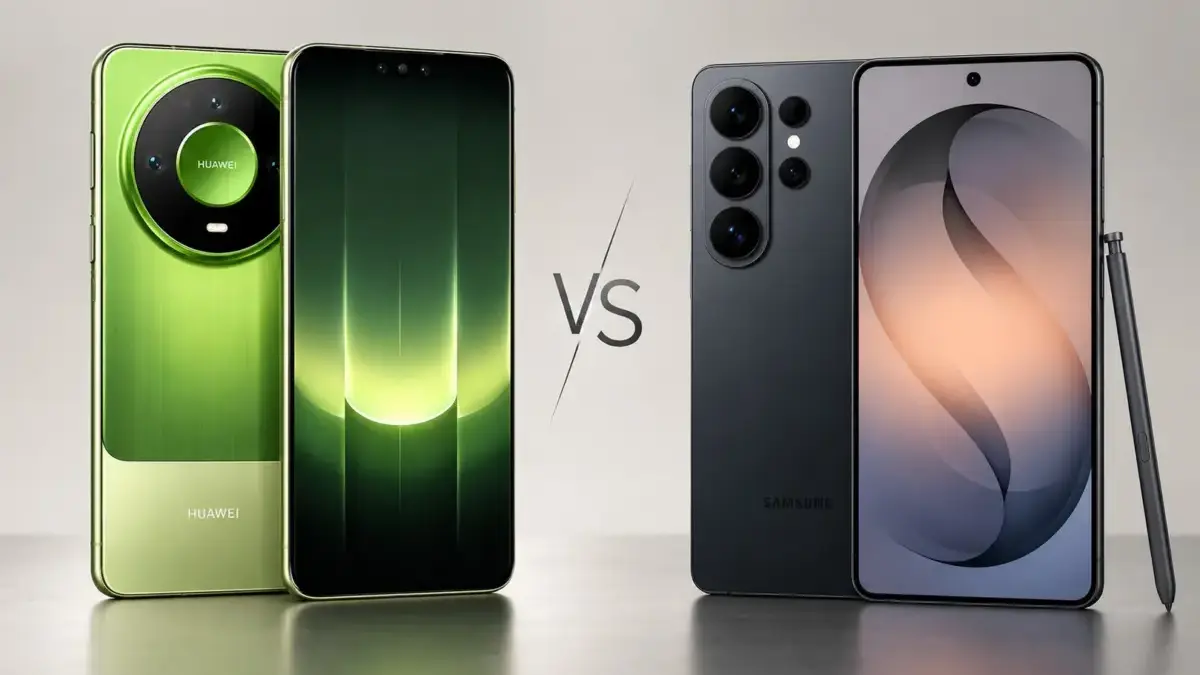
This tension is put to the test when pitting two of the industry’s most ambitious devices against one another: the Huawei Mate 90 Pro Max and the Samsung Galaxy S26 Ultra. While Huawei’s contender outperforms its rival in core energy density and charging speeds, Samsung’s flagship counters with a globally friendly software framework, refined ergonomics, and versatility designed to seamlessly bridge international markets.
1. Main Facts: A Clash of Titans
At first glance, both the Huawei Mate 90 Pro Max and the Samsung Galaxy S26 Ultra present specifications that push the absolute boundaries of modern mobile engineering.
Both devices feature expansive 6.9-inch displays equipped with adaptive refresh rates ranging from 1Hz to 120Hz, ensuring buttery-smooth scrolling alongside optimal battery conservation. However, the underlying panel technologies diverge significantly. Huawei opts for a cutting-edge dual-layer OLED architecture boasting a resolution of 2,848 × 1,320 pixels. Samsung counters with a Dynamic AMOLED 2X QHD+ display running at 3,120 × 1,440 pixels, augmented by its proprietary Privacy Display technology, which physically and digitally restricts lateral viewing angles when activated to safeguard user privacy in public spaces.
When the conversation shifts to power management, the Mate 90 Pro Max establishes an immediate, commanding lead on paper. It packs a massive 6,800 mAh battery, dwarfing the 5,000 mAh cell found inside the S26 Ultra. That is an enormous 1,800 mAh difference. However, real-world longevity is rarely linear; a 36% larger battery does not inherently translate to 36% more screen-on time. Processor efficiency, background task optimization, display brightness levels, and specific user workloads all dictate final endurance.
When it comes time to replenish that energy, Huawei once again outpaces its competitor. The Mate 90 Pro Max supports up to 100W wired charging and 50W wireless charging. The Galaxy S26 Ultra maxes out at 60W wired and 25W wireless, though Samsung notes its device can recover roughly 75% of its charge in 30 minutes using a compatible high-wattage adapter.
| Feature | Huawei Mate 90 Pro Max | Galaxy S26 Ultra |
|---|---|---|
| Display | 6.9″, Dual-layer OLED | 6.9″, Dynamic AMOLED 2X |
| Resolution | 2,848 × 1,320 | 3,120 × 1,440 |
| Refresh Rate | 1-120 Hz | Up to 120 Hz |
| Processor | Kirin 9050 / 9050 Pro* | Snapdragon 8 Elite Gen 5 for Galaxy |
| Battery Capacity | 6,800 mAh | 5,000 mAh |
| Wired Charging | 100W | 60W |
| Wireless Charging | 50W | 25W |
| Main Camera | 50 MP, Variable Aperture | 200 MP, f/1.4 |
| Ultra Wide Camera | 40 MP | 50 MP |
| Telephoto Setup | 200 MP (~4x optical) | 50 MP (5x) + 10 MP (3x) |
| Operating System | HarmonyOS 7 | Android 16 / One UI 8.5 |
| Weight | 234 g | 214 g |
| Thickness | 8.15 mm | 7.9 mm |
*Note: Processor variant depends on the specific regional or memory configuration.
2. Chronology: The Evolution of the 2026 Flagship Standard
To understand how we arrived at this pivotal matchup, it is essential to trace the historical trajectory that shaped both manufacturers’ engineering philosophies over the past several product cycles.
- Late 2024 to Early 2025: As silicon manufacturing transitioned to advanced 3-nanometer and secondary-node architectures, both Huawei and Samsung faced mounting pressure to solve the eternal mobile paradox: packing more performance and larger batteries into thinner chassis without triggering thermal throttling. Samsung heavily leaned into its partnership with Qualcomm, optimizing the Snapdragon platform for AI-heavy workloads, while Huawei continued its independent domestic push to refine its proprietary Kirin ecosystem and HarmonyOS software architecture.
- Mid 2025: Supply chain innovations introduced dual-layer OLED panels and silicon-carbon battery anodes. These breakthroughs allowed manufacturers to dramatically increase energy density. Huawei seized upon this technology early, setting the groundwork for the ultra-high-capacity cells seen in the Mate series, while Samsung focused on display fidelity, energy efficiency, and hardware-level privacy features.
- Early 2026 (The Launch Window): The Huawei Mate series debuted first in the Chinese domestic market, showcasing staggering hardware specifications, including the massive 6,800 mAh battery and a 200MP telephoto module. Shortly thereafter, Samsung unveiled the Galaxy S26 Ultra to a global audience, emphasizing its mature software ecosystem (Android 16 with One UI 8.5), broad international availability, and versatile multi-focal camera array.
3. Supporting Data: Optics, Ergonomics, and Processing Power
Looking closer at the photographic hardware reveals two entirely distinct philosophies on mobile imaging.
The Optical Battleground
Megapixels alone do not declare a winner. The Huawei Mate 90 Pro Max relies on a 50 MP RYYB primary sensor featuring optical image stabilization (OIS) and a physical variable aperture ranging from f/1.4 to f/4.0. This mechanical iris physically alters the optical entrance pupil, allowing the camera to naturally adjust depth of field and light intake depending on the environment. Accompanying it is a 40 MP ultra-wide lens and a high-resolution 200 MP RYYB telephoto lens offering roughly 4x optical magnification alongside dedicated macro capabilities.
Samsung, conversely, spreads its zooming capabilities across two dedicated telephoto lenses. One sensor uses a 10 MP resolution with a 3x optical zoom, while the second steps up to a 50 MP sensor with a 5x optical zoom. The primary wide module utilizes a massive 200 MP sensor at f/1.4, paired with a 50 MP ultra-wide. Furthermore, Samsung utilizes software processing and Adaptive Pixel technology to deliver high-quality 10x zoom steps.
Ultimately, Samsung provides a wider array of native, dedicated focal lengths out of the box, whereas Huawei concentrates immense resolution into its telephoto setup while integrating robust macro photography. Deciding which produces superior images requires strict side-by-side field testing, as color science, noise suppression algorithms, and lens coating quality heavily influence the final output.
(Worth noting: The specialized Collector Edition of the Huawei Mate series introduces compatibility with the Ruiying Z10 external accessory module—a professional-grade add-on featuring a one-inch sensor and a continuous zoom lens. However, because this requires separate hardware, it sits outside the standard evaluation of the core Pro Max device).
Ergonomics and Processing
In the hand, Samsung’s focus on sleek industrial design pays dividends. The Galaxy S26 Ultra weighs 214 grams and measures 7.9 mm in thickness. The Mate 90 Pro Max tips the scales at 234 grams with an 8.15 mm profile. Over extended periods of media consumption or single-handed messaging, that 20-gram variance and fraction-of-a-millimeter difference in thickness become surprisingly noticeable.
Under the hood, raw processing benchmarks remain a toss-up until standardized testing environments are applied. The Mate’s Kirin 9050 / 9050 Pro chips battle against Samsung’s customized Snapdragon 8 Elite Gen 5 for Galaxy. Because both manufacturers utilize disparate architectural frameworks and software compiling methods, synthetic benchmark scores must be corroborated with sustained thermal and graphical stress tests.
4. Official Responses and Industry Perspectives
Representatives from both corporate camps have emphasized different pillars of value to justify their respective engineering choices.
Samsung’s design and product marketing teams have repeatedly highlighted the integration of the Galaxy ecosystem—stressing that hardware supremacy is meaningless if the user experience is fractured. Features like DeX (which transforms the phone into a desktop workstation) and SmartThings integration anchor the S26 Ultra as a productivity hub rather than just a pocket camera. Furthermore, Samsung representatives underscore the importance of global software support, multi-year security patches, and localized carrier compatibility in over 150 countries.
Huawei, on the other hand, positions its hardware innovations as a direct response to consumer demands for absolute independence from the wall charger. By pushing battery capacities past the 6,500 mAh threshold while maintaining rapid 100W replenishment speeds, Huawei aims to alleviate battery anxiety entirely. Industry analysts note that Huawei’s aggressive hardware iteration serves to dominate its domestic market while maintaining technical parity—or superiority—on paper against global rivals, even when facing external trade and ecosystem hurdles.
5. Implications: Navigating the Global Market
For the prospective buyer, the choice between these two flagships boils down to a profound philosophical question: Do you buy for pure hardware specifications, or do you buy for ecosystem utility?
The Import Dilemma
This is where the most critical real-world complication arises. Operating on HarmonyOS 7, the Huawei Mate 90 Pro Max is optimized primarily for the ecosystem landscape in China, where it originally debuted. For consumers looking to import or purchase the device outside of its native launch region, significant hurdles emerge. Potential buyers must rigorously verify the operational compatibility of essential third-party applications, localized push notification services, banking integrations, and regional 4G/5G network band support.
Conversely, the Galaxy S26 Ultra—running Android 16 and One UI 8.5—presents virtually zero software friction for international buyers. Google Mobile Services are natively integrated, regional carrier aggregation works seamlessly out of the box, and warranty support is standardized across major global regions.
Pricing Realities
Pricing structures further complicate direct comparisons. The Huawei Mate 90 Pro Max launches with a base price of 9,499 yuan in China for the configuration featuring 12 GB of RAM and 512 GB of internal storage. The Galaxy S26 Ultra varies dramatically depending on local market taxes, import tariffs, carrier subsidies, and regional currency fluctuations. Attempting a direct currency conversion is frequently misleading, as local distribution policies, regional warranty structures, and trade-in incentives completely alter the final cost of ownership.
Verdict
The Huawei Mate 90 Pro Max and the Samsung Galaxy S26 Ultra represent the absolute pinnacle of what is possible in contemporary smartphone design, yet they target entirely different priorities.
- Choose the Huawei Mate 90 Pro Max if: Your primary metric for success is battery autonomy, rapid charging speeds, and cutting-edge mechanical hardware innovations (such as variable apertures and massive telephoto resolutions), and you are technically equipped to navigate software ecosystem nuances outside of China.
- Choose the Samsung Galaxy S26 Ultra if: You require a frictionless global user experience, native Android integration, polished multi-focal photography, superior ergonomics, and robust international productivity features via One UI and DeX.
Ultimately, the spec sheet tells only half the story. The true best smartphone is not the one with the biggest number on paper—it is the one that seamlessly integrates into your daily life, wherever in the world you happen to be.


Leave a Reply