

BOGOTÁ — Amid an intensifying standoff between the national government and agricultural leaders regarding sector competitiveness and crop profitability, more than 16,000 rice producers across Colombia remain on edge. They are urgently demanding structural interventions to resolve a multi-faceted crisis that has now entered its fourth critical year.
The emergency is not confined to a cumulative 30% collapse in the purchasing price of green paddy rice (paddy verde) since 2023, nor is it solely driven by the looming threats of the El Niño weather phenomenon. Rather, the domestic market is buckling under the immense weight of massive foreign competition and an alarming surge in contraband, which threatens to dismantle local production and undermine the country’s agricultural sovereignty.
Main Facts
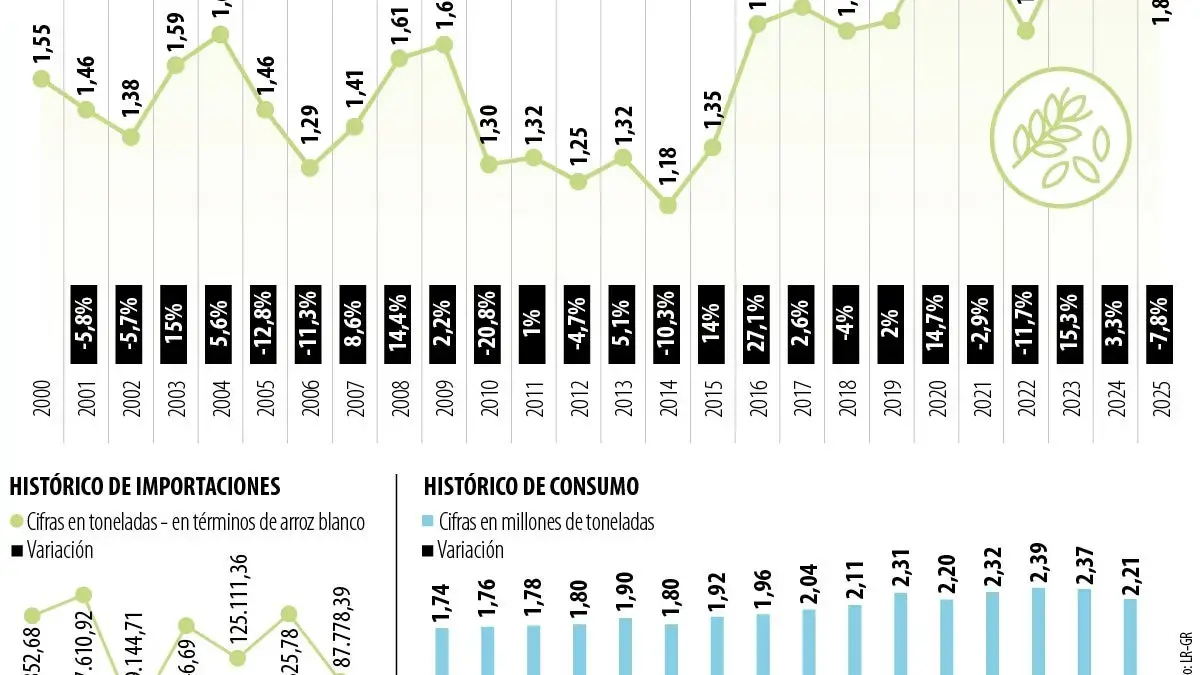
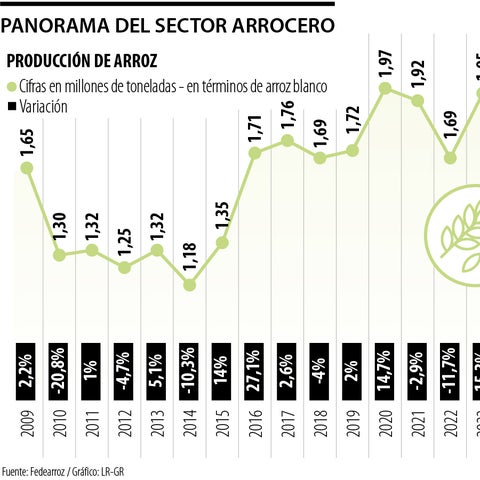
The scale of the crisis facing Colombia’s rice industry is laid bare by official supply, demand, and trade data. According to figures compiled by the National Federation of Rice Growers (Fedearroz), national consumption reached 2.21 million tonnes of white rice. To satisfy this domestic demand, national production stood at 1.86 million tonnes, while legal imports accounted for roughly 87,778 tonnes.
However, the defining and most destabilizing metric of the current market is the sheer volume of illicit trade. In 2025 alone, contraband flooded the Colombian market with an estimated 262,221 tonnes of foreign cereal. This illicit influx accounted for a staggering 11.83% of total national consumption and quietly tripled the volume of legally authorized foreign purchases.
This unregulated surge has fundamentally distorted domestic price formation. Rafael Hernández, General Manager of Fedearroz, warned that the primary vector of this illegal trade originates across the southern border. "At this moment, the threat of contraband is coming principally from Ecuador," Hernández stated, adding that the guild has formally petitioned authorities to restrict and authorize imports from the neighboring country exclusively via maritime routes, given that porous terrestrial borders remain nearly impossible to effectively police.
Concurrently, Colombia has absorbed more than 100,000 tonnes of rice from the United States under the framework of the bilateral Free Trade Agreement (FTA), compounding the supply pressure on local farmers who are already struggling to cover their operational expenditures.
Chronology of the Crisis
To understand how Colombia’s rice sector arrived at this critical juncture, it is necessary to examine the timeline of compounding pressures that have eroded the profitability and sustainability of the grain:
- 2021–2022 (The Post-Pandemic Cost Shock): Global supply chain disruptions trigger exponential hikes in the price of imported fertilizers, agrochemicals, and diesel. Colombian rice farmers absorb unprecedented production costs while initial market prices remain relatively stable, silently narrowing profit margins.
- 2023 (The Price Collapse): Domestic purchasing prices for green paddy rice begin a steep downward spiral. Over the subsequent two years, producers suffer an accumulated price drop of 30%, drastically altering the economic viability of bi-annual harvests.
- Late 2023 – 2024 (Climatic Pressures and El Niño): Meteorological alerts signal the arrival of the El Niño phenomenon, threatening severe droughts across primary agricultural hubs like the Caribe and the Alto Magdalena, raising irrigation costs and reducing crop yields.
- 2025 (The Contraband Peak): Illicit trade accelerates dramatically. Fedearroz data reveals that contraband captures nearly 12% of the national market (over 262,000 tonnes), completely overwhelming local supply adjustments and driving thousands of small- and medium-scale producers to the brink of insolvency.
- Late 2025 – Present (Institutional Deadlock): A public war of words erupts between agricultural trade associations (Fedearroz and the SAC) and the Ministry of Agriculture. While farmers demand immediate state rescue packages and stricter border controls, the government pushes back against what it terms structural inefficiencies, setting the stage for a high-stakes policy showdown.
Supporting Data and Market Economics
The structural imbalance of the market is rooted in a combination of macroeconomic factors and regional trade dynamics. Jorge Bedoya, President of the Society of Agricultores of Colombia (SAC), pointed out that Ecuador’s monetary policy has become an acute external vulnerability for Colombian growers.
Because Ecuador’s economy is fully dolarized, the continuous appreciation of the Colombian peso against the US dollar has created a perverse economic incentive. It has suddenly become vastly cheaper for traders to acquire and smuggle rice from Ecuador than to purchase it from domestic farmers in Tolima, Huila, or the Llanos Orientales.
"This is a bi-annual crop that is currently in a deeply critical situation," Bedoya emphasized. "With the El Niño phenomenon, the outlook could become much worse, and we simply cannot afford to lose the capacity for Colombia to produce its own rice."
Beyond cheap imports and illegal inflows, domestic producers have suffered severe contractions in net yield due to skyrocketing input costs. While historical production models relied on predictable seasonal rains and affordable chemical inputs, today’s farmers must contend with intensive irrigation expenses and expensive soil-restoration techniques.
Consequently, the economic baseline of farming has transformed. Official estimates indicate that thousands of producers are operating at a net loss, with many viewing each successive harvest not as a commercial enterprise, but as a mechanism of mounting debt.
Official Responses and Institutional Clashes
The policy debate surrounding the rescue of the rice sector has exposed a profound philosophical divide between agricultural syndicates and the executive branch regarding state intervention, market efficiency, and agricultural modernization.
During a recent high-level policy forum, Minister of Agriculture Indalecio Dangond addressed the profitability crisis head-on. According to the Minister, current rice cultivation yields a marginal profitability of barely 12%, while sustaining excessively high production costs. However, Dangond drew a hard line regarding the limits of government bailouts.
"The State cannot continue to subsidize the inefficiency of an industry," Dangond asserted firmly. "We have to foster models of regenerative, responsible, and competitive agriculture." The Ministry’s official stance emphasizes that public funds should not be deployed to artificially prop up outdated farming techniques or insulate uncompetitive supply chains from global market realities. Instead, the administration argues that long-term survival depends entirely on technological adaptation, improved logistics, and yield optimization.
This perspective has met with swift and sharp pushback from trade leaders. Rafael Hernández fiercely rejected the notion that Colombian farmers are fundamentally inefficient. He countered that national rice yields—spanning both rainfed (secano) and irrigated (riego) systems—are entirely competitive on a technical level with international counterparts.
Furthermore, Hernández warned that dismissing the crisis as mere inefficiency ignores the existential threat posed by unmitigated foreign dumping and contraband. To prevent structural failure, Fedearroz has repeatedly invited the national government to reinstate traditional stabilization mechanisms, such as storage incentives (incentivo al almacenamiento).
"We must protect national production and prevent the country from becoming entirely dependent on foreign imports," Hernández noted. Without proactive intervention, he cautioned, Colombia risks severe market shocks, localized food shortages, and long-term discouragement among generational farming families.
Implications for Colombia’s Food Security and Future
The ongoing clash over the future of the rice sector carries profound implications that extend far beyond balance sheets and macroeconomic indicators. Rice is not merely a commercial commodity in Colombia; it is a foundational pillar of food security, serving as a dietary staple for millions of households across every socioeconomic stratum.
If structural reforms are not enacted to reconcile the friction between state modernization policies and the immediate operational needs of producers, the consequences could be severe:
- Erosion of Rural Employment: Rice farming is a labor-intensive industry that anchors the rural economies of several key departments. Widespread bankruptcies would trigger cascading employment crises, accelerating rural-to-urban migration and exacerbating poverty in secondary cities.
- Loss of Food Sovereignty: Becoming overly reliant on international markets—particularly when those markets are influenced by volatile exchange rates, regional trade disputes, and climate disruptions—leaves Colombia highly vulnerable to external food shocks.
- Environmental and Technological Stagnation: Without transitional financial support, farmers lack the capital investment required to adopt the very regenerative and sustainable agricultural practices advocated by the Ministry of Agriculture. Paradoxically, withholding short-term aid may permanently disable the sector’s long-term modernization.
As the year draws to a close, Colombia’s rice sector stands at a decisive crossroads. Navigating this multi-dimensional crisis will require a delicate balancing act: harmonizing the government’s push for rigorous, sustainable competitiveness with the urgent, pragmatic need to shield local growers from predatory contraband and systemic market distortions. Only through genuine cooperation between public institutions and agricultural guilds can Colombia ensure that its fields continue to feed its people for generations to come.



Leave a Reply