

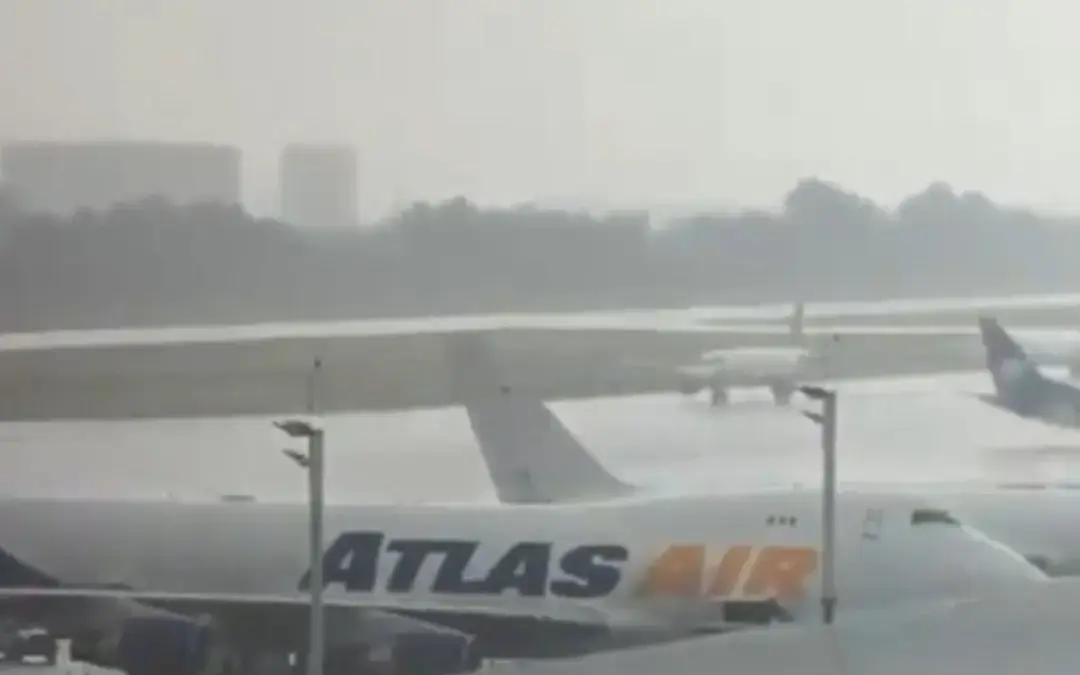
BOGOTA, COLOMBIA — Operations at the continent’s bustling aviation nexus, the El Dorado International Airport, have steadily resumed following an afternoon of profound turbulence both on the tarmac and across the skies of Colombia’s capital. A high-intensity meteorological event, characterized by torrential rainfall, heavy localized hail, severe drops in visibility, and a subsequent failure in critical communication systems, forced the absolute suspension of all incoming and outgoing flights.
The disruption, managed dynamically by the Colombian civil aviation authority, Aeronáutica Civil (Aerocivil), paralyzed air traffic for hours, generating a ripple effect of delays and itinerary modifications that are expected to echo through national and international flight schedules for days.
While passengers crowded terminals and anxiously refreshed flight status boards, city officials scrambled to contain urban emergencies across Bogota’s central-western sectors. The storm, which underscored the city’s ongoing vulnerability to extreme weather phenomena, left a trail of flooded streets, downed trees, and structural collapses. As authorities work around the clock to restore total normalcy, the event has reignited discussions regarding urban resilience, climate adaptability, and passenger rights in the face of unpredictable Andean weather.
1. Main Facts
The core of the crisis centered on El Dorado International Airport, the primary gateway for international and domestic travel in Colombia.
- The Interruption: Aerocivil was forced to order an immediate suspension of all air operations due to a severe localized storm that swept over Bogota. The storm dramatically reduced horizontal visibility for pilots and air traffic controllers alike.
- The Technical Complication: Compounding the meteorological hazards, the severe weather precipitated a failure in communication systems, rendering standard operational procedures unsafe and leaving ground control with severely restricted capabilities.
- The Reopening: Following a brief but intense window of suspension, meteorological radar indicated an improvement in weather conditions. Concurrently, technical teams secured the communication systems, prompting Aerocivil to authorize the progressive resumption of flights.
- The Aftermath: Despite the green light to resume operations, the cascading delays resulted in profound schedule adjustments. Aerocivil strongly advised all travelers scheduled to fly out of El Dorado to verify their flight statuses directly with their respective airlines before heading to the terminal.
- Urban Impact: According to the Instituto Distrital de Gestión de Riesgos y Cambio Climático (Idiger), the storm was not confined to the airport perimeter. It lashed several western and central neighborhoods—most notably Engativá, Suba, and Fontibón—with heavy downpours and intense hail.
- Emergency Responses: Idiger registered multiple emergencies, including structural failures in lightweight infrastructure, localized flooding caused by the backflow of mixed sewage and rainwater, and nearly half a dozen instances of fallen trees blocking roadways.
2. Chronology of the Event
To understand how a routine afternoon in October rapidly deteriorated into a dual aviation and municipal crisis, it is necessary to examine the timeline of events as they unfolded across Bogota.
Early Afternoon: The Gathering Storm
Throughout the early hours of the afternoon, atmospheric pressure and humidity levels across the Bogota savanna suggested an unstable weather pattern. Meteorological monitoring stations noted a rapid accumulation of convective clouds forming over the eastern hills and drifting westward across the urban grid. By mid-afternoon, darkening skies enveloped the central and western districts, signaling the arrival of an intense storm cell.
The Peak of the Tempest: 2:30 PM – 4:00 PM
Between 2:30 PM and 4:00 PM, the storm reached its zenith. Neighborhoods including Suba, Engativá, and Fontibón—situated along the flight paths and immediate surroundings of El Dorado International Airport—were battered by torrential rain and a localized hailstorm.
At the airport, pilots reported a sudden, sharp decline in visibility. Horizontal visibility plummeted below safety thresholds required for visual and standard instrument approaches. Simultaneously, the electrical and atmospheric disturbances impacted communication arrays, severely impairing the ability of air traffic controllers to maintain continuous, clear contact with taxiing and airborne aircraft.
The Decision to Suspend Operations
Recognizing the untenable safety risks, Aerocivil’s air navigation services, in coordination with airport management, executed emergency protocols. Operations were officially halted. Incoming flights were placed in holding patterns, diverted to alternative airports such as José María Córdova in Rionegro (Medellín) or Alfonso Bonilla Aragón in Cali, or delayed at their points of origin. On the ground at El Dorado, aircraft were frozen at their gates or taxiways, and passengers inside the terminals faced immediate uncertainty.
The Recovery Window: 4:30 PM – 6:00 PM
By late afternoon, the storm cell began to exhaust its energy, shifting westward out of the immediate metropolitan zone. Meteorological teams at El Dorado confirmed an incremental clearing of the skies and a return to acceptable visibility parameters. Concurrently, technical personnel isolated and resolved the communication failures.
Following a safety assessment, Aerocivil gave the authorization to lift the suspension, allowing operations to restart in a regulated, phased manner to prevent runway congestion and ensure absolute safety.
Evening Management and Recovery
As night fell, the focus shifted from crisis management to backlog clearance. Airlines worked urgently to reaccommodate stranded passengers, while municipal crews cleared debris from flooded avenues. The operational recovery is projected to extend well into the following day as aircraft and flight crews find themselves out of position due to the hours-long standstill.
3. Supporting Data and Meteorological Context
The severity of the afternoon storm has prompted closer scrutiny from municipal agencies and weather experts regarding the climatic drivers behind such sudden events.
Rainfall Distribution and Urban Vulnerability
Data compiled by Idiger highlighted that the precipitation was highly localized yet intensely concentrated. The districts of Engativá, Suba, and Fontibón bore the brunt of the meteorological impact. These areas, characterized by dense urban development, large expanses of impermeable pavement, and historic drainage challenges, experienced immediate surface water accumulation.
Idiger’s emergency operations center logged approximately five major tree collapses due to wind shear and saturated soil conditions. Furthermore, the sheer volume of water overwhelmed sections of the city’s drainage infrastructure, resulting in backflows where rainwater and sewage mixed to flood low-lying intersections and residential basements.
The Paradox of El Niño and Heavy Rains
One of the most pressing questions raised by the public and media following the storm was how such violent precipitation could occur during a macro-climatic cycle traditionally associated with drought.
Addressing this paradox, Guillermo Escobar, Director of Idiger, provided crucial context during an official press briefing.
"We experienced severe hailstorms in the central-western zone," Escobar stated. "It is entirely normal for this to happen, even when we are navigating an El Niño phenomenon. We can expect these kinds of micro-climatic conditions and intense storm cells to persist throughout October and November, and as a city, we must remain permanently prepared."
Escobar’s remarks underscore the reality of modern climate variability in the Andean region. While macro phenomena like El Niño dictate broad trends, localized geographic factors—such as the high-altitude savanna of Bogota, surrounding mountain ranges, and urban heat island effects—frequently generate aggressive, short-duration convective storms that defy broad seasonal generalizations.
4. Official Responses and Institutional Actions
The response to the dual crisis at El Dorado and across the urban landscape involved tight coordination between aviation authorities, municipal disaster relief agencies, and airline representatives.
Aerocivil’s Directives and Passenger Advocacy
Throughout the suspension and subsequent reopening, Aerocivil maintained a continuous flow of public communication via digital channels and media briefings. The agency emphasized that while safety protocols caused unavoidable inconvenience, protecting human life remains the non-negotiable priority of civil aviation governance.
To mitigate passenger friction, Aerocivil issued explicit recommendations:
- Pre-Travel Verification: Travelers were urged not to travel to El Dorado International Airport without first checking their flight status online or contacting their airline’s customer service hotline.
- Flexibility and Patience: The authority requested that passengers maintain open communication with airlines regarding schedule adjustments, warning that downstream delays would inevitably ripple across national networks.
- Regulatory Oversight: Aerocivil inspectors were deployed to the terminals to monitor airline compliance with passenger rights regulations, ensuring that stranded travelers received adequate information, hydration, and, where applicable, food vouchers or lodging accommodations.
Idiger and Municipal Mobilization
On the municipal front, Idiger mobilized field units to address the urban emergencies reported across Suba, Engativá, and Fontibón. Fire departments, traffic police, and drainage maintenance crews were dispatched to clear fallen trees, pump out flooded underpasses, and unblock storm drains choked by wind-blown debris.
Director Guillermo Escobar utilized the emergency as a public awareness platform, issuing direct recommendations to citizens:
- Emergency Reporting: Residents were reminded to use the unified emergency hotline, 123, to report structural damage, flooding, or fallen trees immediately.
- Preventative Maintenance: Citizens were urged to inspect and clear domestic drainage systems, gutters, and roof downspouts to prevent localized pooling and residential flooding during subsequent downpours.
- Infrastructure Vigilance: Property owners with lightweight roofing structures (such as zinc sheets or temporary awnings) were advised to secure them against anticipated high-wind events common during the current rainy season.
5. Implications and Future Outlook
The temporary paralysis of El Dorado International Airport and the simultaneous urban flooding in Bogota carry significant implications for infrastructure planning, airline logistics, and urban resilience.
Economic and Operational Toll on Aviation
El Dorado is not merely a local hub; it is one of the premier cargo and passenger connectors in Latin America. A multi-hour shutdown at such a facility triggers a domino effect that impacts connecting hubs in Miami, Panama City, Lima, Santiago, and Madrid, alongside domestic routes to Medellin, Cali, Cartagena, and beyond.
Airlines face mounting operational costs resulting from:
- Fuel burn during extended holding patterns prior to diversions.
- Passenger care obligations, including meals, hotel stays, and rebooking expenses mandated by civil aviation regulations.
- Crew scheduling disruptions, where pilots and flight attendants time out due to extended duty hours caused by delays, forcing carriers to substitute personnel or cancel subsequent legs.
In the wake of this event, industry analysts anticipate that carriers will re-evaluate their schedule buffers during peak afternoon convective weather seasons, though commercial pressures often push airlines to maintain tight turnaround times.
Urban Infrastructure and Climate Adaptation
For Bogota, the storm serves as a stark reminder of the urgent need for climate-adaptive urban planning. As extreme weather events become more frequent and unpredictable due to global climate shifts, the city’s stormwater management systems face unprecedented stress.
The flooding in Fontibón and Engativá highlights the limits of traditional drainage infrastructure when subjected to high-intensity cloudbursts accompanied by heavy hail. Moving forward, municipal planners face the complex task of expanding sustainable urban drainage systems (SUDS), increasing permeable surfaces, and upgrading sewage trunk lines to handle sudden volumetric surges without failing.
A Call for Collective Preparedness
Ultimately, the afternoon storm over Bogota crystallized the interconnected nature of modern urban life. A weather anomaly in the upper atmosphere disrupted air travel, flooded neighborhood streets, tested municipal response networks, and impacted thousands of individual lives.
As Guillermo Escobar noted, October and November will continue to present meteorological challenges. For the aviation sector, municipal authorities, and everyday citizens alike, the lesson of El Dorado is clear: resilience requires constant vigilance, robust infrastructure, and proactive communication in the face of an increasingly volatile climate.



Leave a Reply