

Main Facts
The persistent underperformance of Colombia’s educational system on the global stage has once again ignited intense public debate following the release of the latest Programme for International Student Assessment (PISA) results. While the national discourse has thoroughly dissected the disappointing metrics, critical underlying dimensions of the crisis remain largely unaddressed.
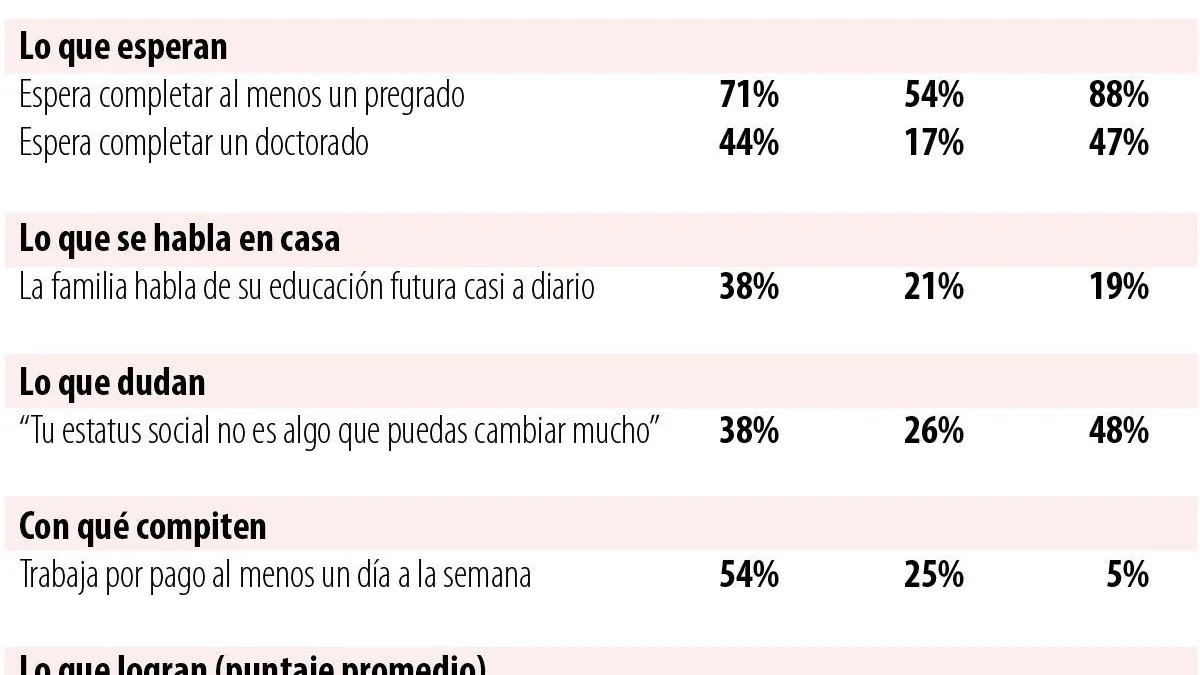
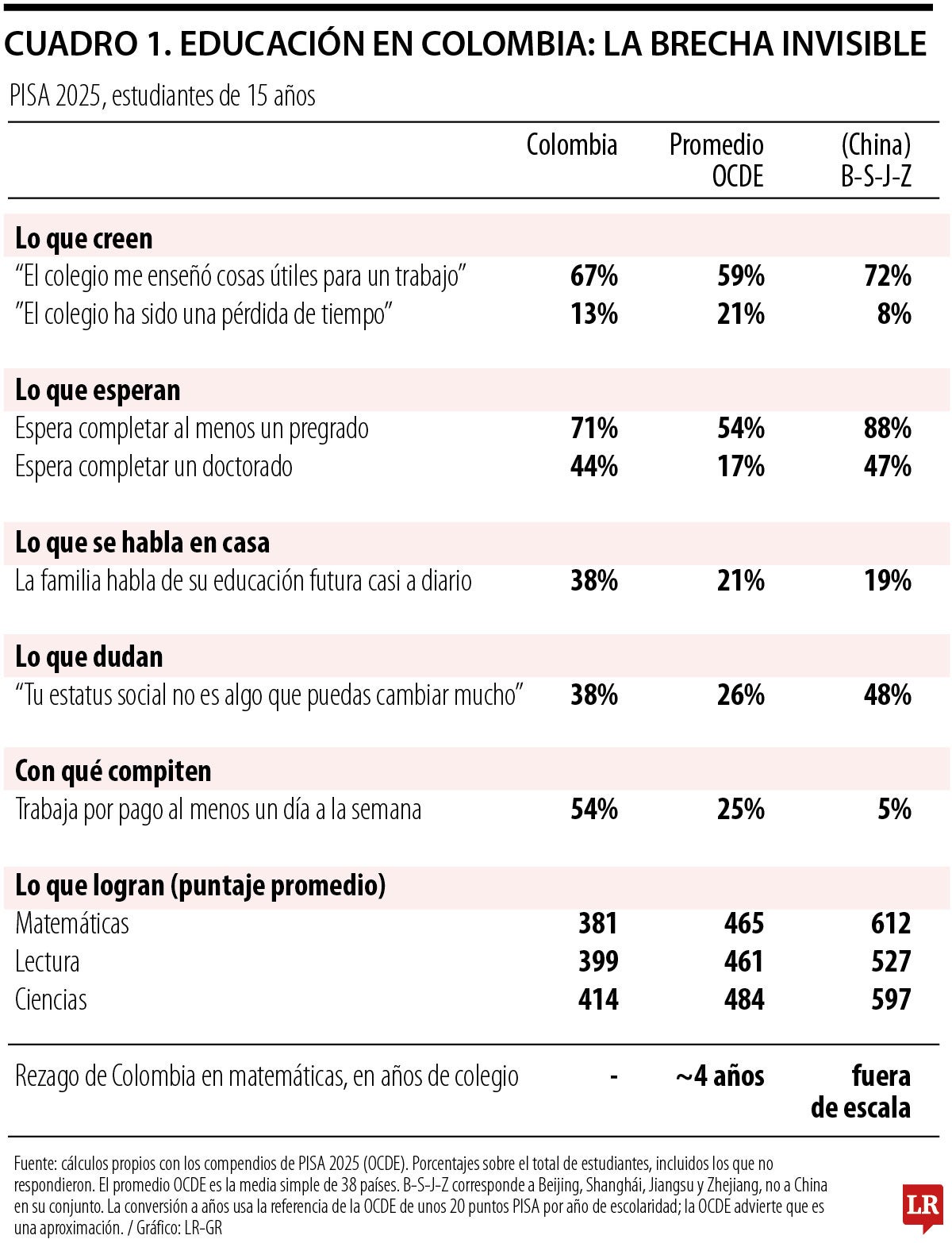
Chief among these overlooked realities is the profound and sobering disconnect between the optimism, dedication, and high aspirations of Colombian youth and the inadequate educational foundation delivered to them by society. Despite structural barriers—including the fact that the majority of 15-year-old students (54%) must work alongside their studies—Colombian youth demonstrate a remarkable commitment to learning. They express faith in the utility of their education, plan to pursue years of additional training, and frequently discuss the value of academic excellence with their families.
Yet, the institutional response falls drastically short. According to PISA metrics, where every 20-point deficit roughly translates to a year of academic delay, Colombian students lag severely behind their international peers. In mathematics, for instance, a 15-year-old Colombian student possesses functional capabilities comparable to an 11-year-old in the average Organisation for Economic Co-operation and Development (OECD) member state—and statistically aligns with the baseline competencies of a newborn in top-performing regions like China.
Compounding this systemic failure is a pervasive political apathy among the socioeconomic elite. For decades, privileged sectors of society have remained indifferent to systemic public education reforms, operating under the dangerous illusion that their children—enrolled in elite private institutions—are insulated from the crisis. However, granular data from the PISA assessments shatters this comforting myth. Even Colombia’s top-performing students (the top 1% and top 10%) fall startlingly short of global benchmarks for high-quality education, proving that the nation’s educational deficit is a universal crisis that compromises the future of every Colombian citizen, regardless of socioeconomic background.
Chronology of a Foretold Crisis: Two Decades of Unheeded Warnings
To understand the current impasse, it is necessary to examine the historical trajectory of Colombia’s engagement with international standardized testing. The nation’s journey toward global educational accountability began in earnest two decades ago.
- 2006 (The Awakening): Under the administration of President Álvaro Uribe and Minister of National Education Cecilia María Vélez, Colombia made the courageous decision to participate in PISA. Despite anticipating a harsh reality check—a proverbial "bucket of cold water"—the government recognized that true reform required an honest baseline assessment. This pivotal moment marked the first time the nation’s educational output was measured against rigorous international standards.
- 2006–2022 (The Lost Decades): Despite consistent data from successive PISA cycles revealing deep-seated structural deficits in reading, mathematics, and science, successive political administrations failed to implement transformative structural reforms. Institutional inertia, powerful interest groups within public education unions, and a general lack of political will coalesced to maintain status-quo policies.
- 2022 (The Post-Pandemic Reality): Post-pandemic evaluations reaffirmed the stagnation of learning outcomes. Analysts highlighted the widening chasm between student motivation and instructional delivery, yet policy discussions remained trapped in superficial debates rather than tackling root causes.
- 2025/2026 (The Current Reckoning): The latest PISA evaluations underscore that two decades of data have yielded virtually no closing of the gap with OECD averages. The persistence of these results has forced economists, policymakers, and public intellectuals to reevaluate the political economy of education in Colombia, questioning why a crisis recognized for 20 years continues to be politically marginalized.
Supporting Data: Quantifying the Educational Chasm
The empirical evidence underpinning Colombia’s educational crisis is both extensive and alarming. Data analyzed from the PISA evaluations reveals multi-dimensional deficits that stretch across psychological, sociological, and cognitive metrics.
1. Student Attitudes vs. Institutional Reality
When surveyed by the OECD, Colombian youth display an overwhelmingly positive attitude toward learning despite immense socioeconomic hurdles:

- 54% of 15-year-old students balance their formal education with employment.
- 38% harbor realistic doubts about their ability to significantly improve their living conditions in the future—a figure remarkably close to international averages, reflecting grounded pragmatism rather than undue pessimism.
- The vast majority maintain a strong belief in the utility of their schooling, aspire to extended academic formation, and engage in regular dialogues with their families regarding the importance of education ("ser pilos").
2. The Metric of Delay: Mathematics and Cognitive Deficits
The quantitative gap between Colombian students and global leaders is measured in years of lost learning:
- The OECD estimates that 20 points on the PISA scale equal one year of schooling.
- Colombia’s average scores place its students years behind their OECD peers. In mathematics, a typical Colombian 15-year-old operates at a cognitive level equivalent to an 11-year-old in the broader OECD.
3. The Myth of Elite Insulation (The Top 1% and 10%)
A critical examination of Colombia’s top performers dismantles the notion that private education completely shields the country’s elite from systemic failure:
- The Top 1%: Colombia’s top 1% of performers reside merely in Level 4, remaining a staggering three years (or a 62-point deficit) away from achieving Level 5, the benchmark for high-quality global performance.
- The Top 10%: Colombia’s top 10% manage only to reach Level 2, which the OECD defines strictly as the minimum functional threshold for modern society.
This data proves that the abyss separating average Colombian students from the national elite is narrow compared to the vast chasm separating that same national elite from true global educational excellence.
Official Responses and Political Economy
The enduring stagnation of Colombia’s educational outcomes cannot be attributed to a lack of technical diagnosis. The data has been clear, transparent, and publicly accessible for twenty years. Instead, the inertia is rooted in a resilient political equilibrium that resists disruption.
The Political Economy of Apathy
According to prominent economic and policy analysts, the decision by successive governments to avoid deep-seated structural reform stems from a calculated, albeit short-sighted, cost-benefit analysis by the political and economic establishment.
- The Public Education Monopoly: Powerful interest groups, including certain factions within public education unions, have historically resisted accountability measures, performance-based evaluations, and curricular modernization, prioritizing institutional privileges over educational quality.
- The Illusion of Private Security: Wealthier segments of society have long rationalized inaction by insulating themselves within the private school system. Because their children historically achieve high scores on national exams like the Pruebas Saber, the broader crisis of public education is dismissed as an external problem—one for "others" to solve.
Institutional Complacency
Government responses over the past two decades have frequently oscillated between rhetorical commitments to educational excellence and incremental policy adjustments. While sporadic increases in budgetary allocations and localized infrastructure projects have been implemented, comprehensive reforms addressing teacher training, pedagogical methodologies, and curriculum relevance have been consistently sidelined. The official apparatus has largely treated PISA results as annual media events rather than urgent catalysts for systemic overhaul.
Implications: The Long-Term Cost of Inaction
The ramifications of Colombia’s educational deficit extend far beyond classroom walls, threatening the nation’s economic competitiveness, social mobility, and democratic stability for decades to come.
1. Compromised Economic Competitiveness
In an increasingly globalized, knowledge-based economy, human capital is the primary determinant of national prosperity. When a nation’s youth—even its statistical elite—function at minimum global thresholds or below, the workforce lacks the advanced analytical, mathematical, and scientific competencies required to drive innovation, attract high-value foreign investment, and transition away from primary-commodity dependence.
2. Perpetuation of Inequality
Education is theoretically the most potent engine of social mobility. However, a broken educational system acts as an amplifier of inequality. By failing to provide high-quality instruction to the 54% of working youth and the broader public school population, society locks vulnerable generations into cycles of restricted economic potential, widening the wealth gap and straining social cohesion.
3. A Moral and Societal Failure
Perhaps the gravest implication is the psychological breach between society and its youth. Young Colombians demonstrate profound resilience, an eagerness to learn, and a willingness to sacrifice—balancing labor and study under adverse conditions. When society responds to this earnest dedication with substandard, uncompetitive schooling, it commits a profound breach of faith.
Conclusion: Time to Disrupt the Equilibrium
The data has spoken with unyielding consistency for twenty years. The myth that educational failure is an isolated issue affecting only the marginalized has been thoroughly debunked by metrics showing that even Colombia’s best students fall short of global standards.
Improving educational quality is not a localized policy challenge; it is an existential imperative that must unite all sectors of Colombian society. The central question facing the nation’s leaders, policymakers, and citizens is no longer diagnostic, but political: Isn’t it finally time to disrupt the equilibrium?




Leave a Reply