

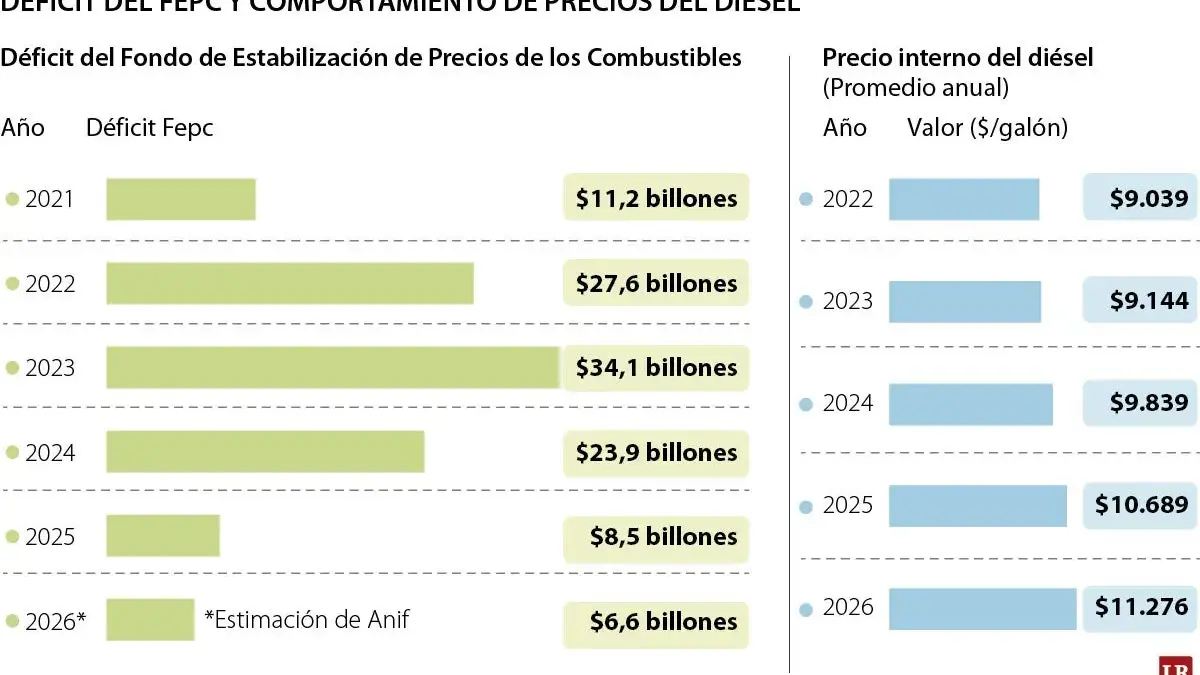
Colombia’s national government is currently trapped between a fiscal rock and a hard place. As the country grapples with a widening fiscal deficit, the Petro administration faces a highly sensitive economic and political decision: whether to align domestic diesel prices with international market benchmarks or to continue utilizing the national budget to subsidize fuel.
The subsidy, managed through the Fuel Price Stabilization Fund (FEPC), has turned into an seemingly bottomless fiscal drain. With domestic diesel—locally referred to as ACPM (Aceite Combustible Para Motores)—currently trading at approximately $8,500 Colombian Pesos (COP) below international parity, the financial sustainability of the state is being severely tested.
Main Facts: The Anatomy of Colombia’s Diesel Crisis
The scale of the diesel subsidy crisis in Colombia is defined by several stark realities:
- The Price Discrepancy: While the average domestic price of a gallon of diesel has been frozen at approximately $11,320 COP since June 2026, the international reference price soared to $19,820 COP by the end of September 2026. This has left a massive gap of $8,500 COP per gallon that the government must cover.
- The Fiscal Drain: According to industry calculations, every $1,000 COP of subsidy per gallon of diesel costs the Colombian state approximately $1.9 trillion COP annually.
- Budgetary Allocation: To keep the system afloat, the General Budget of the Nation (PGN) for 2026 had to appropriate $9.6 trillion COP specifically to cover the diesel deficit. This figure closely aligns with estimates from the Fiscal Observatory of the Universidad Javeriana, which calculated the annual cost of the subsidy at $9.5 trillion COP.
- Fleet Exposure: Any upward adjustment in diesel prices would directly impact over 1.21 million vehicles currently running on diesel, representing 5.68% of Colombia’s total vehicle fleet of 21.46 million. Crucially, this includes 443,870 heavy cargo trucks, which form the backbone of the country’s logistics and supply chains.
- Macroeconomic Context: This subsidy crisis is unfolding against the backdrop of a severe fiscal crunch, with Colombia’s national fiscal deficit reaching a worrying 7.2% of Gross Domestic Product (GDP).
Chronology: The Path to a Fiscal Crossroads
The current crisis is the result of years of structural pricing policies, global market volatility, and domestic political calculations.
[Early 2000s - 2007] FEPC established to buffer domestic fuel prices from global oil shocks.
       │
[2022 - 2024] Petro administration hikes gasoline prices to close gasoline deficit; diesel remains frozen.
       │
[January 2026] International diesel reference price stands at $11,900 COP; gap is minimal.
       │
[June 2026] Domestic diesel price stabilized at $11,320 COP.
       │
[September 2026] Global oil market shifts push international reference to $19,820 COP; gap widens to $8,500 COP.
       │
[October 2026] Fiscal deficit reaches 7.2% of GDP; 2026 PGN allocates $9.6 trillion COP for diesel.
Historically, the FEPC was designed in the late 2000s as a smoothing mechanism to protect Colombian consumers from sudden spikes in global oil prices. When international prices rose, the fund absorbed the shock; when they fell, the fund was supposed to recoup its losses. However, for over a decade, the fund operated at a near-constant deficit, as governments hesitated to raise domestic fuel prices due to fears of public backlash and inflation.
When the current administration took office, it initiated a aggressive schedule of monthly price increases for regular gasoline, successfully closing the gap between domestic and international prices by early 2024. However, diesel was conspicuously left out of these adjustments. Fearing widespread strikes by the powerful cargo transport sector—which could paralyze the nation’s economy—the government repeatedly postponed addressing the diesel subsidy.
By January 2026, the international reference price for diesel stood at a manageable $11,900 COP. At that time, with domestic prices hovering close to this mark, the subsidy gap was relatively small.
However, as the year progressed, global energy dynamics shifted. By June 2026, the domestic price was stabilized at $11,320 COP, but international benchmarks began to climb rapidly. By late September 2026, the international reference price reached a peak of $19,820 COP.
This widening gap of $8,500 COP transformed a manageable fiscal challenge into an acute crisis, pushing the country’s fiscal deficit to 7.2% of GDP and forcing the government to dedicate a massive portion of the 2026 General Budget to subsidizing fossil fuels rather than funding social programs or infrastructure.
Supporting Data: Deciphering the Numbers Behind the Subsidy
To fully understand the economic impact of the diesel debate, it is necessary to analyze the consumption patterns, regional distribution, and industrial reliance on this fuel.
Domestic Production vs. Import Parity
A central point of contention in the pricing debate is Colombia’s high level of self-sufficiency in diesel production.
Colombia Diesel Production (H1 2026):
┌──────────────────────────────────────────────┐
│ 140,800 Barrels/Day (Covers ~95% of Demand)  │
└──────────────────────────────────────────────┘
* An 11.2% increase compared to H1 2025.
During the first half of 2026, Colombian refineries—primarily Ecopetrol’s facilities in Barrancabermeja and Cartagena—produced approximately 140,800 barrels of diesel per day. This represented an 11.2% increase compared to the same period in 2025. According to industry experts, this domestic output is sufficient to cover nearly the entirety of Colombia’s domestic demand, meaning the country relies very little on expensive imported diesel.
Regional Consumption Patterns
The demand for diesel is heavily concentrated in Colombia’s economic and logistics hubs. The regions with the highest consumption through retail service stations are:
- Antioquia: The industrial heartland and a major transit corridor connecting the interior to the Caribbean ports.
- Bogotá D.C. & Cundinamarca: The central consumption market and logistics hub of the country.
- Valle del Cauca: Home to the Pacific port of Buenaventura, through which a significant portion of Colombia’s international trade passes.
- Cesar: A major mining and transit department in the northern region.
Transport Cost Elasticity
According to data compiled by XUA Energy, diesel accounts for approximately 35% of the total operating costs for the cargo transport sector.
Impact of a 4% Monthly Diesel Price Increase on Transport Costs:
┌──────────────────────────────┐
│  +4% Diesel Price            │
└──────────────┬───────────────┘
               │ (35% Cost Share)
               ▼
┌──────────────────────────────┐
│  +1.4% Transport Cost        │
└──────────────────────────────┘
This high cost share means that any price adjustment has a highly leveraged impact on logistics. For example, a gradual 4% monthly increase in the price of diesel would translate to an immediate 1.4% monthly increase in overall transport costs, which would then be passed down the supply chain to retail goods and food.
Official and Sector Responses: The Debate Over Opportunity Cost
The growing fiscal deficit has sparked an intense debate between government officials, retail fuel distributors, and energy analysts regarding how fuel prices should be calculated.
The Retail Sector’s Alternative Proposal
David Jiménez Mejía, President of the Confederation of Fuel and Energy Retail Distributors (Comce), has emerged as a prominent voice advocating for a complete overhaul of the pricing methodology. Jiménez argues that using "opportunity cost" to price domestically produced fuel is fundamentally flawed.
"The ACPM is the fuel of the productive apparatus: it moves nearly a million cargo and passenger vehicles, and right behind them come agriculture, mining, construction, and thermal electricity generation," Jiménez explained.
He pointed out that since domestic refineries cover almost all domestic demand, pricing diesel based on what it could be sold for on the international market is an unnecessary burden on local taxpayers.
"The price is set by opportunity cost, but it is valid to argue that this criterion makes sense when the buyer is another country, not when it is our own taxpayers who are paying," the Comce president stated.
Instead of a sudden price hike to match international parity, Comce has proposed alternative paths to alleviate the fiscal pressure:
- Utilizing Oil Rents: Directing a portion of Ecopetrol’s state dividends and oil royalties directly to cover the pricing differential.
- Tax Relief: Dismantling some of the national and local taxes currently levied on fuel. According to Comce, taxes currently represent $15 out of every $100 COP paid at the pump for diesel.
The Analytical Perspective
From the analytical side, Julio César Vera, President of XUA Energy, emphasizes the delicate balance required when adjusting prices. While acknowledging the need to address the fiscal gap, Vera warns of the compounding inflationary effects of rapid price hikes. He notes that because diesel is so deeply embedded in the supply chains of food and basic consumer goods, any abrupt change could trigger a wage-price spiral, complicating the central bank’s efforts to control inflation.
Furthermore, Jiménez Mejía concluded that the current crisis is not a failure of the stabilization fund itself, but rather a structural failure of pricing policy. "The fund did not fail; the pricing policy did," he remarked, emphasizing that a rigid adherence to international pricing models during global energy shocks is unsustainable for a developing economy with a high fiscal deficit.
Implications: Macroeconomic Shockwaves, Inflation, and the Energy Transition
The resolution of the diesel subsidy crisis will have far-reaching consequences for Colombia’s economic stability, social peace, and environmental goals.
                         ┌───────────────────────────┐
                         │   $8,500 Diesel Gap       │
                         └─────────────┬─────────────┘
                                       │
                ┌──────────────────────┴──────────────────────┐
                ▼                                             ▼
     [Option A: Maintain Subsidy]                  [Option B: Raise Prices]
  ┌──────────────────────────────────┐          ┌──────────────────────────────────┐
  │ • Widening fiscal deficit        │          │ • Immediate surge in inflation   │
  │ • Risk of credit rating downgrade│          │ • Potential transport strikes    │
  │ • Reduced social spending        │          │ • Increased agricultural costs   │
  └──────────────────────────────────┘          └──────────────────────────────────┘
Macroeconomic and Fiscal Stability
If the government chooses to maintain the subsidy, the pressure on public finances will continue to mount. With a fiscal deficit already at 7.2% of GDP, rating agencies and international lenders are watching Colombia closely. Failure to show a clear path toward fiscal responsibility could lead to a downgrade in the country’s credit rating, raising borrowing costs for both the government and private enterprises.
Conversely, allocating nearly $10 trillion COP annually to fuel subsidies diverts vital resources away from poverty reduction, education, and infrastructure projects, directly undermining the administration’s broader social agenda.
Inflation and the Cost of Living
If the government decides to phase out the subsidy and raise diesel prices, the primary concern is inflation. Because diesel powers the trucks that transport food from agricultural regions to major cities, a sharp increase in fuel costs will immediately translate into higher food prices.
In a country where food inflation has already been a major source of economic distress for lower-income households, such a move carries significant social and political risks. It could also trigger protests and strikes by transport unions, potentially paralyzing major highways and causing localized supply shortages.
The Energy Transition
The diesel debate also intersects with Colombia’s long-term environmental commitments. Cheap, subsidized diesel artificially lowers the cost of running carbon-intensive heavy vehicles, reducing the financial incentive for transport companies to transition to cleaner alternatives, such as electric or compressed natural gas (CNG) cargo trucks.
By eliminating the subsidy and allowing diesel prices to rise, the government would create a strong economic incentive for fleet modernization and decarbonization. However, this transition requires capital that many small-scale truck owners currently lack, highlighting the need for targeted government support programs to facilitate the shift.
Ultimately, the Colombian government finds itself at a critical juncture. There are no easy solutions: either it absorbs the massive financial cost of the subsidy at the expense of fiscal stability, or it risks economic disruption and social unrest by raising prices. The path the administration chooses will shape Colombia’s economic trajectory for years to come.



Leave a Reply