

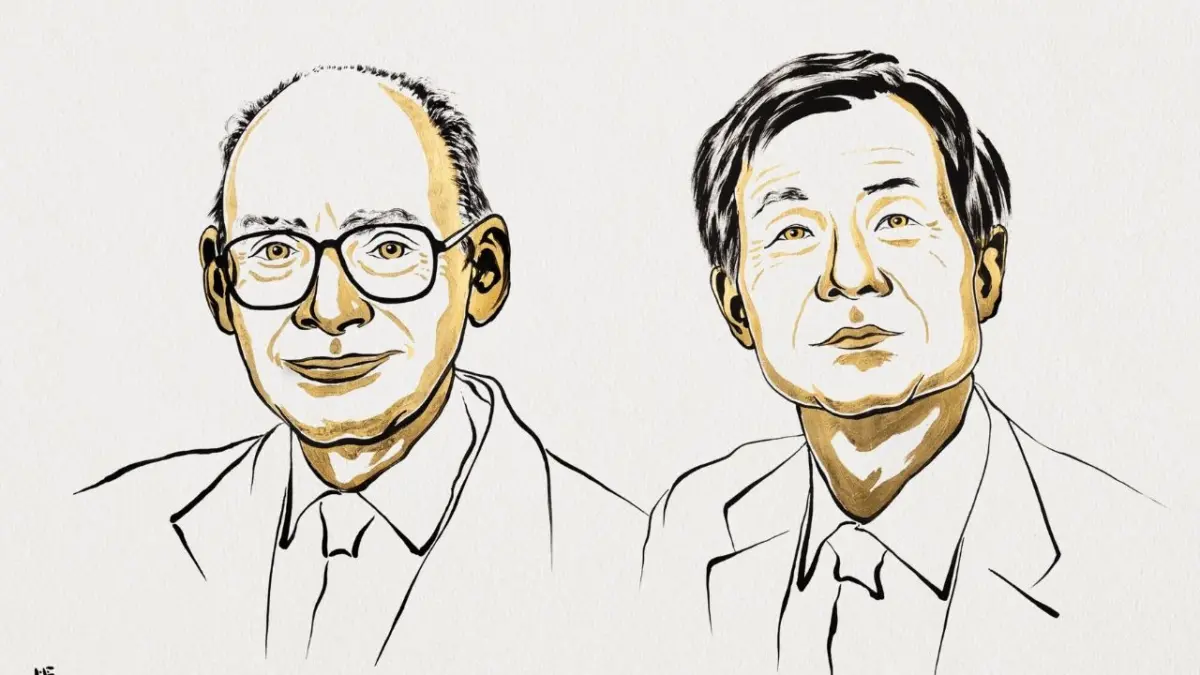
STOCKHOLM — In a landmark decision that bridges foundational chemical theory with vital pharmaceutical applications, the Royal Swedish Academy of Sciences announced on Wednesday that the 2026 Nobel Prize in Chemistry has been awarded jointly to Henri B. Kagan and Kenso Soai. The prestigious prize recognizes their pioneering discoveries regarding "non-linear effects and autocatalysis in asymmetric organic synthesis"—a monumental achievement that decodes one of chemistry’s most enduring and profound mysteries: the origins of homochirality in the natural world.
The announcement was delivered at a packed press conference in Stockholm by the Nobel Committee, marking another milestone year for physical sciences by honoring two scientists whose decades-long dedication has fundamentally reshaped how chemists view molecular geometry, biological evolution, and industrial manufacturing.
1. Main Facts: Decoding Nature’s Chiral Asymmetry
At the heart of Kagan and Soai’s Nobel-winning work is the concept of chirality—a Greek term derived from the word for hand. Just as a human’s left and right hands are mirror images of each other that cannot be superimposed, certain molecules exist in two distinct spatial configurations that serve as exact mirror reflections of one another. These twin molecules are known as enantiomers.
While non-living systems often produce a racemic mixture—an equal, 50-50 distribution of both left-handed and right-handed molecules—living systems demonstrate a striking asymmetry known as homochirality. In all known life on Earth, foundational biological molecules are built from exclusively one handedness. For example, virtually all naturally occurring amino acids (the building blocks of proteins) are "left-handed" (L-enantiomers), while nucleic acids like RNA and DNA rely strictly on "right-handed" (D-enantiomers) sugars.
For more than a century, scientists grappled with a fundamental evolutionary and chemical conundrum: How did this strict preference emerge in prebiotic Earth? Why did nature choose one hand over the other, and how can chemical reactions spontaneously break the symmetry to favor a single enantiomer?
Henri Kagan and Kenso Soai provided the answers. Through distinct yet complementary breakthroughs in asymmetric organic synthesis, Kagan introduced groundbreaking methods to manipulate molecular outcomes using catalytic systems, while Soai demonstrated how chemical reactions could achieve self-amplifying, absolute chiral purity through autocatalysis and non-linear effects. Their work transformed what was once viewed as an improbable chemical fluke into a predictable, reproducible, and deeply understood scientific paradigm.
2. Chronology of Discovery: From Kagan’s Catalysts to Soai’s Autocatalysis
The path to the 2026 Nobel Prize spans decades of meticulous laboratory experimentation, computational progress, and conceptual leaps.
Henri Kagan’s 1986 Turning Point
The first major cornerstone of the awarded research was laid in 1986 by French chemist Henri B. Kagan. Working at the University of Paris-Sud, Kagan sought to crack the problem of exerting absolute control over the spatial orientation of reaction products.
Until Kagan’s intervention, achieving a high enantiomeric excess—meaning producing a vast majority of one mirror-image molecule over the other—was notoriously difficult. Kagan developed revolutionary catalytic systems that introduced non-linear effects into asymmetric synthesis. He demonstrated that the optical purity of a catalyst did not necessarily have to scale linearly with the optical purity of the product. By discovering and explaining these non-linear effects, Kagan provided chemists with a sophisticated toolkit to dramatically boost the yield of desired chiral molecules, shattering previous technological ceilings and setting a new standard for synthetic chemistry.
Kenso Soai’s Symmetry Breaking (1995–2003)
Building upon the foundations laid by pioneers like Kagan, Japanese chemist Kenso Soai—working at the Tokyo University of Science—took the quest for absolute homochirality a step further into the realm of self-replication.
In 1995, Soai published a groundbreaking study detailing a catalytic asymmetric autocatalytic reaction—the Soai reaction. In this remarkable process, the product of the reaction acts as a catalyst for its own formation. Crucially, the chiral product catalyzes the production of more of itself with the exact same handedness.
The culmination of Soai’s work arrived in 2003, when he achieved a milestone previously thought nearly impossible: a reaction in which an infinitesimal, almost undetectable initial imbalance of enantiomers was amplified exponentially through autocatalysis, ultimately resulting in a product that was exclusively formed of only one of the two possible mirror-image configurations.
Soai’s experiments provided the first clear, tangible physical model for how prebiotic chemical systems could spontaneously break symmetry and transition from a racemic mixture to complete homochirality—offering a plausible chemical mechanism for the origin of life itself.
3. Supporting Data and Scientific Impact
To understand the magnitude of Kagan and Soai’s contributions, one must look at the mechanics of chemical synthesis. In organic chemistry, making a molecule is often straightforward; making a molecule with the exact correct three-dimensional orientation is notoriously complex.
- The Enantiomeric Challenge: Traditional synthesis frequently yields a 50-50 racemic mixture. Separating these mirror-image molecules after synthesis is extraordinarily expensive, time-consuming, and environmentally taxing.
- Non-Linear Effects: Kagan’s discovery proved that modifying a catalytic system could result in product optical purities far exceeding the catalyst’s optical purity. This drastically reduced the amount of expensive, enantiopure chiral catalysts needed for industrial-scale synthesis.
- Autocatalytic Amplification: Soai’s discovery of asymmetric autocatalysis proved that chiral induction could be self-sustaining. An initial enantiomeric excess as small as fractions of a percent could be amplified to near 100% optical purity through iterative cycles of reaction.
These principles have reshaped the theoretical framework of physical organic chemistry, opening up entirely new sub-disciplines dedicated to non-equilibrium thermodynamics, systems chemistry, and the origin of biological homochirality.
4. Official Responses and Committee Statements
The announcement was met with global acclaim from the scientific community. During the live broadcast from Stockholm, Heiner Linke, Chair of the Nobel Committee for Chemistry, captured the sentiment of the academy and researchers worldwide:
"Henri Kagan and Kenso Soai have aported a solution to a chemical mystery of more than a century of antiquity: how can homochirality arise spontaneously? The chemical reactions that they have developed are nothing short of spectacular."
Upon receiving the news, representatives of both laureates emphasized the collaborative nature of scientific inquiry, noting that their decades-old papers built upon generations of chemical heritage while sparking modern innovations that continue to inspire young researchers across the globe.
5. Industrial and Practical Implications: Transforming Medicine and Materials
While the philosophical and evolutionary implications of resolving the origin of homochirality are profound, the practical downstream applications of Kagan and Soai’s discoveries are already deeply embedded in modern daily life and global commerce.
The Pharmaceutical Revolution
The most critical application of asymmetric synthesis lies in the pharmaceutical sector. Biological receptors in the human body are themselves chiral (built from chiral amino acids and proteins). Consequently, two enantiomers of a drug molecule can behave entirely differently inside a living organism.
A stark historical lesson in this regard is thalidomide: one enantiomer of the drug effectively treated morning sickness in pregnant women, while its mirror-image counterpart caused severe congenital disabilities.
Because of breakthroughs pioneered by scientists like Kagan and Soai, modern pharmaceutical companies can precisely target and synthesize single enantiomers with absolute confidence. This capability ensures maximum therapeutic efficacy while minimizing adverse side effects, paving the way for safer, cleaner, and more potent life-saving medications.
Beyond Medicine: Fragrances, Flavors, and Advanced Materials
The utility of asymmetric synthesis extends far beyond healthcare. Human sensory organs—our noses and taste buds—are also chiral receptors. This means that the "left-handed" version of a molecule might smell like oranges, while its "right-handed" twin smells like lemons or pine.
By mastering non-linear effects and asymmetric control, flavor and fragrance industries can efficiently produce exact sensory profiles demanded by consumers. Furthermore, the principles discovered by Kagan and Soai are increasingly utilized in the synthesis of advanced functional materials, including liquid crystals, specialized polymers, and organic electronic components used in modern display technologies and renewable energy systems.
A Legacy for the Future
The 2026 Nobel Prize in Chemistry honors more than just two exceptional careers; it celebrates humanity’s growing mastery over the subtle, three-dimensional architecture of matter. By tracing the echoes of molecular asymmetry from the primordial origins of life to the cutting edge of industrial manufacturing, Henri Kagan and Kenso Soai have permanently altered our understanding of the chemical universe—ensuring their names will be linked forever with the mirror of nature.




Leave a Reply