

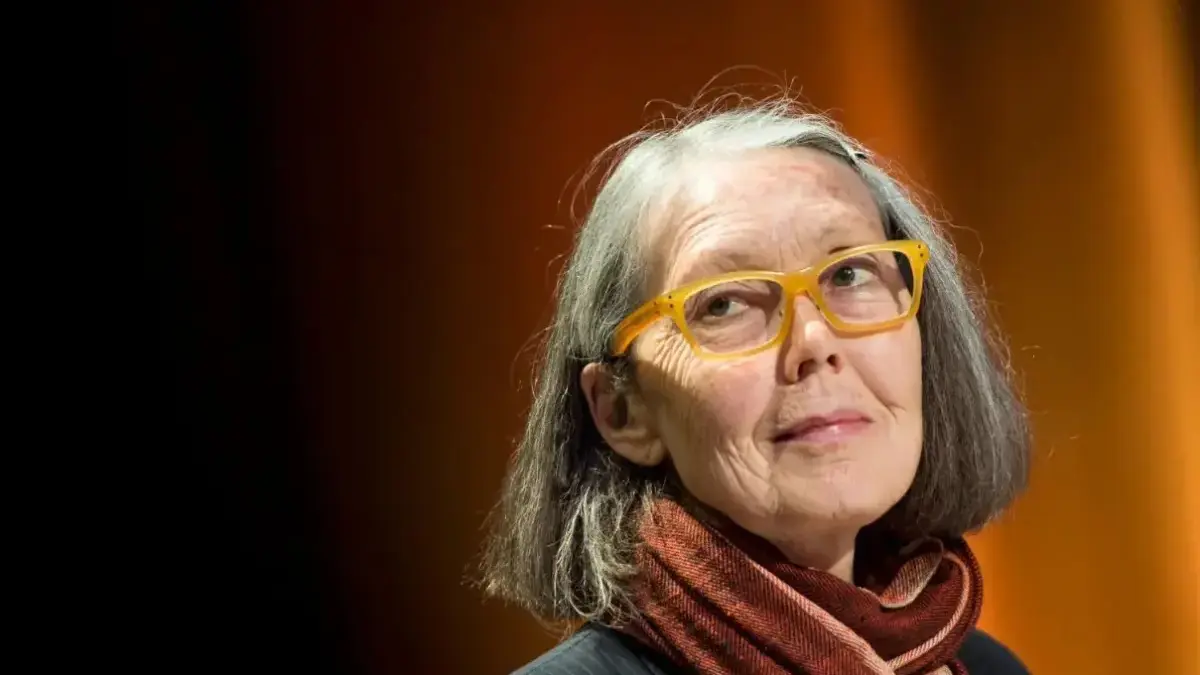
STOCKHOLM — In a momentous decision that bridges the ancient world with the vanguard of postmodern expression, the Swedish Academy has awarded the 2026 Nobel Prize in Literature to the distinguished Canadian poet, essayist, and classicist Anne Carson.
According to the official citation announced by the Nobel Committee, the prize is granted to Carson "for a bold and ingenious body of work that, in playful dialogue with the classical tradition, has forged new forms within contemporary literature."
Carson, born in Toronto in 1950, stands as one of the most intellectually rigorous and formally innovative writers of the past half-century. Her unique synthesis of classical scholarship, radical formal experimentation, and deep linguistic excavation has fundamentally shifted how contemporary readers and writers understand the boundaries between poetry, prose, translation, and performance.
Main Facts: A Triumphant Victory for Experimental Classicism
The announcement positions Anne Carson among the pantheon of global literary giants, validating a career spanning more than four0 years of relentless artistic inquiry. Known just as much for her foundational work as a professor of ancient Greek as for her breathtaking poetry, Carson has carved out a singular niche in letters.
The Swedish Academy highlighted her capacity to make antiquity speak directly—and urgently—to the modern human condition. Her work refuses to respect traditional generic boundaries, frequently combining essay, verse, translation, myth, and visual art.
Key pillars of her extensive bibliography include:
- Autobiography of Red: A Novel in Verse (1998): Her universally acclaimed masterpiece that reimagines archaic Greek myth into a modern psychological landscape.
- The Beauty of the Husband: A Fictional Essay in 29 Tangos (2001): A searing, elegiac poetic essay exploring the anatomy of a failed marriage through the lens of John Keats’s aesthetic philosophy.
- Decreation: Poetry, Essays, Opera (2005): A hybrid collection exploring the concept of undoing oneself, drawing inspiration from figures like Sappho, Simone Weil, and Marguerite Porete.
- Float (2016): A collection of 22 detachable chapbooks packaged in a clear plastic bag, designed to be read in any sequence chosen by the reader.
- Wrong Norma (2024): A heterogeneous mix of text, memoir, and performative critique demonstrating her continued resistance to narrative conventions.
Chronology of a Literary Evolution: From Toronto to Global Acclaim
To understand the weight of Anne Carson’s Nobel win, one must trace a career defined by an unwavering commitment to intellectual depth and formal risk-taking.
- 1950: Anne Carson is born in Toronto, Ontario, Canada. From an early age, she develops a fascination with language, eventually pursuing her passion for ancient languages and literature.
- 1980s–1990s: Carson earns her Ph.D. from the University of Toronto and begins teaching classics at various universities in Canada and the United States, including McGill University, Princeton, and the University of Michigan. Her early academic and critical writings lay the groundwork for her creative output.
- 1986: Publishes Eros the Bittersweet, a brilliant analytical and lyrical examination of love and desire in ancient Greek literature, establishing her signature style of blending scholarship with poetic insight.
- 1998: Publication of Autobiography of Red: A Novel in Verse. The book becomes an instant international critical sensation, praised for its lyrical precision and emotional resonance.
- 2001: Wins the prestigious T.S. Eliot Prize for The Beauty of the Husband, becoming the first woman to win the award.
- 2010s: Carson expands her practice into interdisciplinary collaborations, working closely with theater directors, choreographers, and visual artists. Works like Float challenge the physical architecture of the book.
- 2020: Receives the prestigious Princess of Asturias Award for Literature, cementing her status as a global literary titan.
- October 2026: The Swedish Academy awards her the Nobel Prize in Literature, recognizing a lifetime of defying literary norms and breathing new life into classical myth.
Supporting Data and Analysis: Deconstructing the Myth of Geryon
At the heart of Carson’s international renown is her 1998 masterpiece, Autobiography of Red: A Novel in Verse. The work demonstrates her extraordinary capacity to adapt classical literary traditions into contemporary forms.
Starting from the surviving poetic fragments of Stesichorus—a lyric poet from the 6th century BCE—Carson centers her narrative on Geryon, a monster and red-winged giant from Greek mythology. In the original myth, Heracles slaughters Geryon as one of his legendary labors to steal the giant’s cattle.
Carson radically reinvents the narrative. In her hands, Geryon is reframed not as a terrifying monster, but as a tender, sensitive photographer deeply devoted to his mother. He becomes a symbol of modern alienation and queer self-discovery.
The Core Conflict of Geryon and Heracles
Within Carson’s narrative framework, Geryon—having endured abuse by his older brother—falls deeply in love with Heracles. This dynamic brings forth the central, devastating question that echoes through Carson’s poetry:
"What happens when you love someone who will ultimately destroy you?"
By asking this with profound lyricism and psychological acuity, Carson elevates an ancient myth into a modern epic of initiation, vulnerability, and survival.
Furthermore, Carson’s stylistic philosophy is famously encapsulated in her own aphorism regarding the nature of creative writing:
"If prose is a thing, poetry is someone in flames running through it."
This fiery urgency defines her entire catalogue. Whether examining the etymology of words—the central axis of her intellectual pursuits—or pushing structural boundaries, Carson treats language as a living, volatile entity. Her work in Wrong Norma (2024) and her ongoing collaborations with visual and performance artists prove that she views writing as an event rather than a static product.
Official Responses and Global Reaction
The international literary community erupted in celebration following the Swedish Academy’s announcement. Fellow writers, academic institutions, and cultural ministries across North America and Europe flooded media channels with praise.
The Canada Council for the Arts released a statement celebrating Carson’s victory as a historic moment for Canadian letters: "Anne Carson has continually pushed the boundaries of what literature can achieve. Her work honors our classical past while fearlessly charting the future of poetic expression. Canada is immensely proud to see her genius recognized on the world stage."
Academia has similarly rejoiced. Literature departments worldwide have praised the Nobel Committee for honoring a writer whose work defies easy categorization. Unlike novelists who rely on traditional plot structures or poets who adhere strictly to traditional meters, Carson sits comfortably in the spaces between genres.
Publishers report a massive surge in international orders for her backlist titles, particularly Autobiography of Red and Eros the Bittersweet, as new generations of readers seek out the work of the 2026 Nobel Laureate.
Implications of the 2026 Nobel Prize: A Triumph for Hybridity
The selection of Anne Carson carries profound implications for the future direction of the Nobel Prize in Literature. By honoring a writer whose primary medium crosses the porous borders between poetry, translation, classical scholarship, and visual performance, the Swedish Academy has signaled a broad, inclusive definition of literature for the digital and postmodern age.
For decades, the prize has occasionally struggled to balance traditional narrative excellence with avant-garde innovation. In awarding Carson, the Academy validates the hybrid text—works that refuse to choose between the analytical rigor of the essay and the emotional immediacy of lyric verse.
Moreover, Carson’s win elevates the art of translation. As a lifelong translator of Euripides, Sappho, and Sophocles, Carson has always viewed translation not as a mechanical act of linguistic substitution, but as a creative dialogue across time and space. Her Nobel victory reminds the global literary community that writing is always a conversation with those who came before us.
As Anne Carson joins the pantheon of Nobel Laureates, she leaves an indelible mark on contemporary culture. Through her burning prose, her tender giants, and her relentless interrogation of words, she has proven that poetry is not merely an art form, but a vital way of surviving the world.




Leave a Reply