

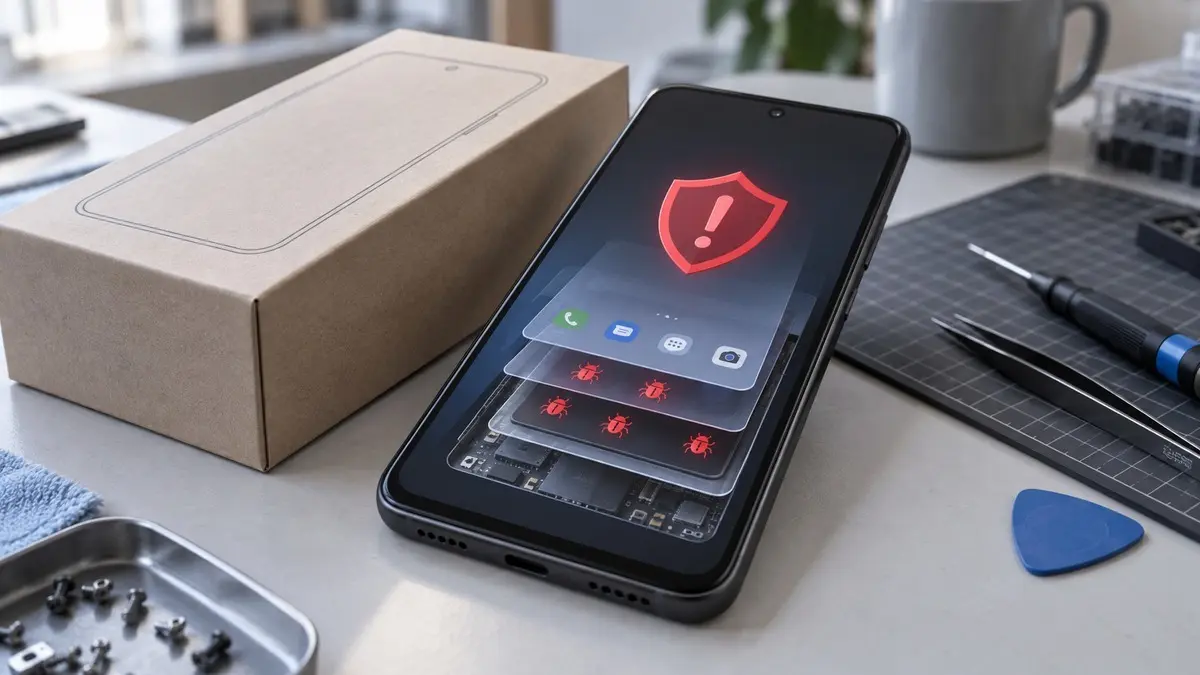
Global Analysis — In an era where smartphones have become indispensable extensions of our professional and personal lives, consumers place an implicit, absolute trust in the hardware they purchase. When unboxing a brand-new device, the expectation is a clean slate—a secure gateway to communication, banking, navigation, and entertainment. However, a sweeping new cybersecurity investigation shatters that baseline assumption, revealing that thousands of budget-friendly Android smartphones are arriving in consumers’ hands already compromised at the factory level.
A comprehensive, multi-year investigation published on October 8 by cybersecurity powerhouse Bitdefender Labs has brought to light a sprawling, sophisticated malware campaign dubbed "Midnight Mimosa." Operating undetected for nearly two years across more than 150 countries, this campaign bypasses traditional threat vectors entirely. Instead of relying on deceptive user downloads or malicious links, the threat is baked directly into the device’s core operating system before it ever leaves the manufacturing or distribution pipeline.
With Latin America emerging as a primary epicenter—and Mexico leading the global detection charts—the Midnight Mimosa operation underscores a terrifying evolution in supply chain vulnerabilities. It demonstrates that for millions of consumers looking for an affordable mobile device, the greatest digital security threat is not something they accidentally invite onto their phone, but something that was waiting for them the moment they paid for it.
Main Facts
The core of the Midnight Mimosa campaign centers on a deeply embedded firmware-level infection that impacts low-cost Android devices, predominantly those built upon MediaTek chipsets. Unlike conventional malware that masquerades as a flashlight app, a mobile game, or a utility tool, the malicious components of Midnight Mimosa reside within protected partitions of the device’s system software.
Anatomy of an Unseen Threat
Because the malicious code is hardcoded into the firmware, the infection is entirely independent of user behavior. A digitally cautious user who avoids suspicious websites, refuses to click on phishing links, and strictly downloads apps from verified sources remains just as vulnerable as anyone else.
Key technical characteristics of the pre-installed malware include:
- System-Level Privileges: The core component possesses elevated, root-level permissions, granting it the unmonitored ability to silently install, update, or delete applications without requiring user consent or triggering standard security prompts.
- Aggressive Evasion Tactics: During operational testing, researchers observed the malware actively and temporarily disabling the official Google Play Store. By cutting access to the official marketplace, the firmware executed silent payload injections before re-enabling the store, effectively blinding security telemetry and minimizing the risk of detection.
- Broad Permission Footprint: The injected modules secured access to sensitive system layers, including accessibility services, notification listeners, and SMS handlers. While researchers noted that certain permissions were not actively exploited during the observation window, their mere presence represents a severe, latent risk to user privacy.
- Disguised Signatures: The malware relies on a rotating assortment of package names deliberately engineered to mimic legitimate, standard Android system components. Consequently, performing a surface-level visual check of installed applications or hunting for a single rogue app name is wholly insufficient for diagnosing an infection.
The Business Model: Ad Fraud and Residential Proxies
Bitdefender’s analysis mapped out the primary monetization strategies employed by the operators behind Midnight Mimosa. The infected devices were systematically weaponized to execute two primary revenue-generating schemes:
- Large-Scale Ad Fraud: The malware orchestrates background interactions with digital advertisements, simulating user engagement to drain marketing budgets and generate illicit revenue for the threat actors.
- Residential Proxy Networks: Perhaps most alarmingly, infected phones were co-opted into acting as nodes within global proxy networks. In this capacity, external third parties could route their internet traffic through the unsuspecting victim’s cellular connection. This effectively masks malicious web traffic, cyberattacks, or data scraping operations behind the residential IP address of an everyday consumer.
Chronology
The discovery of the Midnight Mimosa campaign is the culmination of nearly two years of meticulous digital forensics, tracking anomalous network traffic patterns and supply chain anomalies across the globe.
- Late 2022 to Early 2023 (Inception and Initial Deployment): Telemetry data analyzed by security researchers indicates that the campaign likely began scaling its operations during this period. Devices bearing corrupted firmware began filtering out of manufacturing hubs and into international retail channels, quietly establishing footholds in developing and developed markets alike.
- Throughout 2023 (Global Expansion): The infrastructure behind Midnight Mimosa expanded rapidly. Infections spread across more than 150 countries. During this phase, the malware refined its evasion techniques, perfecting its routine of temporarily disabling the Google Play Store to slip past automated behavioral monitors.
- Early to Mid-2024 (Cross-Correlation of Anomalies): Bitdefender threat intelligence analysts began noticing persistent, unexplainable proxy traffic and ad-fraud signatures originating from specific models of budget smartphones. Researchers isolated the anomalies, tracing the traffic not to user-downloaded applications, but deep within the system partition of the devices.
- October 8, 2024 (Public Disclosure): Bitdefender formally published its comprehensive report on the Midnight Mimosa campaign. The publication revealed that Mexico stood at the absolute forefront of global detections, followed closely by widespread impacts across Latin America, parts of Asia, and Europe. The report also highlighted 13 supplementary applications discovered on the official Google Play Store that shared infrastructure and ad-fraud code with the firmware components, albeit lacking system-level privileges.
Supporting Data and Technical Scope
To fully grasp the scale of the Midnight Mimosa threat, it is essential to examine the specific hardware classes involved and the limitations of what current telemetry can definitively prove.
Targeted Hardware and Brand Realities
The devices identified in the research span a wide spectrum of ultra-low-cost Android handsets, predominantly powered by MediaTek system-on-chip (SoC) platforms. Specific models explicitly noted in technical disclosures include the Doogee S200 X and the Cubot KINGKONG X.
Furthermore, researchers uncovered an alarming subsection of devices masquerading as premium hardware—counterfeit units explicitly branded to look like high-end smartphones from Apple or Samsung, yet harboring cheap, generic Android hardware underneath the shell.
Crucial Distinction: Security analysts emphasize that the presence of these models in the report does not constitute an indictment of all devices produced by brands like Doogee or Cubot, nor does it mean that genuine Samsung or Apple devices are at risk. Rather, the data reflects specific batches, white-label manufacturing lines, or compromised supply chain segments intercepted during Bitdefender’s telemetry collection. The findings represent observed infections, not an exhaustive global census.
The Supply Chain Black Box
One of the most vexing challenges highlighted by the investigation is the obscurity of the hardware supply chain. Forensic analysis of the digital certificates used to sign the compromised firmware revealed references to Shenzhen Zediel.
However, security experts urge caution against jumping to conclusions. The appearance of a corporate name on a signing certificate does not definitively establish that the certificate holder intentionally implanted the malware, nor does it pinpoint the exact juncture in the multi-tiered manufacturing and distribution chain where the malicious payload was injected. From silicon foundry to regional distributor, multiple third-party hands touch a budget smartphone before it reaches store shelves, leaving ample opportunity for malicious interception.
Official Responses and Industry Context
The cybersecurity community has responded to the Midnight Mimosa disclosure with a mixture of professional validation and deep concern regarding the state of mobile supply chain security.
Industry veterans note that while pre-installed malware is not an entirely unprecedented phenomenon—previous investigations have periodically exposed rogue code hidden in cheap tablets or obscure set-top boxes—the scale, longevity, and sophistication of Midnight Mimosa represent a dangerous evolutionary leap.
The Silence of the Assemblers
As of the publication of this report, major generic device manufacturers and regional distributors linked to the compromised firmware batches have offered limited or no official commentary. The complex web of Original Design Manufacturers (ODMs) and White-Label Providers (OEMs) often obscures accountability, making it extraordinarily difficult for researchers or consumer advocacy groups to extract formal acknowledgments or rapid patch deployments from the entities responsible.
Major security software vendors, meanwhile, have updated their signature databases to help identify secondary network anomalies associated with the campaign, while emphasizing that traditional endpoint antivirus solutions face an uphill battle when confronted with threats rooted in the read-only memory (ROM) of a device.
Implications: The Consumer Dead-End
For the everyday buyer, the implications of the Midnight Mimosa campaign are deeply troubling, primarily because standard troubleshooting playbooks fail entirely in this context.
Why Standard Fixes Fall Short
When an ordinary smartphone displays erratic behavior or unwanted advertisements, the standard consumer reaction is straightforward: locate the offending application and uninstall it.
With Midnight Mimosa, that action is futile. Because the core malicious framework is hardcoded into the system partition, standard uninstallation procedures cannot reach it. Furthermore, Bitdefender’s findings indicate that performing a standard factory data reset does not reliably or permanently purge the infection, as the malicious files are often baked into the foundational system image restored during the wipe process.
Complicated remedies—such as unlocking the device bootloader, flashing a clean, third-party operating system (like LineageOS), or manually rewriting device partitions—require advanced technical competencies that are completely out of reach for the vast majority of consumers who purchase budget-conscious phones out of economic necessity.
A Systemic Failure Requiring Systemic Solutions
Ultimately, the burden of security cannot continue to rest solely on the shoulders of the end-user. When hardware is sold pre-compromised, the social contract of consumer retail is fundamentally breached.
Protecting the global mobile ecosystem from threats like Midnight Mimosa will require a coordinated, international push toward stricter supply chain auditing, enforced firmware transparency, and regulatory accountability for device importers and white-label manufacturers. Until hardware distributors are held legally and financially accountable for the integrity of the software they ship, the unboxing of a budget smartphone will remain a gamble—one where the consumer’s privacy is the hidden stake.




Leave a Reply