

Main Facts: The Passing of a Software Engineering Titan
The world of technology and space exploration lost one of its most foundational pioneers with the passing of Margaret Hamilton, who died on September 30, 2026, at the age of 90. Her death was officially confirmed by the Massachusetts Institute of Technology (MIT), an institution where she spent over two decades building a legacy that permanently reshaped the digital landscape.
Long before computer science was recognized as a formal academic discipline or a prestigious career path, Hamilton was already writing code in an era when electronic computers occupied entire rooms, required vacuum tubes, and operated on barely a fraction of the processing power found in a modern wristwatch. Her professional apex culminated in one of the most iconic milestones in human history: the July 1969 Apollo 11 lunar landing. As the director of the Software Engineering Division of the MIT Instrumentation Laboratory, Hamilton led the teams responsible for designing and developing the onboard flight software that guided Neil Armstrong and Buzz Aldrin to the surface of the Moon—and, crucially, brought them safely back home.
Hamilton’s contributions extended far beyond a single historic mission. She is widely credited with coining the very term "software engineering" to lend professional legitimacy and rigor to a field that was initially dismissed as trivial "women’s work" or glorified secretarial typing. Her obsession with fault tolerance, system reliability, and asynchronous executive processing laid the theoretical and practical groundwork for modern computing, influencing everything from commercial aviation systems to the software running on contemporary smartphones.
Chronology: From Paoli to the Apollo Program
Early Life and Academic Foundations
Born in Paoli, Indiana, in 1936, Margaret Heafield displayed an early aptitude for abstract reasoning and mathematics. She pursued her passions at Earlham College, where she earned a Bachelor of Arts degree in mathematics in 1958. Fresh out of college, she briefly taught high school mathematics before moving to Boston, Massachusetts, eager to immerse herself in the burgeoning academic and scientific ecosystem of the city.
The Dawn of Meteorological Computing
In 1959, Hamilton secured a temporary position in the meteorology department at MIT. There, she worked alongside Edward Lorenz, a pioneer of chaos theory whose groundbreaking work on non-linear dynamics and weather prediction would alter modern science. Hamilton’s task involved writing software to model weather systems on early computers. This role served as her baptism by fire into professional programming, teaching her how to translate complex mathematical equations into machine-executable logic.
The SAGE Project and the Realities of Defense Systems
Following her time in meteorology, Hamilton transitioned to MIT’s Lincoln Laboratory, where she contributed to the Semi-Automatic Ground Environment (SAGE) project. SAGE was a massive, continental-scale computerized air defense system designed to coordinate data from radar stations and detect potential Soviet bomber attacks.
Working on SAGE profoundly shaped Hamilton’s engineering philosophy. She witnessed firsthand the catastrophic consequences of system crashes and unhandled exceptions in high-stakes environments. It was during this period that she began formulating a central question that would define her career: What happens when a program encounters an unexpected error, and how can it be engineered to survive it?
Entering the Space Race: The Apollo Era
In 1965, the trajectory of Hamilton’s life—and the history of space exploration—shifted permanently. The MIT Instrumentation Laboratory was awarded the contract to develop the guidance, navigation, and control system for NASA’s ambitious Apollo program. Hamilton joined the project as its very first programmer and the first female software engineer assigned to the MIT Apollo team.
By 1968, the scope of her responsibilities had expanded exponentially. Hamilton was promoted to director of the software engineering division for the Apollo onboard flight software, managing over 400 engineers, scientists, and technicians spread across multiple teams. Under her leadership, the team wrote millions of lines of code entirely from scratch, operating in a vacuum of established software engineering principles.
Supporting Data: The Rigor and Reality of Apollo Software
The Incident with Lauren: Designing for Human Error
Hamilton’s genius was rooted in pragmatism and an acute awareness of human fallibility. She understood that even the most rigorously tested systems could be compromised by unexpected user input. A famous anecdote involving her four-year-old daughter, Lauren, vividly illustrates this foresight.
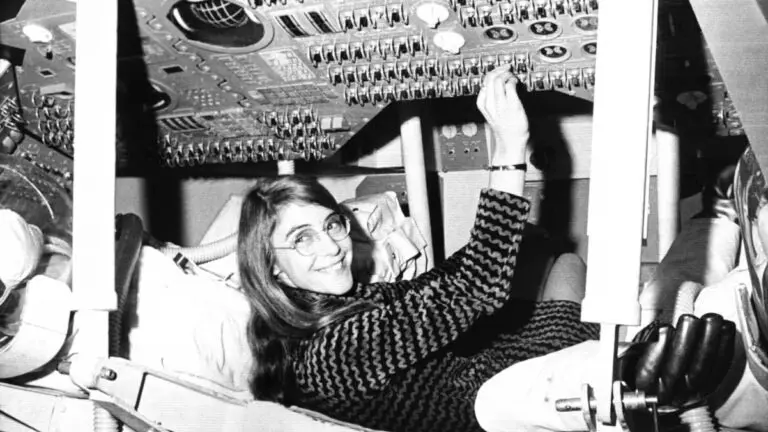
While visiting her mother at the MIT lab, little Lauren was playing near an Apollo command module simulator. She accidentally pressed buttons that activated a pre-launch program while the simulator was already simulating a flight in progress. The action wiped out the navigation data and crashed the simulation.
Realizing that an astronaut could easily make a similar mistake out of exhaustion or panic during an actual space mission, Hamilton proposed modifying the software to incorporate a priority-scheduling safeguard that would prevent accidental overwrites. Initially, project managers and NASA leadership rejected her proposal, arguing that highly trained astronauts would never commit such an oversight.
Their assumptions were shattered during Apollo 8, when astronaut Jim Lovell accidentally triggered the exact same sequence of commands while interacting with the computer in flight. Fortunately, the incident was manageable in near-Earth orbit, but it proved Hamilton right. NASA immediately authorized her team to implement the fail-safe code across all subsequent missions.
The 1202 Alarm: Triumph of Asynchronous Executive Design
The ultimate validation of Hamilton’s engineering philosophy occurred on July 20, 1969, just minutes before Apollo 11’s lunar module, Eagle, was set to touch down on the Moon.
A radar system left inadvertently in the wrong mode flooded the onboard computer with unnecessary data. The computer was suddenly overwhelmed, triggering the dreaded 1202 program alarm. For mission controllers in Houston, heart rates spiked. A computer crash at that exact moment would have forced an immediate abort—or worse, a disaster.
However, Hamilton’s software architecture had been built with asynchronous executive capabilities. Instead of crashing or freezing under the sudden CPU overload, the system recognized that it was running out of processing capacity. It automatically dumped low-priority tasks (such as driving the display screens for the astronauts) and dedicated 100% of its computational cycles to the single, vital task that mattered most: keeping the thrusters stable and guiding the lunar module safely to the surface.
Thanks to Hamilton’s foresight, Neil Armstrong and Buzz Aldrin were able to look past the flashing warning lights, assess that the computer was handling the load, and successfully complete humanity’s first lunar landing.
The Iconic Photograph
In 1969, a photograph was captured that would become the visual shorthand for Hamilton’s career and the monumental scale of early software development. In the image, Hamilton stands smiling next to a towering stack of heavy binders containing the complete source code written by her team for the Apollo project. The height of the paper stack roughly matches her own height. Decades later, as software became invisible, abstract, and embedded in every pocket-sized device, this photograph resurfaced as a powerful cultural icon, celebrating both human ingenuity and the physical weight of early digital creation.
Official Responses: Tributes and Recognition
Following the announcement of her death, tributes poured in from academic institutions, space agencies, and global leaders who recognized the profound debt the modern technological world owes to her vision.
The Massachusetts Institute of Technology released an official statement mourning the loss of a visionary educator and researcher:
"Margaret Hamilton changed the way humanity interacts with machines. Her pioneering work at MIT did not merely help land humans on the Moon; it laid the intellectual scaffolding for the entire software industry. We mourn her passing, but her architecture lives on in every digital system that powers our modern world."
NASA, which had previously honored her with a NASA Exceptional Space Act Award in 2003, issued a formal remembrance highlighting her indispensable role in the triumphs of the 20th century:
"Margaret was a trailblazer who envisioned software engineering as a true discipline when the rest of the world viewed coding as an afterthought. Without her uncompromising standards for reliability and fault tolerance, the Apollo missions—and modern spaceflight as we know it—would not have been possible."
In 2016, President Barack Obama presented Hamilton with the Presidential Medal of Freedom, the highest civilian honor in the United States. During the White House ceremony, Obama encapsulated her impact with a poignant observation:
"From guiding Apollo missions to the Moon to organizing computer science as we know it, Margaret Hamilton’s relentless curiosity and pioneering spirit pushed our nation forward. Her work reminds us that no challenge is too great when met with ingenuity, dedication, and rigorous preparation."
Implications: The Enduring Legacy of a Software Pioneer
Margaret Hamilton’s passing marks the end of an era, but her intellectual footprint continues to expand across an increasingly digitalized world. The implications of her life’s work are visible in virtually every sector of contemporary society.
The Birth of Software Engineering
Before Hamilton championed the term, programming was often viewed as a secondary task performed by mathematicians or engineers after the "real" hardware had been built. By insisting that software required its own rigorous academic and professional methodology, she elevated coding to an engineering discipline on par with civil, mechanical, and electrical engineering. Today, software engineering drives global economies, healthcare systems, financial markets, and global communications.
The Philosophy of Fault Tolerance
In an era of autonomous vehicles, artificial intelligence, and critical infrastructure automation, Hamilton’s core philosophy—designing systems that anticipate and gracefully survive human and mechanical errors—is more relevant than ever. Modern software development practices, including automated testing, redundancy, defensive programming, and exception handling, trace their conceptual lineage directly back to the principles Hamilton established at MIT and NASA.
Inspiring Future Generations
Hamilton’s legacy has also served as a powerful catalyst for diversity in STEM fields. As one of the few women leading large-scale engineering teams during the height of the space race, she shattered glass ceilings long before the term entered the popular lexicon. Her iconic image standing beside the Apollo source code has inspired countless young women to pursue careers in computer science, engineering, and mathematics.
Despite her immense historical importance, Hamilton consistently deflected personal glory, preferring to emphasize the collective achievements of the brilliant young teams she led—a generation of pioneers who worked without manuals, precedents, or safety nets.
Margaret Hamilton spent her entire professional life solving a singular, monumental problem: how to make machines reliable when humanity pushes them to the absolute edge. As humanity looks toward future horizons—including upcoming lunar returns and crewed missions to Mars—the foundational software architecture she pioneered will continue to light the way.



Leave a Reply