

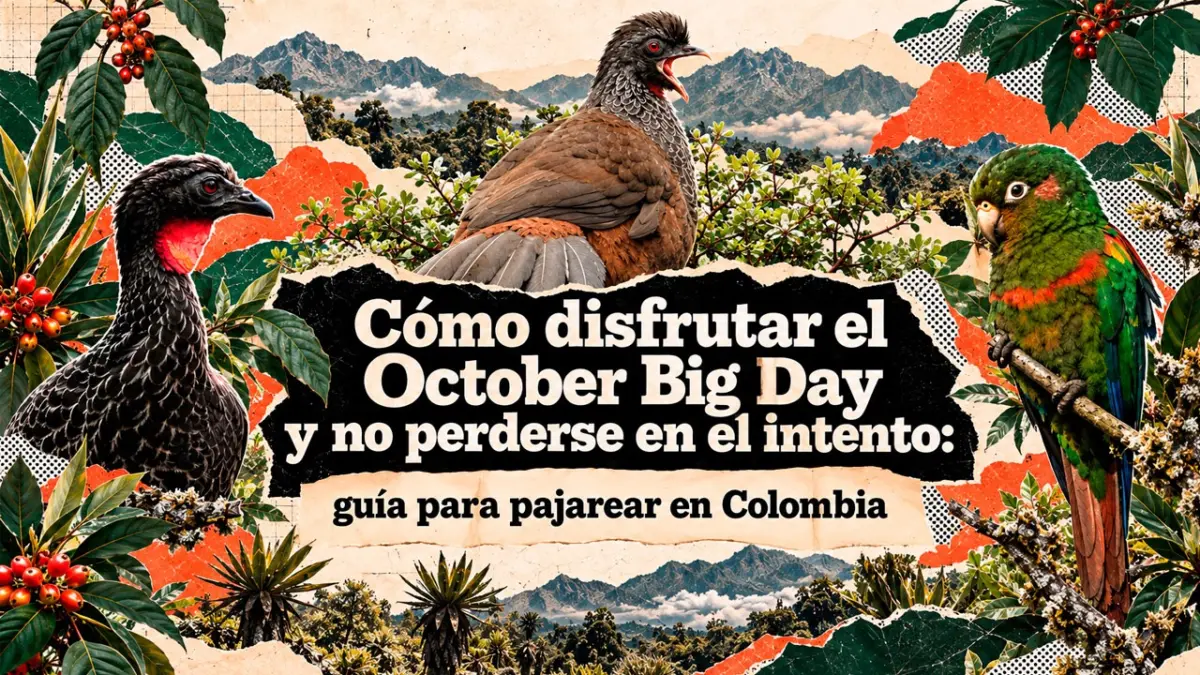
BOGOTÁ — Colombia, globally recognized as one of the most biodiverse nations on the planet and an undisputed paradise for birdwatchers, is preparing for the highly anticipated October Big Day 2026. Scheduled for Saturday, October 10, this global citizen-science event invites ornithologists, local communities, families, and amateur nature enthusiasts to take to the fields, forests, wetlands, and urban parks to observe, identify, and document the country’s rich avian life.
The initiative, spearheaded globally by the Cornell Lab of Ornithology, challenges participants across the globe to spend 24 hours recording as many bird species as possible. In Colombia, this event serves not only as a recreational gathering for nature lovers but also as a critical scientific monitoring effort. By uploading their findings in real-time to the eBird platform, participants contribute invaluable data that helps researchers map bird distribution, track population trends, and understand ecological shifts across diverse tropical ecosystems.
This October edition builds on the phenomenal momentum generated earlier this year. During the Global Big Day held in May 2026, Colombia cemented its status as an avian superpower by registering a staggering 1,566 species, 1,200+ distinct lists, and the active participation of 4,210 observers. As the country looks toward the October event, conservationists hope to match or even surpass these benchmarks, showcasing the richness of Colombia’s natural heritage to the international community.
Main Facts: What is the October Big Day and How Does It Work?
The concept of the "Big Day" originates from a longstanding ornithological tradition: a 24-hour sprint dedicated to finding and identifying as many bird species as humanly possible within a specific geographic area. Over the years, the Cornell Lab of Ornithology expanded this localized tradition into a synchronized global event. While the primary Global Big Day takes place every May during the peak of the northern hemisphere’s spring migration, the October Big Day offers a crucial counterpoint, capturing the movements of resident species and southern migrants during the global autumn.
The Mechanics of Participation
Participating in the October Big Day 2026 is intentionally accessible to everyone, from seasoned field biologists to families stepping into their local neighborhood park for the very first time.
- Observation: Participants spend time—ranging from 10 minutes to the entire 24-hour period—watching or listening to birds.
- Identification: Using field guides, local knowledge, or identification apps like Merlin Bird ID, observers identify the species.
- Documentation and Upload: Observers compile their findings into lists and upload them directly to eBird, the world’s largest biodiversity-related citizen science project.
Crucially, participants do not need to travel to remote jungles or protected national parks to make a meaningful contribution. Observations can be made from a rural farm, a city balcony, a local wetland, or a municipal park. Every checklist submitted acts as a single data point, combining with thousands of others to create a comprehensive, simultaneous snapshot of avian biodiversity across the country on October 10.
Chronology: The Evolution of Colombia’s Birdwatching Phenomenon
To understand the scale of the October Big Day 2026, it is helpful to look back at how birdwatching transformed from a niche hobby into a pillar of Colombian ecotourism and conservation science.
The Rise of Citizen Science in Colombia
- Early Foundations: For decades, birdwatching in Colombia was largely the domain of academic researchers and a small circle of international tourists. However, the country’s unmatched geography—spanning the Andes, the Amazon, the Orinoco basin, the Pacific coast, and the Caribbean—meant that its true avian wealth remained largely undocumented on global platforms.
- The Global Big Day Breakthrough: In the late 2010s, Colombian environmental organizations, regional governments, and local guides began actively promoting events like the Global and October Big Days. By mobilizing communities, schools, and ecotourism groups, Colombia rapidly climbed the ranks.
- May 2026 Milestone: The most recent major benchmark occurred in May 2026, when Colombian birders shattered previous engagement records. The mobilization of 4,210 participants resulted in 15,008 submitted lists and a remarkable count of 1,566 species identified in a single day. This performance routinely places Colombia at or near the top of the global leaderboard, competing closely with regional neighbors like Peru and Brazil.
- The Road to October 10, 2026: Following the success of the May event, planning for the October Big Day began months in advance. Local authorities, National Parks, and cultural centers across the nation coordinated schedules, training workshops, and guided routes to ensure maximum safe participation.
Supporting Data: By the Numbers
The significance of the October Big Day 2026 is best understood through the hard data generated by previous iterations and the unique ecological context of Colombia.
- 1,900+ Species: Colombia is home to nearly 20% of the world’s bird species, boasting more than 1,900 types of birds within its borders. This is more than any other country on Earth.
- 1,566 Species Recorded in May 2026: Demonstrating the incredible yield of a single day of coordinated observation.
- 15,008 Checklists: The sheer volume of data points submitted during the last major event, reflecting high engagement across urban and rural landscapes alike.
- 4,210 Observers: A diverse coalition of scientists, park rangers, indigenous communities, local guides, and amateur bird enthusiasts.
- 24 Hours: The strict time limit of the event, which transforms data collection into an exciting, high-stakes global race for conservation knowledge.
These numbers highlight that birdwatching in Colombia is no longer merely a pastime; it is a massive, organized data-gathering movement that bolsters scientific literature and drives sustainable regional economies.
Official Responses: National Parks and Institutional Mobilization
As the country prepares for October 10, institutional backing has been robust. Parques Nacionales Naturales de Colombia (National Natural Parks) announced that its official park rangers, alongside specialized local observation groups, will actively participate from various protected areas across the nation’s diverse biomes.
Regional Park Participation Framework
While institutional presence is guaranteed across Colombia’s major natural regions—spanning the Amazon, the North-eastern Andes, the Pacific, the Western Andes, the Caribbean, and the Orinoco River basin—authorities have issued important safety and logistical reminders.
"The participation of these protected areas in the national bird count does not automatically imply that all sectors within every park are open for unrestricted public entry," stated a representative from National Natural Parks.
Access Restrictions and Environmental Safety
Citizens wishing to conduct their birding activities within or near national parks must verify local conditions, entry protocols, operating hours, and active restrictions well in advance.
- The Puracé Example: In the Puracé National Natural Park in the southern Andes, while certain select sectors have recently been reopened to the public following environmental rehabilitation, critical trails leading directly to the Puracé volcano and the sensitive Coconucos mountain chain remain strictly closed to protect fragile high-altitude paramo ecosystems and wildlife corridors.
Authorities emphasize that responsible ecotourism must always prioritize environmental preservation over recreational access.
Implications: Urban Birding and Conservation Futures
The impact of the October Big Day 2026 extends far beyond the tally of species recorded. It fundamentally shifts how communities interact with their local environments, bridging the gap between urban centers and wild ecosystems.
Bogotá’s Urban Birding Agenda
In the capital city of Bogotá, municipal authorities and cultural institutions have organized dedicated routes to ensure that urban residents can participate meaningfully without needing to travel to remote nature reserves.
- Cerros Orientales: The District has scheduled guided birdwatching walks along the protected trails of the Eastern Hills, a vital green corridor flanking the eastern edge of the city.
- Maloka Interactive Center: Maloka has organized a specialized morning pajareada (birding excursion) kicking off at 6:30 a.m., designed to introduce families and novices to the art of urban ornithology.
- Usme Archaeological and Cultural Heritage Park: A dedicated community observation event will take place between 7:00 a.m. and 11:00 a.m., blending local cultural heritage with environmental education.
Scientific and Economic Impact
By transforming casual observers into citizen scientists, events like the October Big Day provide researchers with a massive influx of data that would be impossible to gather through traditional academic funding alone. These crowdsourced checklists help identify shifting migration patterns driven by climate change, highlight deforestation hotspots, and guide local policy decisions regarding land use and conservation.
Furthermore, the economic implications are profound. As international and domestic eco-travelers recognize Colombia’s unrivaled avian wealth, sustainable tourism initiatives continue to grow in rural communities that previously relied on environmentally extractive industries. Former hunters and loggers are successfully transitioning into certified local bird guides, creating a powerful economic incentive to protect, rather than exploit, Colombia’s natural habitats.
As the clock ticks down to Saturday, October 10, binoculars are being polished, field guides checked, and eBird accounts prepared. From the high peaks of the Andes to the dense canopies of the Amazon and the parks of Bogotá, Colombia is ready to show the world the vibrant, beating heart of its natural biodiversity.



Leave a Reply