

By Investigative Desk
Main Facts
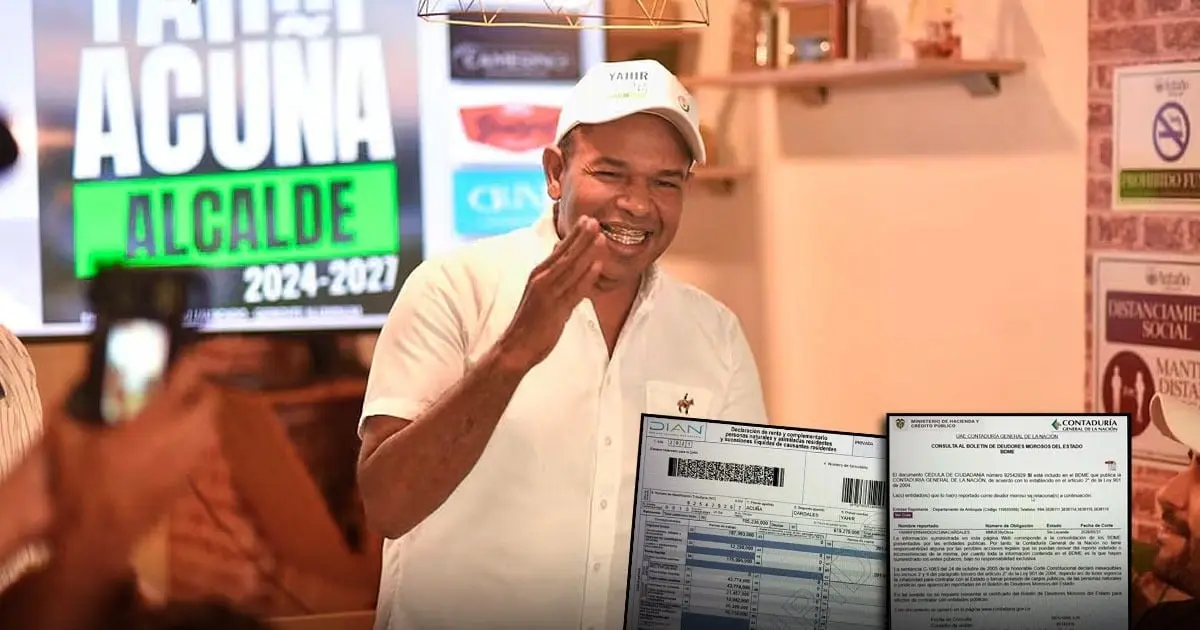
The political and administrative landscape of Colombia was recently jolted by an unprecedented public confrontation when high-ranking officials openly questioned the financial integrity and trustworthiness of local authorities. At the heart of this storm is Yahir Fernando Acuña Cardales, the incumbent mayor of Sincelejo, whose official financial declarations have presented a staggering paradox: while reporting massive debts exceeding one billion Colombian pesos ($1,000,000,000 COP) and a net worth of absolute zero ($0 COP), his historical asset declarations, electoral financing reports, and interactions with state regulatory bodies reveal a labyrinth of inconsistencies.
Compounding these fiscal puzzles, a rigorous cross-examination of multiple public databases—including the National Civil Registration, the National Electoral Council (CNE), the General Accounting Office of the Republic (Contaduría General de la República), and the DIAN (Directorate of National Taxes and Customs)—reveals that Acuña owes money to the state for traffic infractions linked to a vehicle with a tumultuous history.
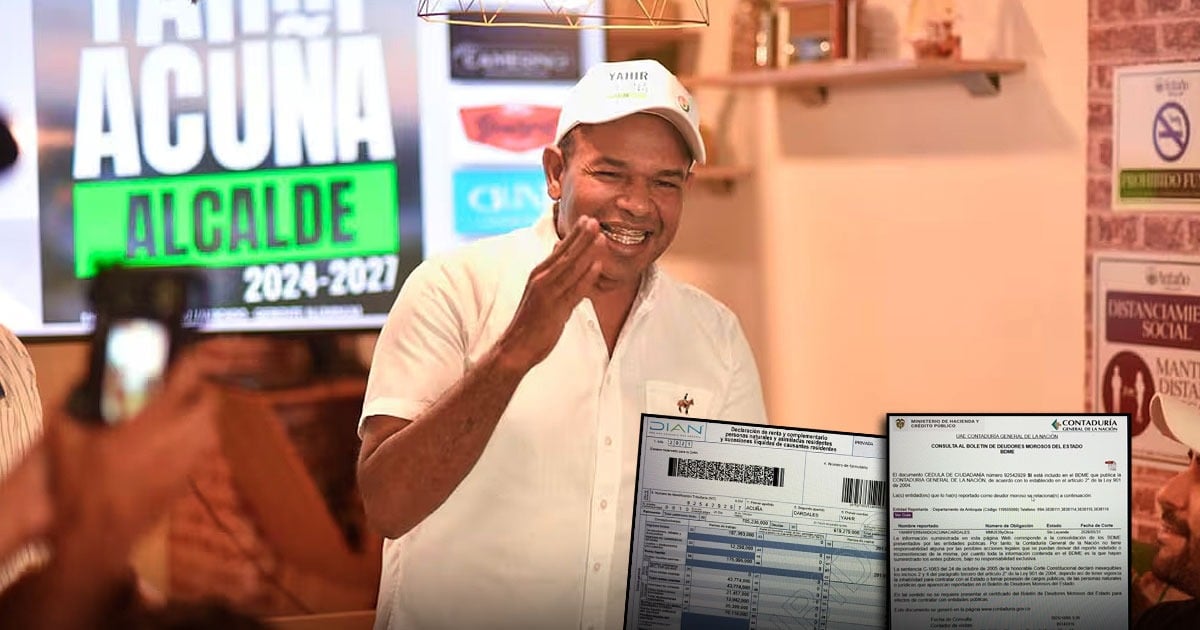
This deep-dive investigative report examines the financial trajectory of one of the most polarizing figures in the Sucre department, unpacking the discrepancies between his reported campaign contributions, the sudden devaluation of prime real estate holdings, active judicial inquiries, and the broader implications for public transparency in Colombia.
Chronology: From Electoral Aspirations to Financial Scrutiny
To understand the current controversy surrounding Mayor Yahir Acuña, one must retrace the timeline of his political campaigns and the escalating scrutiny from national authorities.
- October 2021: A campaign caravan traveling through the Sucre savanna, associated with Acuña’s then-wife Milene Jarava (who was running for the departmental governorship), is intercepted by authorities. Inside one of the vehicles, law enforcement discovers $500 million COP in cash. Although the ensuing investigation is eventually archived, the episode leaves lingering questions about the fluidity of cash during regional political campaigns. Acuña later defends the finding by claiming the money originated from real estate transactions—a claim undermined by prosecutors who discover that the relevant deeds were dated the day after the cash seizure.
- October 2023: Yahir Acuña runs for the Mayor’s Office of Sincelejo under the banner of the Partido de la U. He officially reports campaign revenues totaling $888 million COP, asserting that 100% of these funds originated from his personal patrimony and that of his family members.
- June 5, 2023: As a departmental deputy of Sucre, Acuña submits his mandatory asset and income declaration for the 2022 taxable year. He declares a savings account balance of $32,101,574 COP, a property in Coveñas, Sucre, valued at $850 million COP, and total debts amounting to $67.7 million COP.
- March 17, 2025: Acuña contracts a new marriage with Sofía Isabella Méndez Torres, registered at the Third Notary of Sincelejo. Questions immediately arise regarding whether ongoing investigations into illicit enrichment encompass the newly formed marital partnership’s asset pool.
- April 24, 2025: In his updated declaration as the sitting mayor for the 2023 taxable year, a drastic shift occurs. The exact same property in Coveñas is suddenly valued at $425 million COP—representing an inexplicable 50% drop in valuation within a single year. Furthermore, his declared liabilities skyrocket to $1,003,210,886 COP, leaving his net worth mathematically at zero.
- August 31, 2026: Credit bureau and risk central checks reveal active financial obligations, including frozen savings accounts and credit cards with prolonged delinquency periods, further deepening the mystery of his personal solvency.
Supporting Data: The Numbers Behind the Paradox
An exhaustive cross-referencing of public records uncovers three major areas where Acuña’s financial reporting defies conventional accounting logic: campaign self-funding, asset depreciation, and state debt registries.

1. The Self-Funding Enigma
During his unsuccessful 2019 bid for the Governor’s Office of Sucre, Acuña reported total revenues of $830 million COP, with 74.7% ($620 million COP) derived from family loans or personal patrimony, and the remaining 25.3% ($210 million COP) coming from private donations. No commercial bank loans were utilized.
By the 2023 mayoral campaign, this pattern became absolute. Acuña reported $888 million COP in total income, claiming that every single peso came directly from his own pocket or his family’s reserves. Zero bank loans, zero corporate donations, and zero state financing were utilized to fund $887,963,320 COP in campaign expenditures—over half of which ($526.6 million COP) was poured directly into electoral propaganda, supplemented by $202 million COP for public rallies. Financial analysts are left questioning how an individual with virtually no registered commercial companies, corporate dividends, or private business investments manages to continuously self-finance multi-millionic political campaigns.
2. The Halved Real Estate Valuation
Perhaps the most striking technical anomaly in Acuña’s declarations involves the real estate property located in the coastal resort town of Coveñas, Sucre:
- 2022 Declaration (Submitted June 2023): Valued at $850,000,000 COP.
- 2023 Declaration (Submitted April 2025): Valued at $425,000,000 COP.
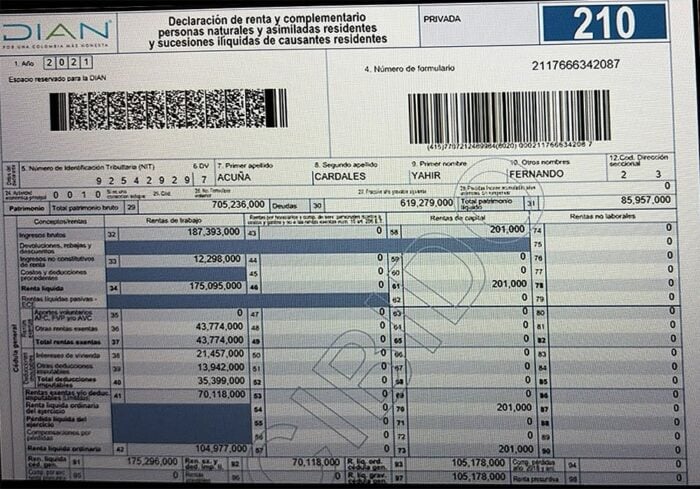
Real estate in premier Colombian tourist hubs like Coveñas typically appreciates or maintains its value over time. Halving the reported value of a multi-million-peso asset in official documents submitted to the Función Pública (SIGEP II) without a clear market justification represents a red flag for forensic accountants. Combined with a gross patrimony of $620,049,000 COP offset by identical liabilities of $1,003,211,000 COP, his declared net worth collapses to zero.
3. State Debts and the Registry of Delinquent Debtors (BDME)
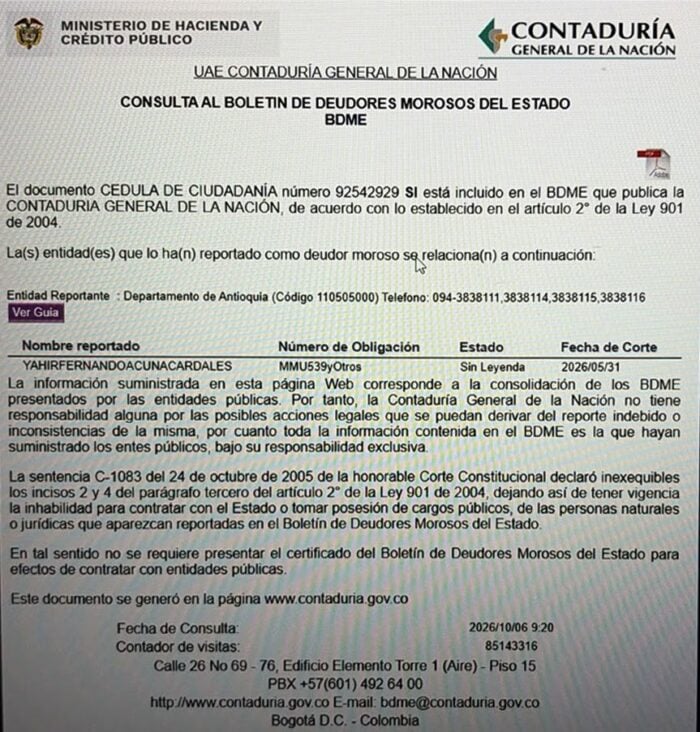
Acuña’s name appears on the Boletín de Deudores Morosos del Estado (BDME), maintained by the General Accounting Office of the Republic. This registry compiles outstanding obligations owed to public entities that exceed five minimum monthly legal wages and remain delinquent for over six months.
Records link Acuña to a debt of over $10 million COP for traffic infractions and associated tax obligations registered in the department of Antioquia, tied to a vehicle bearing the license plate MMU539. Notably, historical records show that a vehicle with this exact license plate was previously linked to the aforementioned 2021 political caravan where $500 million COP in cash was intercepted.

While a landmark ruling by the Constitutional Court (Sentence C-1083 of 2005) established that inclusion in the BDME no longer legally disqualifies a citizen from holding public office or contracting with the state, the presence of state-reported infractions adds institutional friction to his administrative tenure. Furthermore, credit reports from mid-2026 show multiple outstanding obligations, including a Bancoomeva credit card in arrears exceeding 60 days and an embargoed BBVA savings account.
Official Responses and Institutional Reactions
The financial and legal exposure of Mayor Yahir Acuña has not gone unnoticed by national political figures and regulatory bodies. The public friction escalated when prominent national leaders publicly questioned the allocation of public funds to local administrations plagued by legal clouds. Pointing directly to the thirteen separate investigations shadowing Acuña—including inquiries into alleged public enrichment—state watchdogs have stepped up their monitoring.
For his part, Acuña has vigorously defended his position, consistently invoking the constitutional presumption of innocence. He has characterized the sustained institutional and media scrutiny as politically motivated attacks or "false positives" engineered to undermine his democratic legitimacy. Regarding his campaign financing and asset management, his legal representatives maintain that all declarations comply with the formal filing requirements established by the National Electoral Council and the Department of the Public Function.
Nevertheless, civil society organizations, electoral observation missions (MOE), and investigative journalists have noted that official compliance with form does not automatically clear up the substance behind the missing explanations for his asset volatility.
Implications
The financial labyrinth surrounding Yahir Acuña carries profound implications for local governance in Sincelejo and the broader framework of political transparency in Colombia:
- Electoral Integrity and Wealth Transparency: The capacity of political candidates to self-finance high-cost campaigns without verifiable commercial, industrial, or corporate income streams highlights systemic vulnerabilities in the oversight mechanisms of the National Electoral Council (CNE). When declarations show net worth values dropping to zero alongside billion-peso debts, public trust in the origins of campaign capital is severely eroded.
- Institutional Friction: The public clash between national oversight figures and local executives demonstrates a growing tension within Colombian governance. As watchdogs cross-reference real estate registries, DIAN tax filings, and judicial records, local leaders facing multiple investigations find it increasingly difficult to operate without intense national skepticism.
- The Need for Forensic Audits: Experts argue that discrepancies such as the 50% devaluation of the Coveñas property within a twelve-month window, coupled with unresolved questions regarding cash seizures during campaign trails, warrant comprehensive forensic audits by fiscal authorities. Until these questions are systematically addressed by competent courts, the financial paradox of Sincelejo’s mayor will remain a case study in the challenges of tracking public wealth in regional Colombian politics.