

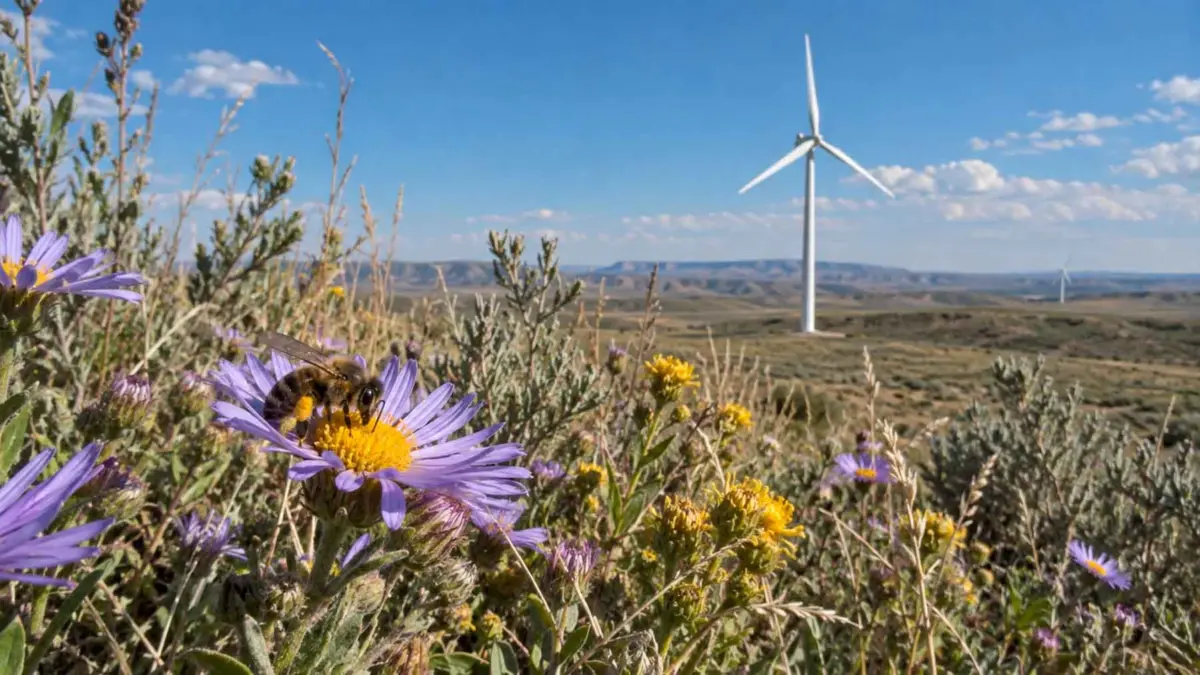
WYOMING — Across the sweeping, windswept landscapes of Wyoming, a quiet transformation has reshaped the horizon. Massive, multi-megawatt wind turbines—their towering white blades slicing through the crisp mountain air—have become permanent fixtures of the high plains. Down below, in the rich tapestry of the prairie and sagebrush ecosystems, life continues at a vastly different scale: a solitary bee pauses on the delicate petals of a native wildflower, completely dwarfed by the industrial monoliths spinning far above.
While the visual dominance of wind energy infrastructure is undeniable, scientists have long understood that these structures do more than just alter the scenery. They generate localized turbulence, cast shifting shadows, create subtle low-frequency vibrations, and introduce mechanical hums into once-serene habitats. For years, the environmental impact assessments of wind farms have justifiably focused on high-flying fauna—most notably migratory birds and vulnerable bat populations susceptible to blade strikes and barotrauma.
However, a critical blind spot has persisted in ecological research: What happens at the base of the tower? How do the hundreds of species of insects that drive the foundational mechanics of these ecosystems—bees, ants, wasps, butterflies, flies, and beetles—cope with the presence of massive renewable energy installations?
A groundbreaking study conducted by researchers at the University of Wyoming aims to answer this very question, shedding light on a hidden ecological layer of the green energy transition.
Main Facts
The research, spearheaded by scientists M. Weschler, B. Martin, and L. Tronstad, investigates the subtle, cascading effects of wind energy infrastructure on terrestrial invertebrate communities. Published in the Nordic Journal of Botany (2026), the study—titled "Proximity to wind turbines altered plant–pollinator dynamics in prairie and sagebrush ecosystems in Wyoming, USA"—moves beyond simple mortality counts to examine behavioral shifts in pollinators.
Instead of looking for dead insects beneath the rotors, the research team deployed high-definition GoPro cameras directly in front of native flowering plants across six distinct sites in southeastern Wyoming. These locations were strategically selected to span a wide geographical gradient: some cameras were placed deep inside operational wind energy facilities, while control sites were located progressively further away, stretching up to 28 kilometers (roughly 17.5 miles) distant.
After meticulously reviewing approximately 45 hours of high-resolution video footage, the researchers documented 472 distinct interactions between insects and plants. Each interaction was cataloged to note the specific behavior of the insect—whether it was actively foraging for nectar, collecting pollen, entering a floral tube, or merely resting on the foliage. Alongside these behavioral logs, the team recorded critical environmental baselines, including local wind speeds and ambient air temperatures.
The central finding? Proximity to wind turbines is significantly correlated with alterations in plant-pollinator dynamics, most notably manifesting in the duration of time insects spend visiting individual flowers. While environmental factors like wind and temperature predictably dictate baseline activity, the structural and microclimatic footprint of wind farms appears to introduce an additional layer of behavioral modification that scientists are only beginning to understand.
Chronology of the Study: From Fieldwork to the Microscope
To understand how industrial wind energy intersects with microscopic ecology, it is necessary to retrace the step-by-step evolution of the University of Wyoming research project.
Phase 1: Conceptualization and Site Selection
The project began as an inquiry into the "micro-scale" consequences of macro-scale engineering. While literature on avian and chiropteran (bat) interactions with wind turbines is vast, empirical data regarding terrestrial invertebrates was severely lacking. The researchers identified southeastern Wyoming as an ideal natural laboratory, given its dense concentration of utility-scale wind farms juxtaposed against pristine, intact prairie and sagebrush ecosystems.
Six study areas were chosen. By establishing a spatial gradient—ranging from directly beneath or adjacent to active turbine pads to control zones nearly 30 kilometers away—the team ensured they could separate broad regional weather patterns from localized turbine effects.
Phase 2: Deployment and Observation
Data collection required immense field patience. Invertebrate activity is highly seasonal, dependent on narrow windows of floral bloom and favorable weather. The team mounted GoPro cameras on specialized, stable rigs pointed squarely at native flowering plants.
Rather than relying on sweep nets or pitfall traps—methods that kill the specimens and only provide a snapshot of presence or absence—the camera-trap methodology allowed researchers to capture living, dynamic behaviors in real time without disrupting the ecosystem.
Phase 3: Video Analysis and Data Coding
Back in the laboratory, the raw footage was subjected to rigorous quantitative analysis. The team logged roughly 45 hours of continuous video, breaking down every second of animal-plant interaction.
Each of the 472 recorded interactions was time-stamped and classified. Researchers tracked:
- Taxonomic group: Broad identification of the insect (bee, wasp, butterfly, fly, beetle, ant).
- Action type: Foraging, nectar feeding, pollen collection, resting, or transit.
- Duration: Exact length of time spent interacting with the plant.
- Microclimate metrics: Local wind velocity and ambient temperature at the exact time of the interaction.
Phase 4: Statistical Modeling and Pattern Recognition
Once the behavioral logs were cross-referenced with environmental data, the statistical modeling began. The researchers ran multi-variable regressions to determine which factors—temperature, wind speed, or distance to the nearest turbine—had the most profound impact on the duration and nature of plant-pollinator interactions.
Supporting Data and Environmental Variables
The statistical analysis revealed a complex web of interacting variables. Unsurprisingly, nature is rarely governed by a single cause-and-effect relationship, and the behavioral patterns of Wyoming’s prairie insects proved sensitive to multiple environmental pressures.
The Role of Microclimate: Wind and Temperature
Before isolating the potential impact of the turbines, the data clearly demonstrated the heavy influence of baseline weather conditions:
- Wind Velocity: As natural wind speeds increased across the open prairie, insect-plant interactions grew noticeably shorter. High winds make flight mechanically difficult and energetically expensive for small invertebrates, forcing them to shorten their foraging bouts or abandon exposed flowers altogether.
- Ambient Temperature: Similarly, rising air temperatures influenced foraging duration. Elevated temperatures can accelerate floral nectar evaporation and alter insect metabolism, leading to faster visitations or decreased overall activity during peak heat hours.
The Turbine Factor: Distance and Duration
When the researchers controlled for wind speed and temperature and began sorting the 472 interactions by their proximity to wind turbines, a distinct spatial pattern emerged.
Insects operating in close proximity to the massive towers exhibited altered residence times on flowers compared to their counterparts at the 28-kilometer control sites. However, establishing why this occurred presented a formidable scientific hurdle.
The research team faced several methodological limitations during the study:
- Acoustic Measurement Gaps: Wind turbines generate both audible noise and low-frequency infrasound. While previous studies have hypothesized that acoustic pollution can disorient or stress insects—many of which rely on sensitive mechanoreceptors to navigate—the research team was unable to formally measure sound pressure levels across all study sites.
- Mechanical Turbulence vs. Thermal Disruption: While turbines undeniably churn the air and create localized wake effects (altering wind currents near the ground), the team could not definitively isolate whether the observed behavioral shifts were driven by these localized mechanical air currents or by other unmeasured variables, such as electromagnetic fields or vibration through the soil.
Despite these limitations, the existence of the pattern itself marks a significant milestone: industrial wind energy installations do leave a measurable behavioral footprint on the surrounding invertebrate community.
Official Responses and Scientific Context
The publication of the study in the Nordic Journal of Botany has sparked nuanced discussions within the broader ecological and renewable energy communities. As nations worldwide accelerate their transition away from fossil fuels to meet climate targets, the demand for land-based wind energy continues to skyrocket. Conservationists and energy developers alike are increasingly forced to confront the hidden trade-offs of green infrastructure.
Dr. L. Tronstad, one of the study’s co-authors, emphasized that the research is not intended to demonize wind energy, but rather to provide a comprehensive ecological accounting.
"The transition to renewable energy is an absolute necessity for mitigating global climate change," academic observers of the study note. "However, sustainable energy can no longer be viewed as having a zero-impact footprint on local ecosystems. Understanding these subtle behavioral shifts is the first step toward better environmental mitigation and site planning."
Industry stakeholders have also weighed in. Representatives from wind development firms operating in the western United States have expressed openness to integrating broader ecological metrics into future environmental impact reports. Historically, mitigation strategies around wind farms have been heavily skewed toward raptors, sage-grouse, and bats. Expanding monitoring frameworks to include pollinator networks could eventually influence micro-siting decisions—such as maintaining larger buffer zones around dense patches of native wildflowers or timing turbine maintenance to avoid peak insect emergence periods.
Furthermore, entomologists point out that pollinators are the vital glue holding prairie ecosystems together. If wind turbine-induced microclimates or acoustic disturbances subtly reduce the efficiency of pollination—even by fractionally decreasing the time an insect spends transferring pollen—it could trigger long-term ripple effects on plant biodiversity, soil stability, and the entire trophic web that relies on seed and fruit production.
Implications: What This Means for the Future of Wind Energy
The findings from the Wyoming grasslands open a new frontier in conservation science, bridging the gap between macro-scale industrial engineering and micro-scale ecology. The implications of this research ripple across several key domains:
1. Broadening Environmental Impact Assessments (EIAs)
For decades, regulatory agencies have evaluated wind energy proposals primarily based on avian radar, mortality monitoring, and habitat fragmentation for large mammals. This study underscores the urgent need to expand EIAs to incorporate invertebrate health. Because insects comprise the vast majority of terrestrial biodiversity and drive essential ecosystem services, ignoring them in pre-construction planning leaves a critical blind spot in environmental stewardship.
2. Unraveling the Mechanistic Drivers
The next phase of scientific inquiry must answer the lingering questions left open by the Wyoming study. Researchers must deploy specialized acoustic sensors, anemometers, and thermal imaging cameras directly at the base of turbines to isolate the exact mechanisms at play. Is it the low-frequency humming of the generator? Is it the turbulent wake of the rotor blades pushing air downward? Or is it electromagnetic interference from the high-voltage transmission lines connecting the turbines to the grid? Pinpointing the exact cause is essential if engineers are to design mitigating technologies.
3. Rethinking Habitat Restoration and Siting
As wind farms expand across the globe, developers frequently implement vegetation management plans around turbine pads, sometimes planting native grasses and wildflowers to prevent soil erosion. Paradoxically, these plantings may attract high concentrations of pollinators directly into zones influenced by turbine turbulence and noise. Future conservation strategies may need to implement "ecologically smart" zoning—encouraging pollinator-friendly plantings at safe distances from the immediate vortex zones of operating towers.
4. Balancing Climate Action with Biodiversity Conservation
Ultimately, the study highlights the delicate tightrope walk of the 21st century: balancing the urgent global imperative to decarbonize the energy grid against the localized need to protect fragile, interconnected ecosystems. Wind energy remains one of our most potent tools against catastrophic climate change, but true sustainability requires a holistic view of nature—one that looks as closely at the insect on a wildflower as it does at the giant blades spinning in the sky.
For those interested in reading the complete, peer-reviewed scientific paper, the study is openly accessible:
Weschler, M., Martin, B., & Tronstad, L. (2026). Proximity to wind turbines altered plant–pollinator dynamics in prairie and sagebrush ecosystems in Wyoming, USA. Nordic Journal of Botany, 2026(6), e04996. https://doi.org/10.1002/njb.04996



Leave a Reply