

Bogotá — The integration of artificial intelligence (AI) into daily life, industry, and governance has long ceased to be a futuristic projection; it is a present-day reality reshaping the global economy, society, and energy grids. While the macro-level explosion of AI is well-documented, recent data reveals distinct regional divides in how populations engage with these transformative tools.
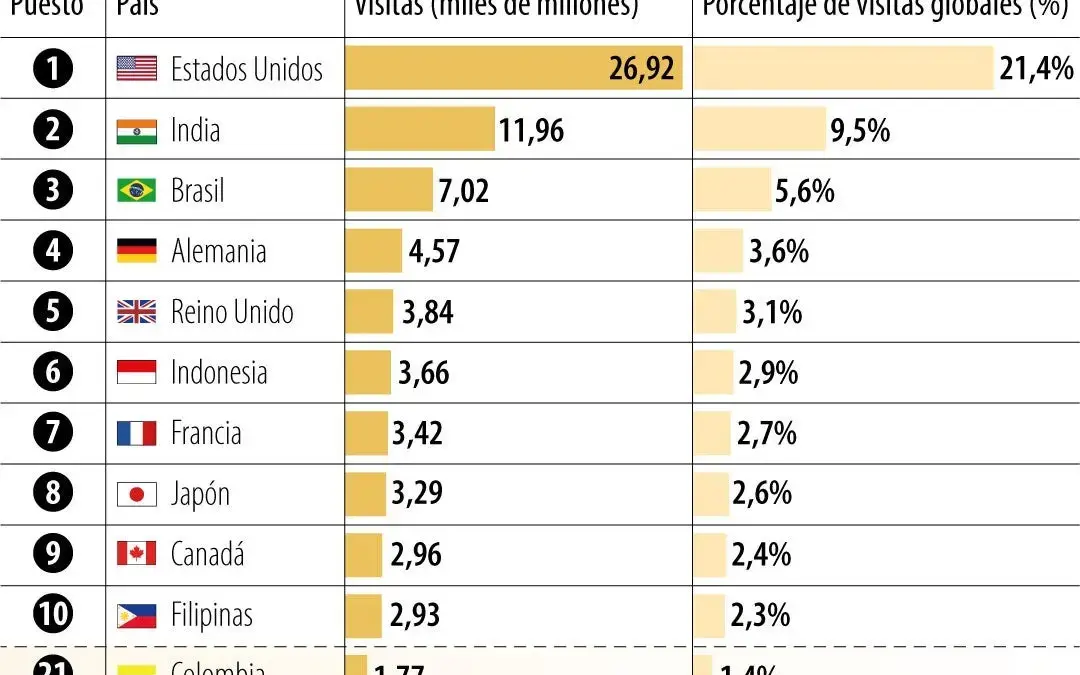
In Latin America, Colombia has emerged as a surprisingly dynamic hub. According to recent analytics tracking global digital behavior, Colombia has secured the number three spot in Latin America for AI tool adoption, ranking 21st globally. This milestone highlights a rapidly digitizing population, even as the country navigates infrastructural and economic hurdles on its path toward technological maturity.
1. Main Facts: Colombia’s Standing on the Global AI Map
The metrics defining Colombia’s digital footprint come from AITools.xyz, a specialized platform that compiles traffic estimates from SEMrush and Ahrefs across more than 9,500 artificial intelligence websites worldwide.
Key figures defining Colombia’s current position include:
- Global Ranking: Colombia sits at 21st place worldwide.
- Web Traffic Volume: The country registered just over 1.7 billion visits to AI-related websites.
- Global Share: This traffic accounts for 1.4% of the total global traffic analyzed in the study.
- Regional Standing: Within Latin America, Colombia ranks third, trailing behind regional powerhouses Brazil and Mexico.
To put this into perspective, Mexico claims the 11th spot globally with approximately 2.8 billion visits (2.2% of global traffic), while Brazil—the undisputed regional leader—commands a significantly higher share of visits, placing it firmly ahead of its Spanish-speaking neighbors.
Globally, the United States dominates the landscape. The U.S. generated a staggering 26.9 billion visits to AI websites, capturing 21.4% of the world’s total traffic. India follows in second place with 12 billion visits, and Brazil takes third globally with 7 billion visits. Combined, these top three nations account for 36.5% of all global web traffic directed toward AI tools.
However, industry analysts emphasize an important caveat regarding the data: AITools.xyz measures total web visits, not unique users. A single user visiting multiple tools or returning to the same site multiple times generates multiple entries. Furthermore, the metrics exclude mobile app sessions—a methodological choice that notably underrepresents markets heavily reliant on mobile ecosystems, such as China, which ranks 15th with 2.4 billion web visits.
2. Chronology: The Exponential Rise of Artificial Intelligence
To understand how Colombia and the rest of the world arrived at these staggering traffic volumes, it is necessary to examine the rapid timeline of AI’s mainstream adoption over recent years.
2022: The Paradigm Shift
- Late 2022: The public release of OpenAI’s ChatGPT marks a watershed moment. For the first time, sophisticated large language models (LLMs) are made freely and easily accessible to the general public via a web browser.
- The Spark: Global curiosity surges, transitioning AI from corporate research labs and academic institutions into classrooms, creative writing desks, and software development firms.
2023: Hyper-Growth and Private Investment
- Venture Capital Influx: Recognizing the profound commercial potential, private investors flood the sector. According to the AI Index Report 2024 published by the Institute for Human-Centered Artificial Intelligence (HAI) at Stanford University, global private investment dedicated specifically to Generative AI skyrocketed from approximately $3 billion to $25.2 billion in a single year.
- Proliferation of Tools: Thousands of specialized software-as-a-service (SaaS) startups emerge, offering AI-driven solutions for copywriting, image generation, data analysis, video editing, and coding.
2024: Massification and Regional Disparities
- Ubiquity Across Sectors: AI ceases to be a novelty and becomes integrated into enterprise software suites (such as Microsoft Copilot and Google Workspace).
- Global Traffic Surge: Web traffic tracking platforms record billions of regular monthly visits across thousands of niche and mainstream AI portals.
- Emerging Markets Enter the Fold: Developing digital economies, including Colombia, begin showing measurable, high-volume engagement with AI utilities, signaling that the technological wave is transcending developed economies.
3. Supporting Data: The Numbers Behind the Global AI Boom
The data compiled by the Stanford HAI AI Index Report and traffic aggregators provides a comprehensive look at the macroeconomic forces propelling these digital interactions.
Global Investment vs. User Engagement
The leap from $3 billion to $25.2 billion in private generative AI funding reflects extraordinary confidence from venture capitalists and institutional investors. This capital has funded massive computational infrastructure, lower consumer costs, and aggressive marketing campaigns that drive web traffic upward.
The Global Podium: Dominance of the Top Three
The dominance of the United States, India, and Brazil highlights a fascinating geopolitical distribution of technology consumption:
- United States (26.9 billion visits / 21.4%): Driven by Silicon Valley innovation, high broadband penetration, and early enterprise adoption. U.S. traffic more than doubles that of second-place India.
- India (12 billion visits): Propelled by a massive, tech-savvy youth demographic, rapid smartphone adoption, and a burgeoning IT and software engineering sector.
- Brazil (7 billion visits): Anchored by a large population, a robust digital economy, and strong governmental and private sector digitization initiatives in South America.
Where Colombia Fits
While Colombia’s 1.7 billion visits place it behind Brazil and Mexico, the figure is remarkably robust for a country of its economic scale. It demonstrates that Colombian professionals, students, and entrepreneurs are actively seeking out productivity, creative, and analytical tools hosted on global platforms.
Nevertheless, the gap between the global leaders and Colombia underscores persistent structural challenges, including disparities in high-speed internet access outside major urban centers (Bogotá, Medellín, Cali) and varying levels of digital literacy among the broader workforce.
4. Official Responses and Expert Perspectives
Governments, academic institutions, and industry leaders have offered mixed reactions to the rapid acceleration of AI adoption—balancing excitement over productivity gains with caution regarding ethical, economic, and security risks.
Academia: The Need for Human-Centered Governance
Authors of the Stanford HAI Index Report have consistently emphasized that while financial investments and website visits are useful barometers of interest, they do not measure the quality or safety of adoption. Stanford researchers argue that as generative AI scales globally, policymakers must prioritize ethical guardrails, transparency, and inclusive access to prevent the technology from widening socioeconomic inequalities both within and between nations.
Local Industry and Tech Ecosystems in Colombia
Colombian technology associations and startup incubators have welcomed the AITools.xyz findings as validation of the country’s entrepreneurial drive. Local tech leaders note that Colombian small and medium-sized enterprises (SMEs) are increasingly turning to AI to optimize customer service, automate supply chains, and compete on a regional level.
However, local experts have also issued warnings. Representatives from academic technology boards in Bogotá point out that passive consumption—measured by website visits—must evolve into active creation. They argue that Colombia cannot remain merely a consumer of foreign AI models, but must foster local talent capable of developing homegrown solutions tailored to Latin American linguistic, cultural, and economic realities.
5. Implications: What This Means for Colombia’s Future
The revelation that Colombia is the third-highest adopter of AI tools in Latin America carries profound implications across multiple facets of society.
Economic and Labor Market Transformation
The heavy interaction with AI websites suggests that Colombian workers are utilizing these tools for content creation, programming assistance, marketing, and business administration.
- The Opportunity: AI can drastically boost productivity, allowing local businesses to punch above their weight class, reduce operational overhead, and tap into global digital service markets.
- The Risk: Without targeted upskilling and educational reform, workers whose routine tasks are easily automated by AI tools face displacement. The digital divide within Colombia could widen if urban tech hubs surge ahead while rural economies are left behind.
Infrastructure and Energy Demands
The exponential growth of AI queries places unprecedented demands on global data centers and power grids. As Colombian adoption deepens, national policymakers and energy providers must prepare for increased electricity consumption driven by data processing centers and cloud infrastructure. Ensuring that this growth aligns with sustainable, renewable energy goals will be a critical challenge for the national government.
Strategic Policy and Education
To capitalize on its status as a regional AI frontrunner, Colombia must translate high website traffic into structural national advantages. This requires:
- Curricular Reform: Integrating AI literacy into primary, secondary, and higher education curricula.
- Public-Private Partnerships: Encouraging collaboration between universities, government agencies, and private tech firms to fund local AI research.
- Regulatory Frameworks: Establishing clear guidelines for data privacy, intellectual property, and ethical AI usage that protect citizens without stifling innovation.
Conclusion
Colombia’s position as the third-largest adopter of AI technology in Latin America—and 21st globally—is a testament to the country’s vibrant digital curiosity and entrepreneurial spirit. As the global generative AI market matures past its initial hype cycle, Colombia stands at a critical crossroads. How government, industry, and educational institutions respond to these shifting technological tides will determine whether the nation remains a mere consumer of foreign innovation or transforms into a leading architect of the artificial intelligence era in Latin America.




Leave a Reply