

WASHINGTON — In an era where modern automobiles have essentially transformed into rolling supercomputers, software glitches are increasingly holding the power to sideline physical machinery. For thousands of truck owners across the United States, a simple shift into reverse has turned into a frustrating—and potentially hazardous—daily gamble.
Ford Motor Company has officially announced a massive safety recall affecting tens of thousands of its flagship pickups. The culprit is not a failing mechanical part, a severed wire, or a broken lens, but rather a persistent software bug that causes the vehicle’s infotainment system to hijack the touchscreen display precisely when the driver needs it most.
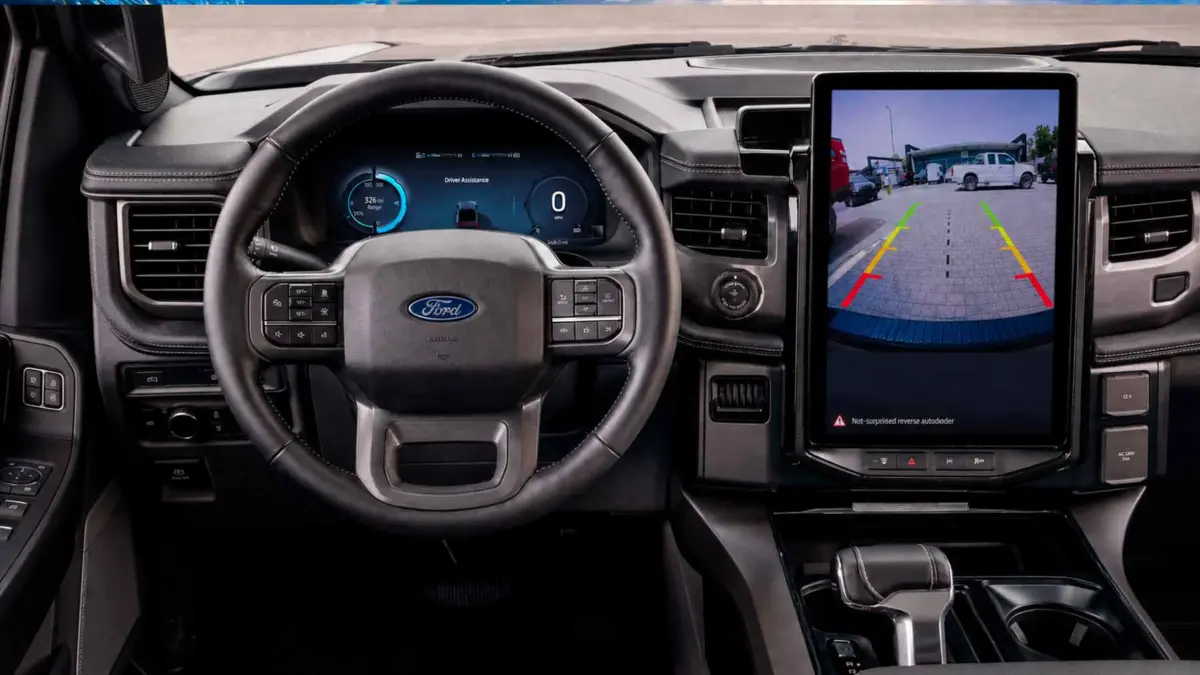
While the physical rearview camera continues to function flawlessly and beams a live feed of the vehicle’s blind spots, an erroneous system menu overlays the display, completely obscuring the driver’s view. To combat potential tragedies in crowded school zones, busy parking lots, and residential driveways, Ford is initiating a widespread service campaign to patch the flawed software.
1. The Core Issue: When Technology Blinds the Driver
The technical breakdown originates within the software architecture governing the vehicle’s central touchscreen interface, specifically tied to the widely used Sync 4 infotainment system. Under normal operating conditions, putting a vehicle into reverse triggers an immediate override, instantly switching the dashboard display to show the real-time perspective from the rear bumper.
However, for the vehicles included in this recall, a glitch in the infotainment module prevents this override from executing correctly. Instead of clearing the screen to show the live camera feed, the primary system menu freezes or remains stubbornly superimposed over the image. The camera is transmitting, and the hardware is operational, but the user interface blocks the visual pathway.
This malfunction means the affected trucks fail to comply with the strict mandates outlined in Federal Motor Vehicle Safety Standard (FMVSS) No. 111. Enacted to drastically reduce back-over accidents, this federal regulation legally mandates that all vehicles sold in the United States provide the driver with a clear, unobstructed field of vision directly behind the vehicle when operating in reverse.
A Hidden Danger in Plain Sight
Although Ford Motor Company has confirmed that it has received zero reports of crashes, injuries, or fatalities linked directly to this software anomaly, safety advocates emphasize that the risk remains statistically significant.
Modern full-size pickups—such as the Ford F-150 and F-250—possess notoriously high rear decks and massive blind spots that traditional side and rearview mirrors simply cannot cover. The elimination of a functioning backup camera disproportionately endangers vulnerable road users, most notably small children, pedestrians, pets, and cyclists positioned immediately behind the tailgate.
2. Affected Models and Chronology of the Recall
The recall campaign is tightly targeted, focusing exclusively on specific configurations within Ford’s legendary F-Series lineup. According to documentation filed with the National Highway Traffic Safety Administration (NHTSA), the campaign encompasses a total of 47,587 vehicles in the United States.
Scope of Affected Vehicles
The recall primarily targets certain models of the Ford F-150 and Ford Super Duty (F-250, F-350, and higher variants) that were manufactured with a specific hardware configuration: the 8-inch infotainment touchscreen display. Trucks equipped with larger 12-inch or 15.5-inch productivity screens utilize a different software branch and are not subject to this specific recall order.
Chronology of Events and Notifications
The rollout of this massive safety campaign will occur in carefully managed phases throughout the late summer and early autumn of 2026:
- August 17 – August 21, 2026: Ford will begin mailing out provisional notification letters to all registered owners of the affected vehicles. These initial letters are designed to alert drivers to the nature of the software defect well before the final software patch is fully finalized and distributed.
- September 2026: A second wave of formal notifications will be dispatched to vehicle owners. By this time, the permanent software update will be fully optimized, tested, and released for deployment.
- Ongoing (Fall 2026 and Beyond): Dealerships and over-the-air (OTA) distribution channels will aggressively push the fix to ensure maximum compliance across the remaining fleet, including secondary owners who purchased their trucks used.
3. Supporting Data and Verification: Is Your Truck at Risk?
Because automotive components frequently cross model years and trim packages, determining whether a specific vehicle falls under an active safety recall requires checking the unique Vehicle Identification Number (VIN).
How to Locate Your Vehicle’s VIN
For owners wanting to check their status ahead of the official mailings, the 17-digit VIN can be found quickly in several locations:
- The Dashboard: Standing outside the vehicle on the driver’s side, look through the bottom corner of the front windshield where the dashboard meets the glass.
- Official Documentation: Located directly on the vehicle’s state registration card, title, or active auto insurance policy documents.
- The Driver’s Door Jamb: Stamped onto the certification label affixed to the B-pillar when the driver’s door is swung open.
Checking Online Databases
Once the VIN is secured, owners can instantly verify if their vehicle is included in this specific campaign (NHTSA Campaign ID pending, associated with Ford reference code 26V-489) by entering the alphanumeric string into:
- The official NHTSA recall lookup tool (nhtsa.gov/recalls).
- Ford’s dedicated owner portal and customer service safety lookup page.
4. Official Responses and Remediation Plan
Faced with a federal non-compliance issue, Ford has moved swiftly to establish a frictionless repair protocol that prioritizes customer convenience without placing financial burdens on the consumer.
The Repair Process: Two Cost-Free Options
To resolve the infotainment screen freeze, Ford is providing a completely free software update for the vehicle’s body control and infotainment modules. Owners will have two primary avenues to receive this fix:
- Over-the-Air (OTA) Updates: For trucks equipped with active FordPass connectivity and an authorized cellular or Wi-Fi network connection, the software patch will download and install automatically in the background, requiring zero trips to a brick-and-mortar dealership.
- Authorized Ford Dealerships: Owners who prefer physical service, lack a stable home internet connection, or experience issues with the OTA push can bring their vehicle to any certified Ford dealership. Technicians will reflash or update the infotainment module manually at zero cost to the owner, regardless of whether the vehicle is currently covered under factory warranty.
Interim Safety Advice for Drivers
While waiting for the final software deployment in September, Ford has not issued a "do-not-drive" advisory, nor are owners required to park their trucks. However, corporate safety representatives and federal regulators strongly advise drivers to exercise heightened caution whenever executing reversing maneuvers.
Until the patch is installed, drivers are encouraged to:
- Rely heavily on traditional physical and convex side mirrors.
- Physically turn around to check blind spots manually rather than depending exclusively on automated dashboard tech.
- Utilize external spotters when backing out of tight, high-traffic driveways or crowded commercial parking structures.
Crucially, Ford has confirmed that this recall travels with the vehicle, meaning that even if an affected F-150 or F-250 has been sold, traded in, or transferred to a secondary or tertiary owner, the new custodian remains fully entitled to the free software remedy.
5. Broader Implications: The Software-Defined Vehicle Dilemma
This latest safety campaign highlights a profound philosophical shift taking place within the global automotive industry. Modern vehicles are no longer defined solely by the brute strength of their steel frames, displacement of their engines, or durability of their suspensions. Instead, they are defined by lines of complex code.
The Double-Edged Sword of Modern Infotainment
Systems like Ford’s Sync 4 integrate navigation, climate controls, telecommunications, and safety systems into a single centralized digital hub. While this consolidation offers unprecedented convenience and futuristic aesthetics, it also introduces a single point of failure.
In older mechanical generations of trucks, a broken reverse light switch would merely extinguish a bulb. In a modern software-defined vehicle, a minor logic loop or memory leak in an operating system can inadvertently blind a driver to the world immediately behind them.
The Rise of Over-the-Air Solutions
On the positive side, this recall serves as a premier showcase for the maturation of modern automotive troubleshooting. Decades ago, a safety recall of this magnitude would require millions of letters, scheduling logistical nightmares at service bays across the country, and hours of technician labor spent tearing apart dashboards to replace physical hardware modules.
Today, thanks to continuous connectivity, a developer sitting thousands of miles away can write a patch, test it against federal regulations, and push it directly into the driveway of nearly 50,000 trucks via an invisible digital wave.
As automakers continue to push the boundaries of automation, connectivity, and screen-dominated interiors, incidents like the Ford F-Series rearview camera glitch serve as a stark reminder: technology can solve remarkable problems, but only if it remains reliably out of the driver’s way when safety matters most. For Ford truck owners, the upcoming September software patch cannot arrive soon enough.



Leave a Reply